THE DIFFERENCES BETWEEN RENDERINGS AND REALITY
[October 27th] --  I remember the day as if it was yesterday. The Nationals announced that renderings for their new stadium would be introduced to the public on March 15th, 2005. I remember because I was due to take two tests that day at school and emailed both professors telling them that I was too *cough-cough* sick to make it to school. About 15 minutes before the press conference, I went to the Washington Post's website and began to hit the refresh button, over and over until David Nakamura's article, and the architect's renderings, appeared.
I didn't know what to expect. A month earlier, Nakamura wrote an article detailing expectations for the stadium. It was to be a "signature" park" with a design that eschewed the retro-look of Camden Yards and its clones (isn't it interesting that the term "cookie-cutter" which once described the spate of circular multi-purpose stadiums can now just as easily be used to describe all of the turn-of-the-century designs that dot the major league landscape?). "We do not want to see just another baseball stadium," said Allen Y. Lew, chief executive of the D.C. Sports and Entertainment Commission. "We want signature architecture. We're not looking to just mimic other cities." In its bid packets, the city government advised architects that they were seeking to "create architecture for Washington that is distinctive and of this time." What did that mean exactly? They never said, other than the complex was to be lower in height than traditional ballparks so as to not hide the vista views that Washington offers.
So I wasn't sure what to expect. When I first saw the renderings, I was happy, but not thrilled. The stadium was great to be sure, but I saw nothing that was particularly spectacular. My biggest concern has been the outside elevations of the stadium. I hope the real deal doesn't have that hodge-podge appearance of the drawings.
I went back and looked closely at the renderings for the first time in more than a year. After all, why bother when you have the real thing to look at. I was curious to see how different the stadium was from those first drawings. From the outfield perspective, things seem about the same save a few glaring differences.
Take a look at the scoreboard. The angle of the steel beams that holds both the "Nationals" name and clock isn't as sloping as it was in the drawings. The letters that make up the team's name was originally to be the same size, using the style of letters that appears on the front of the Potomac Nationals' jersey. The final product, however, uses the same letters that the Nationals' current uniform displays. The letters were to have begun straight and then sloped down towards the clock, but now the 'N' and 'S' begin and end on the same level. Everything else seems the same.
Personally, I liked what the architects envisioned more than what the team ended up with.
The other part that might be different is the huge red "W" above the grassy knoll in dead center. Looking at the construction camera images, I am having a hard time seeing how that it is going to work. Other than that, things are looking pretty close.
It's a great stadium, but it's nothing new and and doesn't redefine baseball architecture. The interior is wonderful but, like I said, I am not particularly enamoured with the exterior.
Still, it beats RFK all to heck.

BALDELLI WILL BE AVAILABLE; WILL BOWDEN MAKE A DEAL?
 [October 23rd] -- Rocco Baldelli. Sounds like a guy who grew up in St. Louis in the 1940's along with Joe Garigola and Yogi Berra. It's a great baseball name. Baldelli, however, is a modern-day man, an outfielder for the Tampa Bay Devil Rays. Following an outstanding rookie year, it was thought that Baldelli would become the face of the Devil Rays for the next decade. It didn't happen, and the team moved on.
Where is Baldelli going to play in 2008? Washington, maybe? Maybe. I can certainly see the logic in such a move, at least from Jim Bowden's perspective.
Baldelli, 26, is a 6'4", 200 lb outfielder from Rhode Island (he sounds more like Carl Yastremski than Berra when he talks). He had an outstanding prep career and was taken with the 6th pick in the June 2000 draft by Tampa Bay. His scouting report read like this:
"Baldelli has outstanding speed and power for a high schooler. He has great natural instincts for the game. He is an excellent outfielder with tremendous range and the ability to be where the ball lands. Projects as a 30-30 player. The only thing that is keeping him for being a true five-tool player is his throwing arm, which is only slightly above-average."
After three very-good-but-not great years in the minors, Baldelli was named the team's starting center fielder in 2003 at 21, more the result of a very bad major league team than his being totally ready for the major leagues. That said, Baldelli had a great rookie season, going .289-11-78 with 27 stolen bases. He finished 3rd in the Rookie-of-the-Year award, behind Angel Berroa and Hideki Matsui. 2004 was even better; he hit .280-16-74 in 136 games. He missed several games during the year with a variety of nagging injuries, but nothing a quiet off season wouldn't have fixed. The off season, however, was anything but quiet.
Baldelli tore his ACL while playing basketball during that off season. The surgery was successful, and he was feeling pretty good when he reported to Spring Training in 2005. While long tossing, however, he felt soreness in his throwing elbow. Within days, he was back in the operating room, this time for Tommy John surgery. He missed the entire season and wasn't able to return until June of 2006. He finished that season .302-16-57 in just 92 games.
2007 was supposed to be the year that Baldelli had a break out year, that he showed he was healthy and able to play a full season.
Never happened.
Baldelli bruised his leg in late April, and while he didn't miss any games, it slowed him down. A month later, he strained a hamstring and was done for the year. He was batting .281 when he bruised his leg, and ended the year .204-5-12 in just 35 games.
Now, it's obvious that Baldelli shares much in common with Alex Escobar and Nick Johnson in that he has unlimited talent but limited availability to play the game of baseball. He also shares something with former National Jose Guillen though. Both players were offered long term, cash-rich deals that were turned down just before their careers went down the toilet. Baldelli was offered a 5 year / $23 million dollar contract at the age of 22 after just two major league seasons. Jose Guillen turned down his deal with Washington because he was stupid. Baldelli? Well, his agent at the time was none other than Scott Boras.
Boras is no longer Baldelli's agent. Gee, I wonder why?
In total, Rico Baldelli has played in 419 games since he began his career in 2003. He has not played in 379. Basically, he was available to play half the time, which means the Devil Rays decision to move on without him makes perfect sense. Here are Tampa's top four outfielders from 2007:
Carl Crawford: .315-11-80, 50 steals [Age 26]
B.J. Upton: .300-24-82, 22 steals [Age 23]
Delmon Young: .288-13-93, 10 steals [Age 22]
Jonny Gomes: .244-17-56, 12 steals [Age 26]
A healthy Rocco Baldelli has no place to play in Tampa Bay next year. Upton and Young are both very young and haven't even begun to reach their potential. Crawford has averaged .302-15-75, 55 stolen bases since he became a starter. Gomes has averaged .245-20-54 over the past three years while averaging 100 games per season.
Baldelli, then, isn't returning to Tampa in 2008. He's still young, but his trade value is limited because of all the injuries. I mean, what do you think the Nationals could get for Nick Johnson this off-season?
So he's going to get traded, but to where? Perhaps the Nats have an interest? He is, after all, a "toolsy player," the kind of guy that makes Jim Bowden salivate.
Count on Wily Mo Pena as a lock in left, just as Austin Kearns is a lock in right. Justin Maxwell has shown he has a bright future in the major leagues, but not just yet. And Ryan Church? Well, we all know how the team feels about him.
It wouldn't take much to bring Baldelli to Washington. But would he be that much of an upgrade from Ryan Church?
Here is Baldelli's average major league season based on his yearly average of 640 at-bats:
Runs: 94 -- Hits: 181 -- 2B: 31 -- 3b: 7 -- HR: 19 -- RBI: 85 -- SB: 22 -- BB: 32 -- K: 122 -- Ave: .282 -- OBP: .324 -- SLG: .443
Pretty impressive, over all, though his walks and on base percentage are poor. He normally batted second, third and fifth in the Rays' batting order.
Now lets take a look at Ryan Church's career averages, based on those same 640 at-bats:
Runs: 84 -- Hits: 176 -- 2B: 49 -- 3B: 4 -- HR: 31 -- HR: 99 -- SB: 8 -- BB: 68 -- K: 143 -- Ave: .271 -- OBP: .348 -- SLG: .462
Church's numbers are for the most part identical to Baldelli's save stolen bases and batting average. But his .348 OBP is much better than Baldelli's .324 and his OPS is 43 points higher as well. And though Baldellis does have a higher stolen base total, his last two years - since his ACL surgery - looks just like Church's.
Some team, somewhere, is in need of a center fielder and will take a chance on Rocco Baldelli. The Nationals will at least take a look at him, but what they now have is a certainty vs. Baldelli's "maybe." And just so it's clear, while Baldelli is a good center fielder, his career fielding average is .984, whereas Ryan Church has fielded at a .993 clip over that same time.
I think if Baldelli stays healthy, he'll likely hit .280-20-80 or so next season. Ryan Church, if given the opportunity, will likely hit .274-18-80 or so but with a better fielding percentage.
Unless Church can be packaged for a top-flight starter, someone like Johan Santana, then the "brain trust" needs to plug their noses and just let Church play.
It makes just too much sense. I guess that's why Jim Bowden continues to waffle about the guy.
Arizona Fall League: This year, Nationals pitchers are doing much better than hitters. Justin Maxwell is hitting just .174-1-3 in 46 at-bats. Kory Casto is at .238-0-1. Devan Ivany is still doing well at .333-3-6, but his average has dropped over the last few games.
Adam Carr is 0-0, 3.38, Zech Zincola is at 1-1, 3.38 and Garrett Mock is 0-0, 0.00.
MAXWELL'S SILVER HAMMER ON VACATION
 [October 21st] -- So, after a year of proving himself time and time again, many Nationals fans expected Justin Maxwell to just show up and dominate the Arizona Fall League. After all, he batted .281-27-73 in his first full year in the minors, and .269-2-5 with the Nationals in September.
Thus far, however, Maxwell is batting just .179-1-3 in 39 at-bats, striking out 14 times while walking just three times. His OPS is a ridiculously low .566.
Regardless whether Maxwell rebounds in the next month or not, his AFL statistics are irrelevant. Most of these players are the "creme of the crop" in their organizations, but Maxwell more than held his own against the best the Marlins and Phillies and Mets had to offer. A player doesn't just stop hitting quality pitching in three weeks. Perhaps Maxwell is tired; he played 91 games in 2006 and 140 games (so far) this year. He could also just be going through a slump right now. It happens.
Perhaps the most important reason not to read too much into Justin Maxwell's stats is fellow National and current teammate Devin Ivany. Ivany, a non-prospect, batted .240 this season in the minors yet currently leads the Javelinas with a .429-3-6 average along with a "that's not right" .1.744 OPS. If Ivany hasn't leap-frogged Jesus Flores as the team's top catching prospect, then Maxwell shouldn't be dropped below Dee Brown and Mike Daniel either.
To be sure, the kid has a future, but he has problems to solve. He struck out once every 3.5 at-bats in the minors in 2007, once every 3.2 times with the Nationals, and now is striking out once every 2.7 times in Arizona. Wily Mo Pena, the "King of K," has struck out once every 2.9 times in his career.
I think he's still "the guy" in center who's just having a tough time of it now.
LITTLE NEWS DAY
 [October 19th] -- It's getting closer to that magical first day after the end of the World Series, when free agents and trades light up the headlines.
Until then, we're stuck with the stuff that falls under the radar screen.
The Nationals announced that a bunch of guys whose names I don't recognize have been added / moved / promoted within the scouting department. The names are unimportant; that the Nationals continue to work diligently to upgrade all facets of the organization is. Boo-yah to Stan Kasten.
Jim Bowden said the team would announce the status of the Nationals' coaching staff on the last day of the season. Three weeks later, we now know that all of the coaches are returning. Good. A few of the guys, Tim Tolman and Lenny Harris especially, showed that they were either unprepared or too rusty to do their jobs effectively. But rather than cast them adrift and bring in new faces who may, or may not, be better, the team is going to let them grow into their jobs. Were the Nationals a pennant contender, then sure, fire their sorry butts and bring in someone who is ready now. But Tolman's mistakes and third and Harris' naivete regarding the amount of work required of a hitting coach didn't hurt the Nationals to any great extent. Hopefully, by the time the Nationals are contenders, the coaching staff will be ready for the challenge of a pennant race.
Will Bob Carpenter swallow his pride and return to Washington for a third season? Not if he can find a two-year deal somewhere else. My guess is Kasten's offer for him to return for one year is a take-it-or-leave-it deal. Unless someone - especially in the Midwest where he's from - really wants him (unlike the Nationals, who simply aren't going to fire him), he'll be back. He's invested too much into the team's future and the new ballpark to walk away from next year's historic season.
The team announced that the Nationals will stay on 3WT for another three years, but didn't mention Charlie and Dave's future (though to be fair, all of the inside whispers insist they are staying). I was very upset when the Nats fired Dave Shea after the team's inaugural season, but I must admit that Dave-2 did a much better job than Dave-1. Shea was an announcer while Jaegler seems more like family.
Memo to Nationals: your fans crave continuity. Everywhere.
Did you get the chance to watch "Build it Bigger" on Discovery? I enjoyed the program, but thought there was too much emphasis on the Lego - how it's put together aspect and not enough on the process of how the park came to be, including all the silliness that was the D.C. City Council. Now, before you say it, yes, I know it's a show about building stuff. It would have been great to see other competing designs or ideas that HOK decided not to use, however.
It was announced earlier this week that the team would be playing fewer day games in 2008, but no one with the team said why this was. I would have thought that a few day games, especially early on, would have eased the possible traffic problems during rush hour. Perhaps it's because the team doesn't think it can find enough empty parking spaces during business hours, or maybe the team's day games last year didn't draw enough fans to make more of them financially viable. Either way, it's too bad; baseball should be played in daylight.
Speaking of announcing but not explaining, Stan Kasten also said that besides a new commemoration patch on the sleeve, the team will not be wearing new togs at the new field. Why? The home white and road grey uniforms were created in a motel room in Boston during the 2004 World Series by a guy who was told by Bud Selig to design something fast. It's not that the uniform is bad but rather it has no connection to the city or the team's owner and management.
I'll never forget the Pirates first game at Three Rivers Stadium. The Pirates, whose uniform really hadn't changed since the early 1950's, came out with not only new colors but a whole new concept in uniform design. Gone was the trouser belt in favor of that triple striped, double knit design. New stadiums smack of new looks and new technology and I wish the Nationals had taken advantage of all the free publicity to display uniforms.
I guess that "continuity" theme cuts both ways, doesn't it?
Well, at least we won't have to endure somthing new like "sliding paths," something first seen at Cincinnati's Riverfront Stadium. Carpet the entire infield? Man, what were they thinking?
MOCK DARK HORSE CANDIDATE FOR NATS '08 ROTATION
 [October 16th] -- I guess you can only get away with sleight-of-hand for just so long. After four consecutive "best of" stories, I got caught.
I guess it's time for some original thoughts, huh?
So, who is going to be the surprise of 2008? I mean, is there going to be one player, perhaps a group of players, who is going to come out of nowhere and make us all go "oooooooooooh?" Nick coming back will certainly be a surprise. Felipe Lopez staying with the Nationals would be another surprise. But, other than perhaps Justin Maxwell making the team out of spring training - something I don't see happening - there aren't any cliff-hangers out there. Ryan Zimmerman could hit .300-30-110 and I wouldn't be surprised, and Wily Mo Pena is just as likely to hit 45 homers as not. Ryan Church - assuming he remains with the Nationals - could hit .285-20-90 and no one would give it a second thought. Had he played a full 162 games this year, he would have hit (more or less) .273-18-88. And Jesus Flores? Well, unless Brian Schneider absolutely collapses, he won't get enough at-bats to make a real difference.
So where will 2008's surprise come from?
How about Garrett Mock.
Mock, the primary player in the Livan Hernandez trade in August of 2006, has had a tough couple of years. Because of his injuries, and his poor performance, his name is seldom mentioned as a possibility for next year's rotation. But should it be? Has something happened that he no longer is considered a prospect, that he has been Casto'd aside by the think tank (get it? Casto'd aside, like Kory Casto getting cast aside? Hey it was funny in my mind)?
Well, he's playing in the Arizona Fall League as we speak, and hasn't given up a run in two appearances. I think that says that the Nationals in fact continue to hold high hopes for the kid.
Mock, 24, is another big boy from Texas. He's 6'4", 220 lbs, and looks a little like fellow Texas Roger Clemens when he was first starting out. He attended the University of Houston.
Mock wasn't much of a prospect coming out of high school. He was drafted by the Indians in the 44th round of the 2001 draft, and then by the Twins in the 14th round the next year. Despite a very pedestrian 9-9, 4.10 record at Houston, the Diamondbacks selected him in the 3rd round in 2004, two selections after our very own Ian Desmond.
He thrived in his first year of 'A' ball, going 5-2, 3.39 in 74 innings. Mock had an excellent 1.05 base runners per 9 innings ratio (WHIP). In 2005, playing for high 'A' Lancaster of the California League, Mock went 14-8, 4.18, striking out 8 per 9 innings while walking less than 2. His WHIP, however increased to 1.35.
Mock was promoted to 'AA' Tennessee and - for want of a better word - stunk. In 23 starts, he went 4-8, 4.95. His strikeouts per 9 innings was still over 8, but he allowed 3.5 walks per 9, more than double his 'A' ball average. His WHIP increased again, to 1.48. Mock started 4 games for Harrisburg after the trade, but was just as bad, going 0-4, 10.26. His WHIP was an astoundingly bad 2.04 base runners per 9 innings. Mock's strikeouts per 9 innings was cut almost in half, though his walks were down a bit too.
His season came to an end a month early when Mock had to undergo surgery to repair a torn patella tendon. Now, while no one has ever said when the tear occurred, his poor performance in 2006, which got worse as the season progressed, had to have been due to pain in his left, or landing, knee. I can imagine how difficult it must have been to try to throw a ball 94 mph while landing your 220 pounds on a knee that barks at you when you try to walk.
His surgery was supposed to take 4-5 months to heal, but Mock was unable to pitch in Spring Training, and he began the year on the disabled list, staying in extended spring training until he fully healed. After rehab starts with the GCL and Potomac Nationals, Mock was able to make 11 starts with Harrisburg, going 1-5, 5.79. His strikeouts per 9 innings was down a little, but the main problem Mock had was his control, allowing almost 5 walks per 9 innings. So far, he's done well in the Arizona Fall League, allowing no runs in 4 innings.
So why the belief that Mock might help the Nationals in 2008?
Mock was the Diamondbacks #7 prospect in 2006, ahead of many of the team's stable of young stars. His 4.18 ERA in the California League looks high, but was really very good considering it is one of the highest scoring leagues in the minors, thanks to the high elevation of some of the cities, low humidity in others, and tiny ballparks everywhere. Mock's 160 strikeouts led the league in 2005. He was named the Diamondbacks' second-best pitching prospect that year. When healthy, Mock has excellent control; he had an amazing 3.3/1 strikeout to walk ratio playing for Tennessee in 2006.
I don't think the Nationals will look at Mock's poor numbers from 2007 when deciding who will, and who won't, get a real chance to win a spot in the starting rotation. My guess is that what he does in the next six weeks in Arizona will be the determining factor. Matt Chico made the jump from 'AA' and pitched well enough this past season, and Chico was the throw-in in the Livan Hernandez trade. Mock was #7 and Chico #11 in the Diamondbacks' prospect list in 2006.
If healthy, if he pitches well this fall and again in the spring, Garrett Mock will likely be given every opportunity to pitch in the Nationals' rotation. Oh, it might not be in April, but look for him in July or August.
Like Jim Bowden always says, how quickly a player rises through the system depends only on how well they play, nothing else.
Five years from now, Livan Hernandez will be a very rich, and very tubby, retired baseball player. Hopefully, five years from now, Matt Chico and Garrett Mock will combine for 32 wins in the Nats' rotation.
Hey, it could happen.
Nats Notes @10/17: Reports are surfacing that Bob Carpenter, the recently fired - oh wait a minute, we might not fire you after all - broadcast dude has been offered a one-year contract to return to the Nationals' television booth in 2008. Were I Bob Carpenter, I'd make the Nationals sweat a bit before accepting the deal. It's like, "Look, we don't like you and we don't want you, but we can't find anyone else who wants the job that we like, so we'll let you sit next to Don Sutton for another year before canning you next September. Okay?" I don't know what other jobs are available at this point, but I'd hold out for a two-year contract. No, he's not great, and yes, some of his "no doubt" homers that ended up on the warning track got a little tiring. But if we use that same train of thought, then the Nats should get rid of Ryan Zimmerman, Austin Kearns and Brian Schnedier because they underperformed too. If everyone within the organization - on the field, in the booth and in the front office - simply does better in 2008, then I think we'll all be satisfied with the product.
GIVING THE BIRD TO BALTIMORE
 [October 16th] - Now that baseball has returned to Washington, and the Nationals have had a better record than the Orioles the past three seasons, it's time to proclaim once and for all that Baltimore is for the birds.
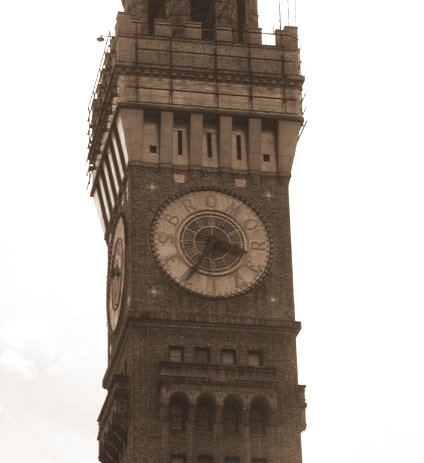
As a young man growing up in D.C., Baltimore was strictly "second-city." After all, Washington had NATIONAL Airport. Baltimore had Friendship Airport. Our city was named after the man who won the Revolutionary War. Their city was named after a British Lord, and according to my Fairfax County Public Schools education, they're the ones who lost the war. My first trip into Baltimore was in 1964. I remember vividly the Baltimore City clock tower. It had black block letters across its face, and as I stared through the windshield of my Father's Buick Wildcat, the words became readable. "Bromo Seltzer." Bromo Seltzer?? "Dad," I began, "Why did Baltimore put 'Bromo Seltzer' on their city clock?" "Because," my Dad began, with that rich, reassuring voice that all fathers had in the early '60s, "It is a reminder to take it because living in Baltimore makes you sick."
Now, that's not why I disliked Baltimore. It was the Orioles. The Senators invited them to leave St. Louis and play in our back yard, and they repaid us by beating the snot out of us every time we played. The Orioles would trade for Frank Robinson and the Senators would trade for Greg Goosen [sigh]. In 1969, the Senators won 86 games and were competitive the entire year. The Orioles won twenty games more and went to the World Series. In baseball, Washington was the weak sister. When Robert Short did to Washington what he did to Minneapolis a dozen years earlier, I was crushed [bet you didn't know he was the Lakers owner who moved them to L.A. - that's why they are the "Lakers," because Minnesota is known as the "land of 10,000 lakes"]. But even Robert Short's "Texas Two-step" couldn't make me an Oriole fan. For five years, I rooted for the Redskins and the Bullets, and spent my summers at Ocean City. But things changed in 1976. Her name was Sharon. Having dated many girls, Sharon was the first "woman" I had gone out with. I had known her throughout high school and had been friends, but I was never considered to be in her "league."
She was an avid Oriole fan, and wanted to see a game in Baltimore. Hmmmm. Hatred of the Orioles vs. a vivacious redhead [actually, the decision was closer than you'd think]. Just a few days before our country's Bi-centennial, Sharon and I zipped down the parkway towards Baltimore in her yellow VW convertible. I had a great time until we pulled into the Memorial Stadium parking lot. I got kind of clammy. My stomach began to hurt.
There before me was Memorial Stadium. It was nothing like RFK.
RFK was [at this time] sleek and modern, and Memorial Stadium looked out of date, with its brick façade and 1930's brushed aluminum lettering. I kept muttering to myself, "vivacious redhead...vivacious redhead" as we walked into the stadium.
I still don't get it. Here, in the middle of a large urban city, sitting among 35,000 people, the loudspeakers blared John Denver's "Thank God I'm A Country Boy" after each inning. Didn't see a single country boy in the stands. And people from Baltimore must like the sun, because there was no roof on the stadium and I boiled like a crab from their harbor. Oh, and the game stunk. Reggie Jackson hit two home runs and Doug DeCinces made a couple of good defensive plays, but the O's lost 14-6 to the Angels. But I couldn't watch the game. I just couldn't All around me were these giant Oriole bird faces with huge grins, staring right at me! They were laughing at me because Baltimore had a baseball team and I didn't. When we got home, the redhead wasn't feeling very vivacious because her team had lost, and she asked me to leave so she could "rest." Crap. The Orioles were even destroying my love life!
I had to get away from that stupid bird. I moved to Pocatello, Idaho 15 years ago, where I don't have to see that beaky bird mocking my misfortune. Alas, the wrongs of the world have been righted with baseball again being part of my life. This time, Washington has Frank Robinson, and the Orioles have the modern day equivalents of Greg Goosen and Jim French. Just as Sir Peter feared, the Orioles will be but a postscript in Washington history. Way back there, in the deep recesses of Washington's memory junkpile, next to the A, B & W Bus company, People's Drug Stores and Glen Echo Amusement Park, will be the faint odor of the Orioles.
Thirty years from now, a young boy will dig up an old picture of his dad wearing an Oriole's cap and, with tears in his eyes, ask "Why?" "Son," the dad will begin, using lyrics from a song that rocked D.C. the summer of the Senators greatest year, 'If you can't be with the one you love, love the one you're with.'" Baltimore, we were lonely. We're not lonely anymore.
Deal with it.
BOB SHORT WAS RIGHT. ONCE.
 [November 14th] -- More than thirty years ago, Redskins' owner Edward Bennett Williams announced the hire of a new, proven head football coach who would lead the team back to prominence in the NFL. This man had a few championships under his belt, and was known to be able to turn around an NFL team almost immediately. No. It wasn't George Allen. He came later. This was Green Bay legend Vince Lombardi. Lombardi turned the Redskins into winners in 1969, their first winning season in 14 years, and only their third since the Truman administration.
Lombardi found something new when the Redskins visited Franklin Field in Philadelphia, owned by the University of Pennsylvania and shared with the Eagles. Gone was the hard grass sod and in its place was a brand new artificial surface. There was a picture of him in the Post, wearing his traditional camel-color overcoat, springing across the plastic grass with a toothy 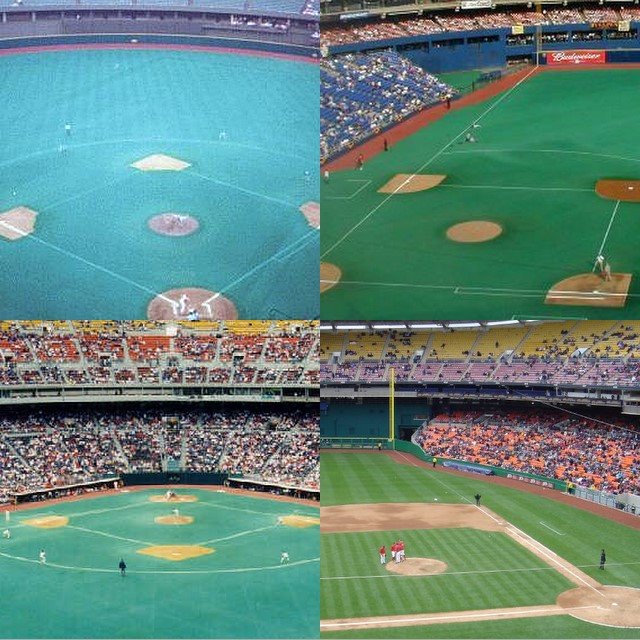 grin that only Lombardi could get away with. St. Vincent loved the feel of the Astroturf as he walked the sideline during the game. He told reporters that he intended to talk to the Armory board about changing the RFK grass to the artifical surface. The Armory board liked the idea of placing Astroturf in RFK Stadium. The cost, over ten years, would be far less expensive than the cost of maintaining a sod field. All that was left was to get approval from Senators owner Bob Short.
It never happened.
Short, in perhaps the only wise move he made during his stewardship in Washington, said "No way." The Armory board, and Lombardi indirectly, negotiated for sometime before finally giving up hope that an agreement could be reached. By the time the Redskins became the sole occupant of RFK Stadium in 1972, Vince Lombardi had been dead for two years and George Allen was the new "sheriff" in town. This sheriff hated astro-turf. That ended any hope of plastic grass at RFK.
Bob Short did the right thing. Man, that is sooo hard to write.
Nats Notes @ 10/11: Still no world on the Bob Carpenter situation. Will he return? Will he go? The Lerner's need to understand that, right now at least, Nationals' fans crave continuity. I am tired of the steady stream of one-year wonders, both on the field, in the clubhouse, and on television ..... As feared, Monument Realty - pronounced sore losers - have sued Metro over their $69 million dollar deal with Ackridge Co. to sell their bus garage. Monument did this knowing that a lawsuit would jeopardize the opening of the new stadium. Hardball at its best. They are going to try to blackmail the city into getting what they want. I wonder if the Lerner's have a security staff like the one Tom Cruise fought in "The Firm." Perhaps a few "black ops" missions might make Monument see more clearly ..... The Harrisburg Senators, owned by the city for almost twenty years, sold the franchise to Michael Reinsdorf (the baby boy of White Sox guru Jerry) for $13.2 million dollars. The good new is that the new owner and all future owners will be tied to Harrisburg for at least 29 years. Perhaps now the city can afford to renovate their old island stadium ..... Dmitri Young was the first Nationals' starter to hit over .300 in three years, and is only the second Washington starter to do it since the Kennedy Administration. Chuck Hinton batted .310 in 1962. Frank Howard came close with .296 in 1969 ..... I came upon a blog yesterday that was touting the new grass soccer pitch (is that right?) at RFK. Several of the commenters were asking when "all that Nationals' stuff" would be removed, and if they would get their soccer clock back. Sounded a little weird, I guess. I don't know a single person who watches soccer. That said, I might be like that Washington socialite in 1972 heard lamenting Nixon's landslide win over George McGovern. "I can't believe this," she began, adding "I mean, I don't know a single person who voted for that man." Maybe I'm the one who's a little out of touch.
BOB SHORT FINISHED WHAT OTHERS STARTED
 [October 9th] -- Bob Short. Just the mention of the name darkens the skies and depresses the soul. In 1970, Short traded three of his best players to the Tigers for the enigmatic and over-the-hill Denny McLain, drastically reducing both wins in the standings and fans at the stands. Crying "poverty," Short and the team were in Arlington, Texas a year later.
D.C. baseball fans remember what Calvin Griffith did to the city of Washington in 1960. D.C. baseball fans remember what Bob Short did a decade later. Few remember, however, that there was another owner who tried to move the team in that period between pariah #1 and pariah #2.
The Braves were not the first baseball team courted by the city of Atlanta. A new, modern stadium, "like that one in Washington," according to the mayor, was on the drawing board since the early 1960's. The city was ready to begin construction the moment a team was found.
Days after Kansas  City officials turned down owner Charlie Finley's request for a new park for the Athletics, he was invited to Atlanta to look at potential sites for the new stadium there. By July of 1962, however, it was obvious that Finley didn't have the support of his fellow owners for a move to Atlanta. The deal was dead. 1963, however, was more fruitful. The Braves, no longer the wonderchild in Milwaukee, were suffering from a combination of low attendance and political indifference. Agreements were eventually signed, a stadium built, and although slowed by a judge's ruling, the move to Atlanta was completed in time for the 1966 season. Atlanta had their baseball team. The Athletics were Atlanta's second choice, the Braves their third. The Senators had been their first.
Calvin Griffith's attempt to move the Senators to Bloomington, Minnesota was met with all the bluster that Washington politicians could muster. It was only when Major League Baseball promised an expansion franchise to the city did the lawyers finally back off. Griffith's moving vans weren't past Fairfax Circle before Elvin Quesada, the FAA administrator, was named the owner of the Senators II.
The honeymoon lasted less than a year.
Quesada was not a wealthy man, and his operating capital was depleted before the end of the first season.
Attendance dropped by 55,000 from 1960. Although playing in the new RFK Stadium would greatly increase revenue, Quesada wasn't sure he could keep the team afloat until then.
Enter Colonel Beauregard Peyton of Atlanta. Beauregard was a life long resident of Atlanta. He was a businessman who envisioned an Atlanta based baseball team as a conduit to a regional television and radio network. A team in Atlanta, he correctly assumed, would likely be embraced by fans in all the southern states. Unlike Short, Peyton didn't hide his plans. Many believed that it was just a matter of time before the team moved south. Washington legend Shirley Povich wrote, "It is not believed that the American League would allow him to move for the 1962 season, so he will have a full year to work on American League president Joe Cronin, a former Senator player."
Peyton promoted manager Mickey Vernon to general manager, and hired another former Senator, Cecil Travis, to manage the club. Povich was wary of this move, "wo ndering" in his column if Peyton made Vernon the GM so that he could succeed, or more likely, so he could fail.
Of course, Peyton never got his wish. American League owners didn't want to hear about losing their "anti-trust exemption" from piqued congressman still angry about the Calvin Griffith move, and refused to entertain Peyton's request to move the team. The Senators were sold again before landing in the lap of Robert Short, who completed Peyton's "dirty deed" in 1971.
In the end, all is forgiven. Washington now has a National League team, a new stadium, and a fan base large enough to support a top-notch organization. Although the thirty-four year wait was painful, it helped all of us remember what its like not to have a team. This time, D.C. baseball will be forever embraced and never taken for granted.
Oh, and Bob Short? Rot in hell.
Nats Notes: Kory Casto went 1-3 in the Arizona Fall League's opening game yesterday. Casto, who went from Minor League Player of the Year to "nowhere man" in four months, is likely being showcased in Arizona in hopes of being traded later this year. While I understand that Casto was over matched to the point of embarrassment in April and May, that may have been the Nationals' fault. He made it to the big leagues after just one year at 'AA' and having never been given any additional seasoning at Columbus. Regardless of the reason, however, he's no longer part of the Nationals' future ..... Barry Svurluga reported that he's confident that all of the team's coaches will return for next season, which is a wonderful thing. Giving coaches, like players, a chance to grow into their jobs creates loyalty and stability in the clubhouse. The next Tim Tolman will now know that he's not going to get fired because he made a few mistakes at third .... Columbus infielder Bernie Castro and outfielder Mike Restovich were granted minor-league free agency today, which really comes as no surprise. Both are the prototypical 'AAAA' player, too good for 'AAA' but not good enough to play at the major league level. Restovich is going to hit .280-20-80 and Castro .280 with 35 steals year in and year out at 'AAA.' Both had a chance with the big club and both looked over matched. Slowly but surely, the Nationals are adding real prospects to their farm system and removing many of the organizational players, guys who have no shot at making the varsity club. I guessed wrong with Restovich. I predicted he'd be a fourth outfielder/platoon kind of guy, hitting .265-13-50 or so with the Nationals. Oh well ...... The Nationals also outrighted Winston Abreu, Mike Bacsik, Chris Booker, Anthony Munoz and Brandon Watson to Columbus. The only real surprise is Munoz and Abreu. Munoz pitched brilliantly last year with the Clippers and pretty well for the Nats in September. He's a lefty situational pitcher, something the team always needs. Abreu was dominant in Columbus and showed some ability in Washington. That these players aren't on the 40 man roster doesn't mean some won't come back in some capacity. Munoz for sure, maybe Abreu, possibly Booker.
MORE OF THIS AND THAT
 [October 8th] -- We have entered the "black hole" of baseball. It's kind of like being on the far side of the Moon and wanting to call Mission Control. From now until the end of the World Series, all major league teams remain silent in deference to Bud Selig's "Don't upstage the playoffs with news or hires" mantra. That, and the fact that the free agent swap-meet doesn't start until the day after the World Series ends, makes it for a very dull few weeks.
So I thought today would be a good time to talk about "stuff," things that caught my eye but I never got around to talking about it.
And we're off .....
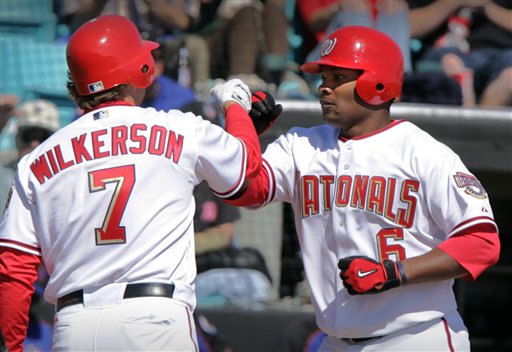
Now, the above photo of Brad Wilkerson and Jose Guillen, taken during Spring Training in 2005, doesn't mean much other than I think it's a great picture (does something on the uniform look a little different other than the patch?). I found it on "llamabutch
 ers.nu.mu," which is kind of strange in and of itself. It's obvious that Stan and Jim aren't going after name free-agents this winter, but what about "plan-B" types like former National Brad Wilkerson? Kasten has recently said that he won't overpay for top tier free agents, and that the other guys probably aren't going to help the team in any significant way (and we'd have to overpay to get them too). But what about Wilkerson, a former franchise favorite? In two injury plagued years in Texas, Wilky has hit 35 homers in 700 at-bats, but other offensive indicators don't look as good. He would come cheap and he'd likely love to return and play in the new stadium.
 Well, let's think about this for a minute. The number of times that Wilkerson has hit above .270 in 6 major league seasons is ZERO. His average season, based on a 550 at-bats: .250-22-69, 164 strikeouts, .805 OPS. Now lets look at Ryan Church, the guy he'd replace, based on those same 550 at-bats: .271-19-85, 118 strikeouts, .810 OPS. Wilkerson has a career .981 fielding percent in center, Church .987. Church is also two years younger than Wilkerson, and outside of running into that wall in Pittsburgh in 2005 (and his foot problem), he's been 100% healthy for the Nationals.
 Belliard deserves to be the starting 2nd baseman. I couldn't agree more. He also said that team management believes that Jon Rauch "took his game to another level" in 2007, placing Chad Cordero firmly on the trading block yet again. Rauch had a 3.61 ERA in 2007, allowing 1.09 base-runners per inning. He struck out 71 in 87 innings. Cordero's ERA was 3.36 but allowed 1.38 base-runners per inning. Cordero struck out 62 in 75 innings. I don't think there is much difference between the two. Cordero allows many more base-runners, but then strands many more as well. But if the two pitchers are "6's," then it makes sense to trade Cordero and move Rauch to the closer position. Luis Ayala could easily take over the role of 8th inning setup man, with the 7th being handled by any of the other solid relievers, i.e., Chris Schroeder, Jesus Colome, Saul Rivera, Jonathan Albaladejo, etc.
Most of us had hoped that the Nationals would have a new uniform in time for the new stadium. Though the deadline has long since past for requesting it, I had hoped that it was kept quiet and the team would surprise us come spring. Nope. It's now official; the only difference will be a new patch on the arm. And that's too bad. I love everything about the uniform except the way "NationalS" appears across the chest. I blogged in 2004 that the uniform was "temporary," designed to be used until the new owners took over and made the team over in their image. 2008 would have been the ideal season to do that.
The 2007 division winners averaged about 62 wins from their starting rotations, and every team but the Phillies had at least one guy in the 18-20 win range. Conversely, the Washington Nationals had a total of 40 wins from their (many) starters.
I think we can count on Shawn Hill, Jason Bergman and Matt Chico to lead the staff next year. However, I think it would be folly to count on them winning any more than 39 wins combined (an average of 13 each). Had they remained healthy in 2007, the three - assuming a full season of starts - would have won about 22 games. To get close to contention, the other two guys in the rotation - whoever they may be - would both have to average about 10 wins a piece. About the only guy from 2007 who might do that is Tim Redding. The Nationals, then, would have to find a stud capable of winning 15+ games (plus one big bat for the middle of the lineup) to be able to stay in contention through September.
Not a chance.
 m Tracy being fired, GM Neal Huntington may be anxious for some immediate changes, and Bay's .247-21-74 is far removed from his .290-35-100 'esque seasons in 2005 and 2006. He still has two more seasons
  remaining on his contract, though the amounts ($5.7 million in '08, $7.5 million in '09) are certainly not overwhelming, even for the penny-poor Pirates. In fact, Bay's contract calls for him to receive just $200,000 more than Austin Kearns over the next two years.
 Gammons blogged that the deal was probably not going to get done "straight up," that the Mets (from the Nationals perspective) needed to add another player. Of course, that never happened because the Mets see The Chief in a setup role. The Metssox blog said that the Nationals were interested in Humber and Lastings Milledge ( I don't know about that -- that's just too much for Cordero).
  backs' #9 prospect in 2006 (Matt Chico was #11). After a 19-9, 3.62 start in his first three years in the minors, Mock has run into trouble. In 2006, splitting time with 'AA' Tennessee and Harrisburg, Mock went 4-12, 5.23. To be fair, his knee was bothering him (a tear of the patella tendon), a problem he had repaired this off season. He didn't show much in his first two stints in the GCL and at Potomac, and really looked bad in 11 starts for the Senators. Mock went 1-5, 5.79 in 51 innings, allowing a ridiculous 12 hits and 5 walks per 9 innings.
 The surgery occurred September 2nd, and Mock was supposed to be ready to go come spring. He still complained of soreness, however, and was held out for the first part of the year. It was his left knee, his "landing" leg, so I can understand the poor statistics if it was still sore during the season. But should it have been sore a year after arthroscopic surgery?
WAS WATERGATE THE RESULT OF NIXON'S INACTIVITY??
 [October 7th] -- With all due respect to President George W. Bush, Richard Nixon was the Oval Office's most rabid baseball fan. During his years in congress [1948 - 1952], the legislator from California would often duck out of meetings and head over to Griffith Stadium to watch the Senators play. He once told Senators' manager Ted Williams that he had watched more than 200 games at the old park during the 1950's.
The then vice president spoke out against Calvin Griffith's move of the Senators to Minnesota, and was ecstatic about the city receiving a replacement expansion franchise the following year.
When he lost the 1960 presidential election, he returned to his home state of California, and began to follow the new Los Angeles Angels, owned by his friend Gene Autry, and spent many nights in the owner's box with Autry and his family. By 1968, though, the was again ready to run for national office. He returned to Washington in 1969 as the president of the United States.
Nixon was a familiar face at RFK Stadium during the 1969 season, the lone highlight of the expansion Senator's decade in Washington. Ted Williams was the new manager, Bob Short the new owner. the team's 86 win season renewed hopes in a city decimated by the assassinations of Martin Luther King and Bobby Kennedy the previous year. Resurrection City was gone from the mall and blacks and whites seemed comfortable with each other for the first time in years. Most Washingtonians believed that Nixon would keep his campaign promise and get the country out of Vietnam.
It was a hopeful time for all. Things change quickly, however. Especially in D.C.
By 1971, Bob Short, underfunded to begin with, was having real financial problems, and he began floating the idea of moving the team if the D.C. Armory board, which had oversight authority for RFK Stadium, wouldn't negotiate a new lease that would have ended up being little more than legalized theft. The acrimony reached the sports page of the Washington Post as both sides hammered the other throughout the summer.
On July 1st, Roger Ailes, then a Republican strategist, contacted an aide to Bob Haldeman and suggested that it would help the president's image if he got involved in the Short - Armory fight. Ailes thought that some "federal assistance" might end the standoff and save the team. By mid August, fans were beginning to worry that Short might actually move the team. Virginia Senator William Spong wrote Nixon, asking him to meet with Washington Post columnist Shirley Povich to come up with a plan to block any potential move. The Post's sports editor, Marty Zad, asked the president to use "the power of the presidency" to help stop the move. Ultimately, all hopes of a "presidential pardon" came to an end on September 7th. Herb Klein, White House director of communications, told Zad that it would be "inappropriate" for the president to get involved in a private financial matter. The following week, Nixon made his first and only public remarks regarding the matter, saying that he would be "heartbroken" if the team were to move to Dallas.
Now assured that there would be no last minute Oval Office intervention, Major League Baseball voted 10-2 to allow the team to relocate to the Dallas - Fort Worth area. The two dissenting votes were Brewers owner Bud Selig and the Baltimore Orioles. The vote was announced on September 21st.
Nixon was right; he had no "legal" authority to stop the move. But in the rest of the world, away from the beltway, "moral" authority is something used when "legal" authority isn't available. Nixon might have been able to apply enough pressure to force Short to sell the team to someone better able to run the team. It wasn't the fault of the Senators' fans that Major League Baseball chose an underfunded owner with a history of moving professional sports franchises to run the team. Nixon's position as the leader of the free world was strong enough to scare the Russians and subdue the Egyptians, so why wasn't it strong enough to put a little "scare" into Bowie Kuhn and the baseball boys?
Is it a coincidence that just a year after refusing to help the Senators, Richard Nixon's world came tumbling down around him? Maybe. Maybe not.
He spent the next two years fighting the media, the Democrats, and ultimately, his own base until he was finally forced to resign in August of 1974. Watergate was payback from the baseball Gods. In 1948, Harry Truman threatened to draft striking railroad workers into the Army if they didn't go back to work. He knew he couldn't, but he didn't care. Both sides caved and the workers returned to their trains.
Nixon could have done the same thing. Draft Bob Short. Draft Bowie Kuhn. It would have worked. Scare them all. Isn't that what Washington D.C. is all about?
NO JOSHING, DON'T KARP ABOUT MINORS ANY MORE
Yep.
Would you have liked the 2007 Washington Nationals to look like this?
- [CF] Curtis Granderson (.302-23-74)
- [RF] Alex Rios (.297-24-86)
- [2B] Chase Utley (.332-22-103)
- [3B] David Wright (.325-30-107)
- [LF] Garrett Atkins (.301-25-111)
- [CA] Brian McCann (.270-18-92)
- [1B] Prince Fielder (.288-50-119)
- [SS] J.J. Hardy (.277-26-80)
And this starting rotation wouldn't have been too bad, would it?
- Barry Zito (11-13, 4.53)
- Jeremy Bonderman (11-9, 5.01)
- Dan Haren (15-9, 3.07)
- C.C. Sabathia (19-7, 3.21)
I would think that this version of the Washington Nationals would have played well into October, and could easily have been the World Series champion. The Nationals wouldn't have had to trade for, or sign as free agents, any of these players -- all they would have to have done is to choose them in the amateur drafts from 1998-2002. Each player listed was available in one of the first four rounds of each draft after the Expos made their selection.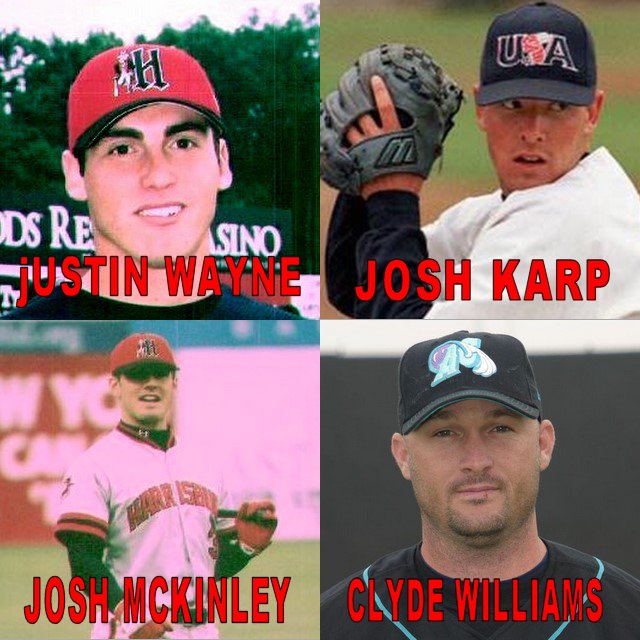
Incredible, huh?
In the first round of the 2000 draft, the Expos chose pitcher Justin Wayne, bypassing Utley and outfielder Rocco Baldelli. In 2001, with Aaron Heilman, Bobby Crosby, Jeremy Bonderman, Noah Lowry and David Wright waiting to be chosen, Montreal went with pitcher Josh Karp. In 1998, infielder Josh McKinely was chosen ahead of Brad Lidge, Jeff Weaver, C.C. Sabathia and Aaron Rowand. Three rounds later, first-baseman Clyde Williams, was taken by the Expos instead of Zito, Mike Maroth and Ryan Langerhans.
2002, however, was the worst. With one of the top picks in the draft, Montreal chose pitcher Clint Everts, a pitcher today still toiling at the Class-'A' level. In that same first round, however, they could have chosen Zack Greinke, Prince Fielder, Jeremy Hermida, Khalil Green, Scott Kazmir, Nick Swisher, Jeff Francoeur or Matt Cain.
There can be only two possible conclusions for the team picking lumps of coal for their Christmas stockings when candy and toys were still available. Either general managers Jim Beattie (1995-2000) and Omar Minaya (2001 - 2004) were stupid and couldn't find a major league prospect in a barrel of fish or they were told by owner Ebeneezer Scrooge to draft "signable" players and not the best player available.
I vote the latter.
Jeff Loria was so cheap and difficult to work with that the city of Montreal withdrew it's funding for Labatt Park, the stadium that was to keep the team in Quebec. The following season, no English speaking radio station would carry the Expos games for what Loria demanded. Today, Loria is the owner of the Florida Marlins, and his 2005 fire sale has shown bottom lines still take precedence over wins and losses.
Both owners, then, saw the amateur draft as a drain on resources, and told the team's general manager to only draft players that would sign within a particular financial parameter. That kind of draft philosophy destroyed the team's farm system, once one of the richest in the major leagues.
Justin Wayne (#1, 2000) is out of baseball having fashioned a 25-34, 3.97 career record. He started only eight games in the major leagues. Tom Mitchell (#5, 2000), the guy chosen over Garrett Atkins, never played professionally. Josh McKinley (#1, 1998), the 11th player chosen, never made it above 'AA' and retired in 2004.
Josh Karp is the poster-boy for the team's low-budget draft philosophy. Karp, a 6'5" right-hander, was drafted in the 8th round out of high school by the Atlanta Braves in the 1998 draft. Not wanting to sign for 8th round money, he played three years for UCLA (8-3, 4.29 in '99, 10-2, 5.08 in '00 and 5-2, 3,26 in '01). Though he did strike out 10 batters per 9 innings during his college career, he also walked 4 and gave up 8.50 hits. He was considered a mid-round pick at best. Yet the Expos, having the 6th pick of the draft, weren't about to pay some whipper-snapper a bonus that could reach three million dollars. They instead chose Karp, a player they assumed would be so grateful to be a first round pick that he'd sign quickly and easily. He signed all right, and for very little money. He lasted four seasons in professional ball, going home to Bothell Washington in 2005 with a 24-32, 4.74 record. That #6 pick could have brought the Expos Jeremy Bonderman .... or David Wright ... or Aaron Heilman ... or Bobby Crosby .... or .... well, you get the idea.
I'm not nearly as mad at Bowden for not pulling the trigger on that last-second trade this past summer as I was. The Nationals, having clearly expressed a commitment to signing the best players and then doing what's needed to sign them, will come away from next spring's draft with two players that will have a good chance to make a difference in Washington. The Justin Wayne's and Josh McKinley's and and Josh Karp's of the world are now a footnote in the team's history. Sure, the players they sign may never make it to the major leagues. But they also might end up being stars for years to come.
That's whats fun about the draft.
LOOKING FORWARD: OUTFIELDERS
 [October 4th] -- We've been taking a peek into next year to see which current Nationals' players will, or will not, return in 2008. Yesterday, we reviewed the infield. Today, we'll take a look at the outfield. Are they a lock to return? A maybe? Perhaps a long-gone?
 Left Field:
 him in high esteem (of course, who knew that Henson would crap out?)
Center Field:
 id defense. What they got was .265 with a .304 OBP and 25 steals. His defense seemed okay because his speed could make up for his many mistakes, but he seemed to always break back before reading the ball properly and then sprinting to reach the ball. It helped to give up switch-hitting, but there is nothing overwhelming about any part of his game that should suggest he return as a starter.
 here at the Beltway Boys a far higher upside than he really has. His .272-15-70 in 2007 extrapolates out to .272-19-86 over a full year. He is a .993 career center fielder, though his arm and speed is nothing more than average. He has excellent pursuit angles, however, which allows him to get to balls in the alley's very well.
 Right Field:
 tionals with a very favorible multi-year contract. Need I say more? Kearns' second half (11 homers, 44 RBI's) tells me that 1) the first half was a fluke and 2) he'll probably hit .270-24-85 at the new park, great numbers from such a tremendous right fielder. Though he has a very so-so career .265 batting average, his .359 OBP more than makes up for it. And he's not the strikeout machine that most fans (including me) believe he is. He struck out 106 times in 587 at bats, acceptable for a run-producing outfielder. Defensively, he committed just 2 errors all season.
Reserves:
Tomorrow: Pitchers
This-'n-That: Time to see how some of the former Nats did in 2007 playing for other teams:
How many days until spring training????
SO WHO'S COMING AND WHO'S GOING?
 [October 3rd] -- Things are beginning to happen quicker than expected regarding the comings-and-goings around the major leagues. Andruw Jones, for example, is no longer an Atlanta Brave. I guess the combination of Scott Boras an the agent and 7 years/$140 million as the contract request will do that. We'll also be finding out in the coming week many of the players that the Nationals will be either cutting lose or non-tendering. With that, I thought now might be a good time to look at the 40 man roster and try to get a feel as to who's a lock to stay, who may return, and who's long-gone.
We'll cover the position players today.
1B: Nick Johnson: Maybe - Although all of us want him to return to his 2006 form (.293-20-77), Johnson' s age (29) and past history (he's only played 54% of the team's games since 2004) suggest that we just can't count on him come spring training. And even if he is 100%, what's to say he'll stay that way. Since 2005, he's hurt his knee, heel, lower back, and had a cervical strain, all before breaking his femur last year in New York. Some guys just can't stay healthy, and there is no reason to believe that will change as he gets older. Just ask Alex Escobar.
Another concern is his production. Nick, at his best, is no Albert Pujols or Ryan Howard. He's more like Mark Grace or Lyle Overbay. He'll give the Nationals a good average with below average homers and RBI's for a first baseman (though his on-base percentage is tremendous). Teams can afford good field/good enough hit first baseman only if they have power at another, non-traditional position, like short or catcher. Remember, Johnson got 500 at-bats in 2006 and drove in just 77 runs, pretty low for a cleanup hitter. I read one person write that was because Ryan Zimmerman drove in all the base runners before Johnson got the chance. I don't agree with that. Chase Utley drove in 103 runs this year (in 132 games) while Howard, batting behind him, drove in 136 (in 144 games). To succeed, the Nationals need someone in the four-spot who is a real slugger.
Dmitri Young: Maybe - Young, the Comeback Player of the Year, had a tremendous year for the Nationals, batting .320-13-74 in 474 at-bats. The .300 average is no fluke; Y oung batted over .300 four consecutive seasons for the Tigers. But his power production isn't much different from Nick Johnson. He averaged a homer every 35 at-bats this year, down from 1:27 for his career (no doubt, RFK played a roll in that). But based on a 162 game season, Young has averaged .291-21-83, almost identical to Johnson's production (when healthy).
Nick is 29, Young 33. Both have two years remaining on their respective contracts, both for about $5 million a year. Nick's OBP is 50 or so points higher, and his fielding is far superior. Both are capable players, but neither will give the Nationals 30 homers and 110 RBI's, something they desperately need at first. Sadly, their combined salaries of nearly $11 a year would have bought the Nationals just such a player.
I have to believe that if Nick's not ready by spring, or is ready but is no longer the same player, then Dmitri plays first in 2008. But if Johnson is happy, healthy and upright, Young is just too expensive to keep as a reserve, especially for the entire season. Somewhere, some American League team will be in need of a DH, and the Nationals will likely trade Young away.
2B: Ronnie Belliard (Lock) - Unlike Dmitri Young, the signing of Ronnie Belliard to a minor league contr act made no sense. Over the previous four years, Belliard averaged .279-13-71 and showed no sign of slowing down at age 31. True, he had some legal issues during the off season, but that shouldn't have stopped someone from giving him a multi-year, guaranteed deal. That said, he was one of the Nationals most consistent players, hitting .290-11-58 in 511 at-bats. He committed just 6 errors in the field. He's signed for two more years, and at a much cheaper rate than Felipe Lopez. No way the Nationals could have won 73 games in 2007 without Belliard.
SS: Felipe Lopez (Long-gone) - I wasn't sure whether I wanted Lopez to return next year until I read that he was the only National to refuse to greet fans at the gates for the team's last game at RFK. Combine that with the Guillen-like grumpiness with the poor defense with the bad offensive year and I say see--you--later! Sure, 2007 might have been an anomaly offensively, but the Nationals don't need players who implode when the going gets rough. We just got rid of someone like that in Jose Guillen. Defensively, he has to play 2nd; he committed one error every 43 games at 2nd compared to one every 5 games at short). Because the Nationals are better with Belliard at 2nd, Lopez will probably be non-tendered rather than give him a raise on his $3.9 million dollar contract.
 al bust in D.C.
While his offense was horrid in 2005, his defense was stellar. After missing the entire 2006 season, he came back to hit .328 in 46 games. Strangely, his defense was bad, as Guzman committed 8 errors, a pace of nearly 30 miscues over a full season.
You would think that Cristian Guzman will be able to "get in right" in one out of the four years of his contract. Count on him staying healthy, hitting enough and playing Guzman-like defense.
C: Brian Schneider (Lock) - Was it just two years ago that Brian Schneider batted .268-10-44? In 2006, he had to hit .333 in August and .289 in September to raise his average to .256. Defensively, he's as good as ever, matching his career .992 fielding percentage in 2007. Had Jesus Flores not shown promise, no one would be talking about who was going to catch for the Nationals in 2008. But Schneider is now 30, and isn't going to get better over the next five years. He's a barely average hitter and a superb defender. The Nationals have to accept that's what he is and embrace what he does for the pitching staff.
But to get better, to become as good as he can be, he needs to spend some time in the minors playing every day. Let him get 400 at-bats next year at 'AA' Harrisburg or 'AAA' Columbus before bringing him up for good later in the season. This will hurt the team in the short term but Flores needs the polish to become a star catcher in the National League. How good can Flores be? His arm looked every bit as strong as Schneider's and his power looks like 20 homers / 80 RBI's.
Reserves:
Robert Fick (Long Gone) - I like Fick as a player and as a crazy guy but the Nationals can do better. I understand the difficulty he faced with the death of his mother, but even at his best, he's an adequate defender and a hitter without power. There is a chance that he could return if Dmitri Young is the team's starting first baseman, but no way he returns if Young becomes a pinch-hitter deluxe.
So the only uncertainty in the infield is at first, where Nick Johnson's health issues remain. The Nationals might try Wily Mo Pena at first if needed, or perhaps trade for Adam Dunn (he's played 108 games at first). Other than that, the players who will man the other positions are already on the roster. And without question, the infield will be a strength again in 2008.