WITHDRAWALS STARTING ALREADY
 [October 1st] -- The season is over, and Nationals' fans are now preparing for their third off-season since baseball returned to Washington.
Some fans put away their "curly-W" hats and turn their attention to the goings on at FedEx Field, giving the Nationals nary a thought until late February.
Others - like me - believe the off-season is the best part of the year. It is now that we can make predictions and prognostications without reality deviating our dreams. What we think will happen next year won't be proved wrong for another nine months or so.
Some blogs go on hiatus. Others will keep the hot stove burning.
This off-season will be far more interesting than the past two. In 2004, we didn't even know the names on the roster. Last year, we knew that the team was going to be gutted, and that there was few players in the minors who could take their place. No free agents and no one to trade. But this year, well, things are different. The minor leagues are no longer the worst in the business, at least according to Baseball America. Most believe that when the new list comes out in December, the Nationals will be somewhere in the 14-17 range, quite a jump in a single year. And though Stan Kasten says he's not going to pursue "name" free agents, he is still going to increase the payroll. Trades. Big trades, or so it would seem.
Many are predicting - Manny Acta included - that next year's team will be .500 or better. Be careful now, boys and girls. We're just as apt to take a step backward next year as we are to reach that magical .500 plateau. And remember, teams don't go from 73 win to pennant contenders in a year or two. In 2003, Cleveland won 68 games, then 80, then 93 in 2005. In 2006, the year they were supposed to break out, then won just 78. They rebounded to win 96 this year. Building a team is more art than science. We just don't know what's going to happen.
We'll cover all of this, plus take a hard look at all the players who took the field with the Nationals this year and try to figure who's coming and who's going and who's staying. That will start tomorrow.
For now, I'm going to enjoy time with my children and my foster children and grandchildren
Oh, and my wife.
Good things she doesn't read my blog....

CHICO SILENCES PHILS FANS
 [September 30th] -- The Nationals did something that they haven't done since moving to Washington on Saturday; they won a game in the season's final series. they were swept by the Phillies in 2005, and by the Mets last year. Their 4-2 win was even on national TV (we in the West were supposed to watch the Padres - Brewers game, but Fox nixed that broadcast once the Brewers were eliminated from the playoffs).
So - for the first time this year - I got to watch the Nationals on TV and not on my computer.
And I am so proud of the job they did. I wasn't sure if Friday night's 6-0 loss to the Phillies was the result of a letdown following the Mets' series or a well pitched game by Cole Hamels. No question, it was all Hamels.
Now, I'm sure that the Phillies fans looked at Matt Chico's ERA and thought Saturday's game was in the bag. After all, his 6-9, 4.75 record looked ripe for the picking. What they didn't realize, however, is that Chico isn't the same pitcher since returning from Columbus earlier this month. Without question, he's been the team's best pitcher in September. Chico pitched 6 innings against the Phillies, allowing just 4 hits and 1 run. Take a look at the night-and-day difference between his six starts since returning versus his last six starts before being sent down:
Since September 2nd:
IP: 34 -- H: 36 -- ER: 13 -- HR: 3 -- BB: 9 -- K: 19 -- ERA: 3.44
July 19th - August 17th:
IP: 30 -- H: 37 -- ER: 21 -- HR: 7 -- BB: 22 -- K: 19 -- ERA: 6.30
The difference is stunning. A shortened leg kick has allowed Chico to regain control over his pitches. Fewer runners equals fewer runs. Before he was sent to Columbus, Chico was averaging almost 2 baserunners per inning. Since his return, he's allowing just 1.3 baserunners per inning. To be able to cut his walks by 60% says a lot about Matt Chico's determination. He's guaranteed himself a spot in next year's rotation and we're now seeing what Jim Bowden and Mike Rizzo knew was there all along. And remember, Chico wasn't the main man in the Livan Hernandez trade. Garrett Mock was considered the much better pitcher.
It was a wonderful game, but a game we might not have won had it not been for Ryan Howard's miscue at first. Have you ever seen anything like that before? The ball skittered off his glove and into foul territory, but he never noticed. He reached into his glove for the ball so he could nail Felipe Lopez at home, only to realize that he didn't have it. That mistake, plus Carlos Ruiz's bad throw into center, gave the Nationals the win. Phillies' fans must be muttering about "what might have been."
LOOKING UNDER ROCKS FOR PROSPETS
 [September 28th] -- I was pouring over the Nationals' farm clubs minor league stats in preparation for a series of articles that will start next month. I began to feel much better about the state of the team's minor league system, and began to count the players that - based on stats and comments by team management - seem destined to succeed at the major league level. I got to 15, though by no means is this list totally inclusive:
Colin Balestar, John Lanna, Garrett Mock, Jack McGeary, Jeff Smoker, Colton Willems, Glen Gibson, Jordan Zimmermann, Michael Burgess, Adam Carr, Chris Marrero, Justin Maxwell, Shairon Martis, Clint Everts and Ross Detweiler.
Fifteen out of roughly 150 players (not counting the Dominican teams), not exactly a large number.
I then decided to compare the current Nationals' with three teams' farm clubs from 2000, the Expos, Yankees and Braves. I was trying to see how many players each team had seven years ago that made it to the major leagues and made some contribution. I didn't count guys who failed, only those who either started or was valuable as a reserve player:
Braves [8]: Wes Helms, Mark De Rosa, Marcus Giles, Jason Marquis, Ryan Langerhans, Rafael Furcal, Horacio Ramirez and Wilson Betemit
Yankees [6]: Ted Lilly, Alfonso Soriano, Zach Day (stretching my parameters), Juan Rivera, Brandon Claussen, Wily Mo Pena and Chien Ming Wang
Expos [9]: Tony Armas, Milton Bradley, Brian Schneider, Joey Eischen, Brad Wilkerson, Jamey Carroll, Brandon Phillips, Shawn Hill and Grady Sizemore.
So it would seem that at any given time, there are about 7-8 players in any given minor league system that will make it to the major leagues and produce. So what does that mean for the Nationals? Well, if a well-stocked farm system is going to produce seven players, then one like the Nationals, better than it was but still not very good, will probably produce five or so.
And the fifteen I counted didn't include several others who were considered real prospects just a few months ago, players like Larry Broadway, Kory Casto, Josh Whitesell, Ian Desmond and Zech Zincola. I could probably make a case that 25-30 Nats' players have the potential to become major leaguers. A little more digging at baseball-reference.com found that roughly 20% of true prospects have a productive major league career. So if the Nationals have 30 players we consider talented, we would then expect six of them to play in Washington one day.
Of all the various minor league levels, the one most bereft of future major leaguers was at the rookie league level, and it just so happens that is where the majority of our "prospects" played last year.
That's not terribly promising.
Without a doubt, the Nationals' future is much brighter today than it was a year ago. That said, we can't assume that each one of these promising kids are going to make it to the new ballpark. which ones? Hard to say. I'd guess that two out of [Marrero Maxwell Burgess] and four out of [Balestar Lannan Mock McGeary Willems Carr Zimmermann Gibson Martis Detweiler Everts Smoker].
But it's just a guess. Unlike the NFL and NBA, projecting baseball players is more art than science.
Acta Stays Through 2009: The Nationals announced on Friday that they have picked up the first option on manager Manny Acta's contract; he'll now remain with the team through 2009. If all continues to go well, Bowden will pick up the 2010 option next year.
Don't doubt for a second that the timing wasn't due in large part to the Mets' slide from seven games up with seventeen to play to a flat-out tie with the Phillies. Willie Randolph is under tremendous pressure and I don't see him returning if the Mets don't win the division. Heck, he might not return even if they do. Manny Acta is a favorite son of both Omar Minaya and owner Fred Wilpon. Would Manny prefer to return to New York instead of staying here in D.C? They're getting a new park too, and they have much deeper pockets.
It's become a moot question. He's now locked up for two more years and Jimbo said the Nationals without question would deny any other team the right to talk to him about a managerial job. I think that he'd be crazy to go back to that 'Big Apple' pressure cooker.
I have to admit, I was dead wrong regarding Manny. I wrote when he was hired that he was going to be an interim manager, a caretaker while the team was bad. Once the parts were in place to win, he'd be jettisoned in favor of a "name" manager. My reasoning was sound, or so I thought. Every "first" manager for every expansion team was long long gone before the team turned the corner. And the Nationals were certainly no better than an expansion team, or so I thought.
Glad to have Manny in the fold for a while. I don't like uncertainty.
72 AND COUNTING
 [September 27th] -- Although you can't tell, this is the fourth time I've started to write this story. Each time, the words and thoughts I wrote just didn't capture what I was feeling. I mean, the Nationals just swept the 1st place New York Mets, they came back from a 5-0 deficit and even scored two runs against Billy Wagner, something that just never happens. There was outstanding defense, timely hitting and - as usual - terrific relief pitching.
I am half tempted to delete that paragraph one more time and start over.
But, nah, it's too late for that.
I really didn't give the Nationals much of a chance of winning last night's game. Regardless of how well you're playing, it's just too hard to sweep the Mets at Shea Stadium (though to be fair, they are only four games over .500 at home this year). But sweep they did, and coupled with the Phillies' win against the Braves in Philadelphia, New York's lead is now just one game.
As Three Dog Night once said, "One is the lonliest number ...."
Observations from the game:
Ryan Church, the deposed starting center fielder, went 3-5 with a homer and four RBI's. He's now batting .275-15-70 in just 461 at-bats. Based on a 590 at-bat season, he'd have ended the year .275-18-91 with 54 doubles. Now, to be sure, he's hit much better since he's been reduced to a part-time player. Does this mean that he can't produce as a starter, or did he simply get hot late in the year and has played well over the past couple of months? Last year, he played well the last month and solidified his place on the roster in 2007. I have to believe that Church, had he been given the chance to play every day, would have had a very good year. Nook Logan played well initially as the team's everyday center fielder, but has seen his average drop from .291 to .261 over the last two months.
How much would a free agent cost who could hit .275-20-90? A lot. How much would Church cost next year? Not much. I think the team can afford to take a chance and pencil him in the starting outfield along with Wily Mo Pena and Austin Kearns. Play him in 130 games and give him plenty of rest. He'll produce. He has in the past and he will in the future. Time for the "great experiment" to be over and done with.
Wily Mo Pena went 2-4 with another 2 RBI's while hitting no homers. Pena is no longer the "all or nothing" slugger that came to the Nationals in August. He's hitting the other way and he's just making contact with runners on base. With his power, he could hit 20 "excuse me" homers along with another 20 that he muscled out of the park. His batting average has risen since his arrival from .218 to .256 in just 33 games. I wonder what Red Sox fans are thinking now that Pena is again playing up to his potential? And, no, you can't have him back.
The "real bullpen" (I'm not counting Joel Hanrahan's outing) pitched five innings of shutout ball, allowing just two hits and no walks. Luis Ayala pitched the 9th and dominated the Mets, something we haven't seen from Chad Cordero in quite some time. What does Ayala's entrance and Cordero's exit mean? I don't know. Perhaps Cordero was tired and was saved for the Phillies' series or perhaps Manny Acta simply didn't have the strength to watch Chad implode one more time (note: turns out that Chad barfed in his glove as he started to warm up). I think the Nationals need to accept that Cordero is one of the nicest players on the team and that he has to be traded before he is of no worth at all. Ayala has the ability to close as does Jon Rauch. Either of them would be a step up from what we have now. Perhaps Cordero will once again find his magic, but perhaps he won't.
So with three games remaining, the Nationals have surpassed last season's win total, and have the opportunity to dash the Phillies' playoff dreams just as they dashed the Mets'. But remember, the Nationals have never won a game in the team's final series of the year. They were swept by the Phillies in 2005 (when an above .500 record seemed a certainty) and they were swept by the Mets when they had the chance to reach 74 wins, a good number for that group of players. So until something changes, I can't count on them to do well in Philadelphia this weekend. But isn't it nice to know that they'll finish no worse than 72-90? And, perhaps even better, is the near assurance that the team won't finish last. The Nationals would have to lose all their remaining games while the Marlins must win all of theirs. Possible, but not likely. Highly unlikely.
Way to go guys. Way to go.
71 AND COUNTING
 [September 26th] -- It wasn't easy, but the Washington Nationals won their 71st game of the year last night. With four games to go, they will in all probability end the season 73-89 or some similar figure.
Most predictions last March were in the 59-64 win range. I came in at 63-99.
It's a very strange formula that Jim Bowden has followed. Strip virtually every star and every pseudo-star from the team, halve the payroll and fill the roster with players no one else wants and - voila! - you have a better team.
That the Nationals of 2007 will surpass last year's team is something. That they did it so easily is something else.
With the game 10-3 in the top of the 9th, I took my daughter for a walk around the neighborhood. I came back a half hour or so later and saw that final 10-9 score on my laptop. I am sooo glad I didn't have to watch that almost-comeback. My bum heart has a hard enough time without having to watch adreneline filled cliffhangers like the one last night.
Justin Maxwell. Wow. He could easily have a .300 batting average along with 4 homers and 8 RBI's in limited play. No question, he's not ready for the big leagues; he gets fooled on the breaking stuff too easily. But that'll change with time. But he's already able to hit mistakes a long, long way. How amazing it is that he started the season at low-A Hagerstown and is now hitting homers at Shea Stadium in New York. He won't be starting in center next year, but I think he'll be there come 2008.
Jason Bergman didn't have a quality start, but he came close, allowing three earned runs over 5.2 innings. No, that isn't great, but you have to look at the Mets' lineup to realize that they just aren't going to get shut down that often. From one through eight, they have players who can hurt you (you know a team is good when their #8 hitter is Shawn Green). So, based on who he pitched against, Bergman did well, pitching well enough to allow the Nationals a chance to win the game. Bergman, along with Matt Chico and Shawn Hill, have to be considered locks for 2008. If they continue to progress, if they continue to get better, than that's a good start. But that "good start" is only 60% of a major league starting rotation. Tim Redding and Joel Hanrahan, after good starts, are now showing why multiple teams have given up on them. Redding, however, would be a very good #5 starter if the other four pitchers are solid.
Forget those 24 errors committed by Ryan Zimmerman; they don't mean a thing. That double play he turned against friend and former teammate David Wright, that means everything. Had that been me, I would have likely gone home and tried to get the runner trying to score from third. He probably would have gotten him. But instead he did a pirouette and threw a bullet to second while falling backwards. Amazing.
For the next decade, Zimmerman will be compared to Wright. Without a doubt, he's a better a fielder (Wright has averaged 21 errors per year). I don't think anyone else playing today could have made that throw (Brooks Robinson could have; I've seen him do it several times). But will Zimmerman be as good a hitter as Wright? At 22, in his first full year in the majors, Wright batted .306-27-102. At 22, in his second full year in the majors, Zimmerman is on pace to hit .268-25-92, good enough numbers for an average defender but superb stats for a gold-glove caliber fielder. Zimmerman isn't going to be a super-star, he's not going to hit like Albert Pujols. But remember he's only 22. My guess is that his ceiling is somewhere around .310-35-120 or so. But guys who field like Zim don't need to be sluggers. Brooks Robinson averaged .267-15-76 over a 23 year career. If Zimmerman just duplicate Robinson's offense, the team will be much stronger having him there at third. But he'll hit better than Robinson did, and he will likely be more important to the Nationals than Brooks Robinson was to the Orioles. And that's all that matters.
Wily Mo Pena has become a singles machine. Don't get me wrong, now, he's not the next Pete Rose. But he is finally beginning to realize that hitting isn't "all or nothing," that singles aren't like small fish caught on a hook that should be thrown back. He had 35 hits with the Red Sox in 2007, and has 35 hits so far with the Nationals. 55% of his hits with Boston were singles while 69% of his Nats' hits are singles. He's still swinging for the fences early in the at-bat, but is now trying to go the other way after he gets two strikes. As a result, his batting average is higher and his strikeout ratio is lower. Over his career, Pena has struck out 34% of the time. Earlier this season, with the Sox, he struck out 37% of the time. With the Nationals, he's fanning "just" 25% of the time. His numbers with the Nats are remarkable; based on a full season, he's on pace to hit .297-30-100 with a .357 OBP.
Looks like he's the real deal and is now a fixture in left for years to come.
RFK
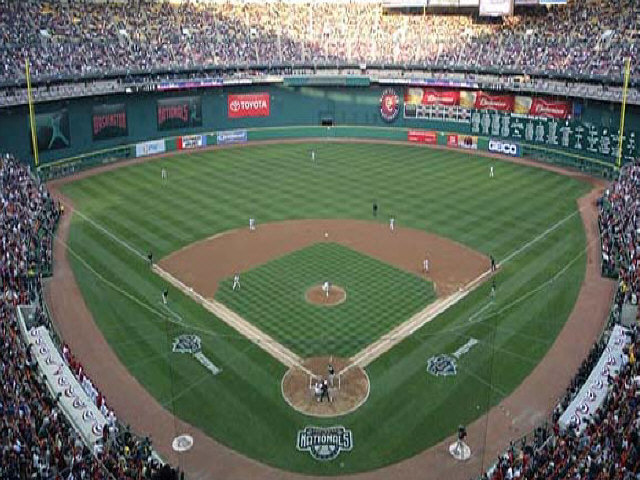 [September 20th] -- I haven't posted for a few days. It wasn't because of the poor play the last three or four games, however. I have begun to feel very melancholy about the impeding demise of RFK's baseball future.
Some are surprised that the Nationals were not able to fill the old girl up with well-wishers seeking to say goodbye. I'm not surprised, not one bit. One glance around the stands and it becomes obvious that the great majority of those who attend Nationals' games these days were born after the team left town, meaning that the stadium holds no sentimental value whatsoever to the vast majority of the team's fan-base.
And what about those of us who did attend Senators' games at RFK? Well, to be sure, we have memories of Frank Howard and Ted Williams and Claude Osteen and Don Zimmer and Tom Cheney, good memories to be sure. But RFK, to us anyway, was never a place where memories were easily formed. D.C. Stadium was scrubbed clean of any memory makers for the fans. There were no big green monsters, or short porches in right field, or "hit sign win suit" signs or nook and cranny's where balls would get lost. There wasn't any monuments in center or dark corners in the stands where you could be alone with your thoughts. Or your girl friend. No, D.C. stadium was all about neutrality. The stadium was designed to facilitate the game, not to become part of it.
So a stadium that was never loved, that wasn't used for baseball From the Nixon through the Bush administrations, is on the way out. Some of us will remember it, a few will miss it. But come next year, no one will reflect fondly on it's impersonal bowl, the seemingly endless concrete walkways, and that waffle-top roof that got you seasick if you stared at it for too long.
But let me tell you why I am going to miss the stadium, and it has little to do with unassisted triple plays and 500 foot homers. It's all about my youth. I was there when the stories began to run in the Washington Post and Daily News and Evening Star about this new "flying saucer of a stadium" that was going up on East Capitol Street. Baseball was being played there when my father would scream at me and call me names, and baseball was there when my mother died when both of us were too young for it to happen. Baseball remained through the riots following Martin Luther King's death and remained alive while Resurrection City came, and went, on the mall.
Neil Armstong walked on the moon and Richard Nixon became our president while my generation turned the stiles at RFK. Baseball at RFK was seven years old before Vince Lombardi came to town, and was still there when George Allen was hired by Edward Bennett Williams. Baseball was here when we lost John Kennedy, and his brother Bobby. When I hear Charlie Slowes say, 'Good Afternoon, and welcome to RFK Stadium...,' I remember the dark days of 1968, when the murders of Bobby and Martin turned the city against itself.
To me, RFK isn't a place, but rather a time. America lost its innocence during its run, it grew up from it's 'Leave It To Beaver' beginnings to become 'All In The Family.' 18 year-olds got the vote and the draft disappeared. At no time will America experience a decade like the '60's. That's a good thing, and a bad thing all in one.
So while I'm happy to see the Nationals move into their new digs, I only wish that the memories, both good and bad, could move with them. Regardless of the future, the new Nationals' park will never see the history that RFK did.
And that's why I'm a bit melancholy, why games are being played but stories aren't being written.
AMAZING
 [September 19th] -- What's happened at RFK the past two days isn't exactly like what Appalachian State did to Michigan, but it's close. The Mets came into town on a three game losing streak and in desperate need of wins to stave off the charging Phillies. The Nationals are finishing out the year with nothing to play for, save perhaps a bit of pride by not finishing in last place, something no one will remember a year from now.
I was supposed to be a one-sided series, and thus far it has been. But not this way.
Washington rules.
After the Mets went up on Joel Hanrahan and the Nationals 4-0 in the first, I turned to my son and joked, "We've got 'em right where we want 'em." I was kidding, but the Nationals weren't. A few hours later, the Nationals were winning and, later in the night, the Phillies beat the Cardinals to close within 1.5 games of the moribund Mets.
How weird is all of this?
The Nationals are now 68-83 and need to win just four more games to better last year's 71-91 record.
Now, that's all good, but last night's game wasn't all good news. Chad Cordero has begun to scare me. He loaded the bases his last time out against Atlanta before getting Chipper Jones to bounce into a double play. He blew his save opportunity the game before that. Last night, he came within one pitch of loading the bases after allowing a run to score to make it 9-8.
Now, let's be honest, here. Cordero has always been a Cardiac Kid. He's spent the last three years allowing baserunners before - usually - closing the door. We knew a slew of baserunners were going to reach when he pitched, but that they weren't going to score. We had confidence in Cordero.
That confidence, sadly, has now eroded. One and two run leads in the 9th make me uneasy and are no guarantee of a Nationals' victory. Cordero leads the league in blow saves this year and he isn't giving us any reason to believe that this is going to change anytime soon. Afterall, he's not really allowing more baserunners than before, he's simply allowing more of them to score.
Next year should be interesting. If the team is still a year or two away from respectability - or contending - then the team can stand another year of Cordero's uncertainty. But what if the Nationals start off strong and look promising only to be hamstrung by "the Chief's" blown saves? What will happen then? 72 win teams can afford Chad's miscues; 82 win teams cannot. Perhaps his future lies in the setup role as most of the other team's believe.
After seeing his batter average dip from .292 to .266 over the past month or so, Nook Logan is again make a push to keep his playing time in center field. He had two more hits last night and is now batting .271. Regardless of what he does the rest of the season, however, I don't see him returning as a starter. It's either going to be Ryan Church or a slugger obtained via free agency or trade. Logan, however, does look like a very solid 4th outfielder/pinch runner.
Speaking of late season comebacks, Ronnie Belliard, who dropped from .303 to .277, went 3-4 with that mammoth home run and is now back to .289. Will someone please explain to me why no one wanted the veteran infielder last winter? It must have been that "situation" and those allegations coming out of St. Louis of which he was eventually cleared. I can't imagine the Nationals playing this well since May without Belliard, especially after losing Cristian Guzman on June 24th.
I wanted to punch Bob Carpenter last night. "Maxwell swings and hits one deep to left .... how far is this one going to go? ..... (chuckling) well, it goes to the warning track and is caught. Gee, I thought that one was heading out." To be fair, I guess, most in the stands thought it was going out too. Maxwell, playing in any other park but RFK, would have three homers in September and 9 RBI's. Either that, or the kid has real "warning track power." Him and Willy Mays Hayes. Regardless, Maxwell has a beautiful swing; almost majestic. I hope he is the real deal.
Joel Hanrahan.
Enough said.
Stadium Update: The workers have begun attaching letters on the top of the arched portion of the stadium's scoreboard that will eventually read "Nationals" in the team's current, stylized jersey lettering. That tells me that the team is in fact not making any radical changes to the uniform for next season. There has been much speculation that "new ballpark = new uniform" even though the team failed to meet the filing deadline with Major League Baseball to make changes earlier this season. And that saddens me a little bit. While I've always loved the team's uniform, I've never been too keen on that arched lettering that looks like it was (and it was) created on a laptop in a hotel room one night. I understand that the lettering had to be arched to make room for all those letters, but there had to be a better way.
Hopefully, the letters on the scoreboard will at least be the same size.
NATS CONTINUE PUSH TOWARDS 72
 [September 17th] -- It took me two innings to recognize him, which was really two innings too long for a team blogger. But sure enough, there was former National Brian Lawrence on the mound for the New York Mets last night. Really. He was a National. Well, sort of. Does one day count? He injured himself on the first day of spring training last year and we never saw him again in a Nationals' uniform. This picture, taken moments after both he and the team found out about the season-ending-before-it-began injury. was the highlight of his time with the team. I had predicted great things for Lawrence. I thought he'd be the #2 starter behind Patterson and I predicted a 13-8, 3.89 season.
 Missed it by that much.
I knew he signed a minor league contract with the Rockies last winter, but hadn't heard about him again until last night.
How 'bout them Nationals?!
With 67 wins, the Nationals now need to go 5-7 the rest of the way to surpass last year's win total of 72. Think they'll do it? I think that if they beat the Mets one more time in this series it should be a lock. The Nationals are now two games up on Florida for "worst of the East," which really amazes me. By all accounts, the Marlins lineup is much better than the Nationals; they have all those young players at the major league level now that we (hope to) have in the minors. As of right now, Mike Jacobs, Dan Uggla, Hanley Ramirez, Josh Willingham, Cody Ross and Jeremy Hermida all start on the Nationals. If I was really honest, I'd also choose Miguel Cabrera over Ryan Zimmerman (at this moment in his career). The only National who would be on my team is catcher Brian Schneider. And the pitchers? All young, and all pretty good.
So how come they are in last place? Now, what was the name of that manager last year ...?
Tim Redding's star isn't glowing quite as brightly as it was a month ago. I think we're now beginning to see the real Redding, a pitcher who can be dominating but usually isn't. At least, he didn't last night, allowing 4 runs and 6 hits in 4 innings (though to be fair, his last three innings were very good). I think his chances for staying in the rotation next year remains only because Joel Hanrahan hasn't been able to find the plate in 3 out of his last 4 starts. It seems that managers tend to forgive pitchers who give up too many hits, but not pitchers who give up too many walks.
And that would be Hanrahan. And oh, by the way, he's pitching tonight against John Maine. Will he continue to miss the strike zone? My guess is that - if past performance is any indication - that he'll come back with another beauty of an outing and tantalize us yet one more time before breaking our hearts one more time.
Apparently, friendship never ends. Remembering his good friend Ryan Zimmerman's struggles with the glove a week or so, David Wright decided to honor him by throwing wildly to first himself, then getting his team to commit three more miscues along the way. Four errors in game. Wow. Your welcome, Ryan.
That doesn't even come close to the six they committed two games ago, however. That's ten in two games. That's really very, um, Washingtonian of the Mets. That's also four losses in a row for the Gothom's, and the Phillies - the team of Del Ennis - are only 2.5 games back in the standings (Aaron Rowand hit his 25th and 26th homers of the year by the way, making him even more expensive as a potential free agent).
The Nationals drew less than 19,000 last night. The Mets are in town, RFK's days - like sand in an hour glass - are slowly dwindling down and the boys are playing for pride, and the team draws one of their smaller crowds of the year. Had to have been the Redskins - Eagles game, which is a shame. The Nats are the clear #2 team in D.C.. Just look at the Washington Post's sports page. Even on off-days, the Redskins get front page treatment while Nats game stories are buried on page three or four.
Until the press, and some of the fans who don't know better, fans who grew up as baseball orphans, think Nationals first, this is going to continue to happen. My greatest hope would be a playoff game in the new park in a year or two with 41,222 fans in the stands while Fedex Field is looking a lot like Dolphin Stadium during a Marlins' game. Okay, of course that'll never happen. But a few empty seats .... please .....
Speaking of the whole football - baseball thing, the Nationals announced that the press box in the new park will be named after Shirley Povich. That's wonderful. Povich was "the voice of baseball," meaning that unless Povich said it was so, it just wasn't. If Povich anointed a young rookie, he was going to be a star. It was kind of like Howard Cosell. No matter how good your team played, no matter how good a particular player did, it was just as if it didn't happen unless Cosell talked about it on Monday Night Football. By the way, kiddies, dig this: Back in the first few years of MNF, no one could show taped highlights of the games until after MNF's halftime, when Cosell would narrate that week's highlights. Warner Wolf would show still images of Sonny and Billy and Chris and Jerry as he reported on channel 9. Can you imagine that today? I can't remember for sure, but I suspect the NFL threw that bone to MNF to coax them into doing the game. Most of my friends thought an NFL game on Monday night was pretty weird, and it took us a while to warm up to the idea. But man, the first time Dandy Don Meredith sang "Turn out the lights, the party's over" (indicating the game was no longer in doubt) I got chills. The first time he sang it for the Redskins, by the way, was during their 38-24 win over the Los Angeles Rams in 1971. That was the first meeting between the two teams after the big trade and all the "Ram-Skins" stuff was still very hot.
But, I have digressed. Looks like I too can become a feeble-minded Redskins minion at the expanse of my beloved Nationals.
Ryan Church!
Aaaaahhhhhhhhhhhhh.
See? It happ ens every time. Just say his name and people's faces begin to contort and toxic gasses emanate from all kinds of orifices. Manny said a couple of months ago that he knew what Ryan Church had to offer, and he wanted to see what Nook Logan could do.
What if that had never happened .... what if Church had remained in the lineup for the rest of the season. What kind of numbers would he have put up? Take a look (based on 580 at bats):
AB: 580 -- R: 71 -- H: 154 -- 2B: 49 -- 3B: 2 -- HR: 18 -- RBI: 80 -- OBP: .342 -- AVE: .266
Now, if Manny Acta knew that's what he could get out of Church, and knew he'd be able to produce those types of numbers, then why did he put in a guy who has the same batting average but could never come close to any of those other numbers? Sure he's fast, but that speed doesn't translate very well to defense when Logan continues to make bad reads on the ball.
It seems to me that Ryan Church is a better starter and Nook Logan a better 4th outfielder.
Here is what next season's outfield could produce (tinching up the stats a wee bit for the new, slightly smaller park):
LF - Wily Mo Pena: .275 - 35 - 100
CF - Ryan Church: .268 - 20 - 80
RF - Austin Kearns: .274 - 25 - 85
Um, what's wrong with that exactly? With the smaller outfield, Church's lack of speed in center will be more than made up for by his better fundamentals. And Church's numbers aren't speculative. Over a full season, here is how his last three years would have looked:
2005: .287-18-84 (.353 OBP)
2006: .276-28-95 (.256 OBP)
2007: .266-18-80 (.342 OBP)
I know that Ryan Church isn't the sexy choice for centerfield next season (is that the first time you've seen the words "church" and "sexy" in the same sentence?) but it may be the wise choice. Were the Nationals to sign, say, Torii Hunter, for $14 million a year, they'd get six or seven more homers and ten to twenty more RBI's (plus a great defender) at a net cost of about $13.5 million.
As much as I want the Nationals to prove to me that they will sign big-name free agents, I'm just not sure that center is the place to do it. Now, I'm not suggesting I have the answer because I don't. I just can't see spending that much money on that much more offense.
What do you think?
It seems that Mike Rizzo - through Jimbo - is trying to pull of some more "minor transaction" magic. The Nationals claimed Diamondbacks pitcher Enrique Gonzalez off the waiver wire yesterday. Gonzalez, 25, had a bad year in Arizona, both in Phoenix and Tucson. Prior to his 8-10, 5.15 2007 'AAA' season, however, Gonzalez had a career minor league record of 25-19, 2.89. During that time, his hits + walks per 9 innings (WHIP) was never higher than 1.31 while striking out almost 8 batters per 9 innings.
Who then, do you believe? Do you accept his bad 2007 as a sign of regression or do you trust the previous six seasons of solid work plus his former boss wanting him in Washington. Two years ago, he was the Diamondbacks #11 prospect. Garrett Mock was #9 and Matt Chico was #20.
It gets interestinger and interestinger.
CHICO, LEFAVE BRING HOPE FOR THE FUTURE
 [September 15th] -- Well, I certainly enjoyed my little mini-vacation away from blogging. You know, warm temperatures and water everywhere. Too bad the warm temperatures came from my body (102 degrees) and all that water kept streaming out of my nose. One of the worst cases of the flu I've ever had.
That being the case, I still watched the Nationals ply their trade, though my ever-lasting sneezing and wheezing made those three losses in a row especially hard to watch. Hard not because they lost, but because they could have - perhaps should have - won all three. Had they just won those two extra inning affairs, the team would have a record of 68-80 record this Sunday morning and be in great shape to surpass last year's 71 wins. As it is, the Nationals need to go win six of the teams final 12 games to reach 72 wins. If they play .500 ball the rest of the way - something they've done since their 9-25 start, they'll end the season with a record of 74-88, which is just too much to ask.
Isn't it?
One thing to remember, though. The Nationals have yet to win even a single game in either of their two final series, In 2005, they went into that final series with an 81-78 record and seemed sure of a winning record. Last year, a sweep would have given the team a 74-88 record, certainly respectable considering all the injuries the team had to deal with.
What will happen this time around? Well the good news - I guess - is that they are concluding their season on the road, something new for the team.
My prediction (for what it's worth considering I'm so full of NyQuil that I can't see straight): The Nats split their final homestand (five wins) and win two of their remaining six road games.
With that, the Nationals will end the season with a record of 74-88. And that, my friends, will be something to be proud of (for the record, I predicted a 63-99 record on opening day).
Matt Chico showed me a lot the other night against the Braves. After giving up three runs in the first inning - and looking like he reverted to overstepping on his delivery - Chico shut down the Braves effectively the rest of the way. What could have been a real blow to Chico's chances to return to the starting rotation next year ended a quality start: three runs in six innings.
Take a look how Chico has faired in his three starts since returning from Columbus:
Starts: 3 -- IP: 19 -- H: 16 -- ER: 4 -- BB: 3 -- K: 12 -- % of pitches for strikes: 66% -- ERA: 1.89
Pretty amazing, huh? Now, compare that to his previous three starts before getting sent down:
Starts: 3 -- IP: 14 -- H: 15 -- ER: 11 -- BB: 14 -- K: 10 -- % of pitches for strikes: 56% -- ERA: 7.07
And that is the proverbial "night and day difference." Why? How could a few games in Columbus straighten out somet hing that took most of the summer to occur?
You got me.
Some pitchers slowly get better and the transformation from young and inexperienced to a master of their domain is almost seamless. Others toil for sometime before finally "getting it." Jim Palmer was the former, Sandy Koufax the latter. Koufax was just another National League pitcher from 1955-1961, when he went 54-52 with a 3.80 ERA. Then, as if someone threw a switch, he became the most dominant pitcher of his era, going 111-34 with an unbelievable 1.98 ERA (the league average then was 3.22). How'd he do it? He basically cut his walks in half. After averaging nearly 100 walks per season before 1962, he was down in the mid 50's over his final five years.
How did Chico manage his turnaround (at least so far)? He cut his walks down from one an inning in his August starts to one ever six innings since his return. He's no Sandy Koufax, that's for sure, but he just might be that solid number three starter that we had hoped for.
NOTE: Jason Bergman's return from the minors/DL has also been successful, but for a different reason. His four July starts were horrid; he he gave up 23 hits in 18 innings and had a ERA of 8.00. Since his return, Bergman has been much better, going 3-0 with a 3.66 ERA. He's allowed just 22 hits in 25 innings and three of his four starts have been "quality starts." But take a look at his control: both his walks per 9 innings (3) and % of strikes thrown (64%) are the same in July (8.00 ERA) and since his return (3.66 ERA). His problem, unlike Matt Chico, has been location, not control.
Andrew Lefave for Ray King? Wow. I know, I know. He was a 23 year old last year in a league full of 18 and 19 year olds. True, but so was Justin Maxwell, and he seems to be doing very well for the Nationals. What I can't figure out is why this good a hitter didn't get drafted, and why his first opportunity to play professionally was in the end-of-season Arizona Fall League at the age of 22. None of the scouting web-sites shows that he even went to college which makes his age even more of a question. Where was he all that time?
According to some, Lefave is an anomaly, his career .347 average not withstanding. The USA Today reported the trade and said that Lefave "doesn't have a chance to reach the major leagues."
Really? Based on what?
Now, I shouldn't be too hard on them; apparently the Brewers don't think he has a chance either or they wouldn't have traded him to the Nationals for a rental player that can't even play in the post-season, a guy who said he'd love to return to Washington next year (though the way Arnie Munoz is playing ....).
Here are his 2007 stats converted for a full major league season (minor league numbers are deceiving because of the fewer games played):
G:158 -- AB:592 -- R:126 -- H:204 -- 2B:35 -- 3B:0 -- HR:24 -- RBI:110 -- SB:17 -- AVE:.345 -- OBP:432
Very impressive, indeed.
At first blush, his numbers have a John Olerud or Sean Casey feel to them. In 1998 while with the Mets, Olerud batted .354-23-93 with a .447 OBP. That said, Olerud only played three games in the minors and made it to the majors at the age of 20.
Sean Casey's first 550 at bats produced similar numbers at Class 'A.' He batted .331-14-94 with 48 doubles and a .402 OBP. Casey was 21 playing against teenagers.
I'm not suggesting that Lefave is going to be a star, but neither can I say that he doesn't have a chance to play at the major league level. Yes, his age is a bit of a concern, but Lefave has shown he can hit (.354 & .345 in two minor league seasons) and if he continues at that pace - or close to it - he'll make up for the late start. He'll almost certainly start at 'AA' Harrisburg, replacing Josh Whitesell who will almost certainly replace Larry Broadway, who is almost certainly on his way out of the organization. If he hits .320-15-80 or so with an OBP over .400 next year, he'll likely be given a shot at making the major league roster if (if if if) Nick Johnson is no longer a viable option for the Nationals.
Lots of if's, but then, lot's of hope too.
NATS NOTES: With the explosion of Ryan Braun in Milwaukee, I have begun to wonder if Jim Bowden made a mistake by choosing Ryan Zimmerman as the tea m's 1st round pick because he was "most ready" to make it to the major leagues. Braun, who has played in only 98 games, is on pace to hit .324-35-95 this season. The Brewers took him with the next pick in the 2005 draft. In other words, the Nationals could have had him if they wanted him.
Poor choice?
No way.
Zimmerman has never been looked at as a slugger. He'll likely bat .300-32-120 over the next decade, ideal for a #3 hitter. Braun will likely be a better slugger.
It's defense, however, that makes Bowden's choice of Zimmerman sound (I'm forgetting those 23 errors; it's an aberration). Let's compare the two third baseman's stats for the year (I have extrapolated Braun's 98 games out to 147, the same number Zim has played):
Putouts: Zim:123 -- Braun:78
Total Chances: Zim:459 -- Braun:318
Assists: Zim:313 -- Braun: 207
Errors: Zim:23 -- Braun:33
Fielding %: Zim:.950 - Braun:.896
Their minor league stats are almost identical as well. Braun has a .898 fielding percent in 182 minor league games while Zimmerman has a .965 percent in 47 games (Zim's .965 is identical to his 2006 stats, numbers that more closely resemble his real ability).
Zimmerman is a sure-fire future gold glover while Braun is going to hurt the Brewers with his bad defense. So, the Brewers can have Ryan Braun, though there is little doubt that Braun will become a 40-40 player.
40 homers, 40 errors, that is.
MAXWELL JUST GRAND
 [September 12th] -- Well, that wasn't a particularly pleasant game to watch, now was it?
Actually, I'm not going to grouse about the Nationals' poor pitching; the law of averages says that games like Tuesday's are going to happen regardless of talent or timing. The idea is to limit them to a manageable few, something the Nationals have done very well this season. The last one that sucked this bad was against the Rockies on August 25th. Once every two and a half weeks? I can live with that.
Ryan Zimmerman seems to have a stop-gap built into to his persona. Just as he's about to tank and slip back into his first half statistics, he has a night like Tuesday. Zimmerman went 3-5 and raised his batting average back up to .269. Notice here how important it is for him not to go into a prolonged slump to end the season. Three hits and average jumped just three points. An 0-20 skid this late in the year will just about guarantee a sub-Zimmerman batting average come season's end.
Wily Mo Pena showed last night 1) why he has the capability to be a star with this team and 2) why he's 25 and never started a full season. After getting two hits and driving in two runs to begin the game, he struck out twice, both times on three pitched balls. He also left five runners on base. I guess the reason why his strikeouts bother me so much is that he looks so bad doing it. When Zimmerman fans, he at least looks like he has a plan - as if he knows what he's doing. Pena looks lost. I've noticed that once he swings and misses on a low-and-away slider to begin an at-bat, he will continue to swing and miss at that very same pitch until he's back in the dugout. With an 0-2 count, it seems that everyone in the stadium knows what's coming next; everyone except Pena of course.
So, what's to think about Justin Maxwell? Fresh out of 'A' ball, he's hit a ball deep enough that would have gone out of any park but the one he was playing in, struck out on three pitched balls (and didn't look very good doing it) and, after looking bad on two pitched balls, blasted his first hit - a grand slam - on Tuesday. Was it luck? Was it talent? Maybe a little bit of both. Manny Acta said that the ball that Chris Seddon threw was "three feet" away from where he wanted it. Maxwell, then, slammed a down-the-middle fastball for his first major league hit.
Who cares?
The kid hit a grandslam in his third major league at-bat and deserves the opportunity to start a game or two the rest of the way. I doesn't happen often, but players have made the jump from 'A' ball to the big leagues and thrived. Kent Hrbek is one that comes to mind. I have no doubt that the Nationals would like to find out if he can make that jump. If he plays more in the coming three weeks, then the team is giving him a trial run for next year. If they don't, he'll start in Harrisburg next year for sure.
Below is a story I wrote about Maxwell a few weeks ago. I thought it might be a good time to reprint it.
When the Washington Nationals played their inaugural season in 2005, I payed close attention to the National's minor league teams. Oh, I didn't look at the individual players; there wasn't anyone to keep tabs on. No, I would check in and see how the teams were doing in the standings. These days, however, things are different. I couldn't care less about team records. Each evening, I scour the box scores to see how our prospects are doing. Chris Marrero, the Nationals' top draft pick last year, continues to dominate. Marrero, 18, has not only been named the best hitting prospect in two different leagues, but now Baseball Prospectus has anointed him as the second best corner outfielder in all of minor league baseball. He's great now, will be great in the future, and darn well should be as a number one pick. That said, Justin Maxwell - on the whole - is having a much better year.
Go figure.
The Nationals signed outfielder Justin Maxwell in the 2005, the team's second overall pick, taken in the 4th round of the draft (The Nationals lost their 2nd and 3rd round picks when the signed Cristian Guzman and Vinny Castilla). Maxwell, who graduated from the University of Maryland, had rebuffed the team's efforts to sign him because of the contract's structure and not its financial considerations. Team officials described the negotiations as "amicable." My guess is the contract addressed his injury plagued seasons of 2004 and 2005. Injuries in those two years robbed Maxwell of what would have been a sure first round selection in the amateur draft.
An inside fastball during spring practice in 2004 broke a bone in his forearm, forcing him to miss the entire season. He tried to play in the Cape-Cod League that summer but broke a finger there effectively ended his year.
Seven games into Maryland's 2005 season, he broke a bone in his hand, ending his collegiate career. Nationals GM Jim Bowden drafted him not on what he had done during his career, but rather what he could do. The term "high risk, high reward" fits Justin Maxwell perfectly.
Maxwell has been a star at every level. He played in the Cape-Cod League in 2004 and hit .307 with 47 hits and 2 home runs. In his abbreviated 2005 season at Maryland, the 6'5", 220 lb outfielder batted .455 with 3 home runs and 10 RBI's. He started the 2006 season at low-A Savannah, but struggled, hitting just .172 in 58 at-bats. And those struggles weren't surprising considering how few games he had played over the last four years. He joined Vermont when their short season started, and played very well, batting .269-4-33 with 20 stolen bases. The Lake Monster's general manager told me last winter that Maxwell was his favorite player.
 He was drafted in 2001 by the Orioles, and again in 2004 by the Rangers. Texas scout Grady Fuson called Maxwell "one of the top college players" in 2004, and said that Maxwell "could very well be one of our most important selections in some time." Maxwell didn't sign with the Rangers.
Maxwell is both powerful and fast, and is often compared to former Met great Daryl Strawberry. His swing has a high arc, allowing him to not only drive balls, but drive them very high and very deep.
While his physical tools might be compared to Strawberry, his personality is more like Cal Ripken, which is good for him and great for the organization. Sean Welsh, GM of the Bourne Braves, a summer-league team Maxwell played for two seasons ago, said that he's as apt to be reading his Bible as he his sanding his bats in preparation for the next day's game.
Things could change, but - for now anyway - Justin Maxwell is looking to be more "reward" than "risk." The problem with him - if there is one - is his age. Maxwell is 23 and playing against kids four or five years his junior. Common sense suggests that Maxwell should be overpowering the opposition. How would he do against, say, 'AA' competition? I guess we'll know next year. One thing that Maxwell doesn't want to do is end up being a 26 year old rookie. Kory Casto was a 25 year-old rookie this spring and was given an opportunity to play with the Nationals, an opportunity that went poorly. Now remember, this was the team's top minor league prospect the past two years. He gets 54 major league at-bats and since then, no one has mentioned his name as being part of the team's future. Why? Because he'll be 26 next spring and doesn't have any more chances to screw up. Chris Marrero was an 18 year old at Potomac. Kory Casto was 23. So is Maxwell.
If Justin has any hopes of making it to the major leagues, he needs to accelerate his advancement and go into spring training 2008 ready to compete for a job.
He doesn't want to be a 25 year old rookie.
Just ask Kory Casto.
NATS BEAT MARLINS, MONSOON
 [September 11th] -- Allow me this opportunity to remember those who lost their lives on this day six years ago. Six years? Wasn't it just yesterday that a united Congress stood on the steps of the Capitol building and belted out their impromptu rendition of "God Bless America?"
Regardless of which side of the aisle you may be, regardless of whether you believe the war on terrorism has been properly prosecuted or not, let us together keep the memories of the fallen within our hearts this day.
Okay. Let's play ball!
For the past week, I have been railing on Wily Mo Pena, saying over and over that the last thing this team needs is a one-dimensional player who can't do anything other than hit mammoth home runs every now and again. We want Church! We want Church!
Did I say that?
I don't like players who tease me with their talent, who pretend - for a game or a series or a week - to be stars. Just when I'm ready to pull the plug on WMP, he walks, singles to right field and hits two long home runs. He's now batting .263-7-13 in 72 at-bats with the Nationals. Do a bit of extrapolating, a tinch of mathematics, and voila: we can figure out his production based on a full season: .263-40-80. That's great. He's also projecting to about 160 strikeouts, not really as bad as his past would indicate.
I think that Pena could really help the Nationals next year, that he can hit 40+ homers and drive in 100+ RBI's. But he could also stink really bad, strike out 200 times, and make us wish that Ryan Church was still with the club (trust me, if Pena starts in left, Nook Logan will be the 4th outfielder and Ryan will get traded somewhere). And without Church, and without a productive Pena, any hope of the Nationals approaching, and surpassing, the .500 mark would be gone. I guess I can live with Pena in left next year, but please, Jimbo, have a plan 'B' just in case.
Shawn Hill is a stud. He's learned how to win when he doesn't have his good stuff (last start vs. Florida: 6.1 innings pitched, 11 hits, 6 strikeouts), and when he is sharp, he's pretty much unbeatable. He pitched 6 innings on Monday, allowing 4 hits and no walks while striking out 4. He didn't walk a batter for the second straight outing. With each passing game, Hill is slowly but surely turning himself into the team's #1 starter for next season. The question then becomes his health. Will he, after two straight years on the disabled list, be able to start 30-35 games next year? If he can - if he does - then the Nationals' rotation will be strong next year.
Just when we thought that Ronnie Belliard was about to slowly sink into the Potomac, he goes 3-4 and raises his batting average back up to .282. I never thought he was going to hit .300 (he has a career average of .272), so the .282 looks great to me. However, after averaging 14 homers a year the past four seasons, he's on pace to hit 11, but that can be attributed to playing at RFK instead of Jacobs Field (and playing a few less games). If he returns next year as a starter, it's not a stretch to assume that he'll hit 14-16 homers at the new ballpark. Please please please, Jimbo, let Ronnie be the starting second baseman next year.
The Nationals are now 65-79, four games out of last place, and on track for 73 wins. That would be an astounding feet considering this is a team rebuilding for the future. If they can sweep the Fish, they would need only five wins the rest of the way to better last season's 71-91 mark (a record of 5-11). And that's without Alfonso Soriano, Jose Vidro, Jose Guillen, Nick Johnson ......
PUT ME IN COACH, I CAN PLAY ... CENTER FIELD
 [September 10th] -- In the coming months, the Washington Nationals will have some tough decisions to make, the most prominent being who will be the team's opening day center fielder next season. Who ever they choose (if indeed they do choose one), the cost is going to be exorbitant. Will it be worth it?
Let's take the case of Alfonso Soriano. Obtained in a trade for Brad Wilkerson et. al. two winters ago, Soriano stunned the baseball world last year by 1) playing an adequate left field and 2) turning into a real slugger, batting .277-46-95 with 41 stolen bases. He signed with the Chicago Cubs last fall for $17 million a year over 8 years ($136 million dollars in all).
Going into Monday night's game, Soriano is batting .295-24-53 with 18 stolen bases and a .332 on-base percentage. That's not a lot of return for $17 million, is it? To be fair, he's only played in 116 out of the Cubs' 142 games played. That said, based on playing every game, Soriano's numbers are still not worth $17 million; he'd end up the year .295-31-69 with 22 stolen bases.
For Cubs' fans, Soriano isn't judged by the size of his contract because the team can afford a dozen Soriano's if needed. The Nationals, however, cannot, and the Nats' faithful would be howling had he signed here for that kind of money and than reverted back to the player he was with Texas and New York (that being a good -- not great -- player)
Given that, what then should the Nationals do regarding the hole in center field? Yes, Nook Logan has played well, but he doesn't provide enough ooomph in the lineup; the Nats are bat-barren and can't afford a sub-singles hitter in center.
Going into this season, there were several star center fielders that would have been available in the free agent market. Two of them, Eric Byrnes and Ichiro, resigned with their teams earlier during the season. That leaves Aaron Rowand, Torri Hunter and Andruw Jones as the team's three best hopes for a productive center fielder.
So who's the best fit for the Nationals?
Aaron Rowand: Age 29 -- 2007: On pace to hit: .316-26-91 w/.382 OBP
Rowand, who was traded to the Phillies by the Chicago White Sox in the Jim Thome deal, is a ca reer .286 hitter, but his yearly averages fluctuate a great deal. He's as apt to hit .316 as he is .262. His power numbers have increased in the past few years, averaging 17 homers from 2004-2006. He plays solid defense, though it's nowhere close to the level of Andruw Jones and Torri Hunter. He is a very hard nosed player and because of his willingness to run into walls, he can't always be counted on to play a full season. Estimated Cost: $12-$14 million a year
Torii Hunter: Age 31 -- 2007: On pace to hit: .290-32-112
At 31, Hunter is the 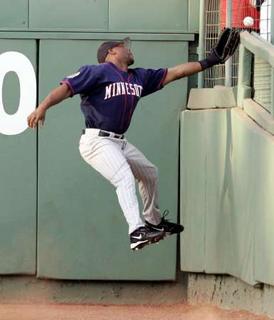 oldest of the three players. Though he has power (he's averaged 25 homers a game the past 6 seasons), he's not much of an average hitter, which really surprised me. His career average is just .271. Another surprise: he doesn't get on base as much as I thought, as his career .324 OBP indicates. His defense is every bit as good as Andruw Jones, which says a lot. Estimated Cost: $14-16 million a year
Andruw Jones: Age 30 -- 2007: On pace to hit: .223-27-96
Oh boy, this could be trouble. Jones has a long and valued frie ndship with Pat Corrales and respects former boss Stan Kasten. He has recently said that if he has to play somewhere other than Atlanta, he might as well play with the people he knows. That would be us, I think. To be sure, Jones didn't become the 5-tool super stud that everyone thought he would be in 1996. I expected him to put up A-Rod numbers over the last decade and he hasn't. And he won't in the future. His career batting average is just .263 and he sports a .342 OBP. Since 2001, he's hit above .263 just once. You would think that he'd be available more cheaply because of his off year, but most baseball insiders have said that he'll probably end up costing more than Soriano did last year. More than $17 million a year? Sheesh. Estimated Cost: $18-20 million.
So, who do the Nationals go after? After a month of watching Wily Mo Pena flail-n-fail on off speed pitches, I'm not sure that I want another all-or-nothing player in center. Andruw Jones is not the same player he was six years ago, and I just don't believe he's going to be worth Soriano-type money. Torii Hunter is a great player, but - again - I'd like to add a player who gets on base on a regular basis and .324 is just too low, especially if Pena is a starter next year.
I think my vote goes to Aaron Rowand, especially if the Nationals bring in another thumper, someone like Adam Dunn. He gets on base, he hits for enough power, he can steal bases when needed, and goodness knows that he isn't afraid to run into walls for his team. If the Nats can sign him for, say $12 million a year, the team would still have another $10 - 15 million for another bat or bats to round out what will be a pretty impressive lineup.
Unless something very very weird happens, the pitching staff is all but set with players currently under contract (both major and minor leagues). As of right now, there are only two positions up for grabs, center and left (assuming Pena isn't the answer). Trade Pena and a pitching prospect or two for a slugger. Sign a slugger. Kidnap a slugger. Add him and Aaron Rowand to the mix and the Nationals will be an above .500 team. How much above .500 depends on: 1) if Jesus Flores continues his maturation, 2) if Ryan Zimmerman blossoms next year, 3) if Austin Kearns fulfills his promise of being a .275-25-90 player, 4) and if Shawn Hill becomes a real #1 pitcher while Jason Bergman and Matt Chico pitch as well as they are now.
Aaron, Aaron, he's our man, if he can't do it ......