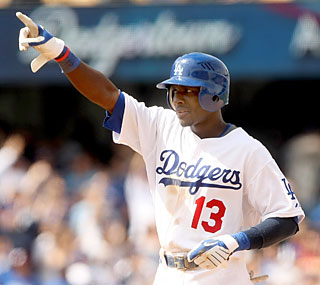
THE RETURN OF LUIS ATILANO
 [August 31st] -- I noticed the name of Luis Atilano among the forty-some players who have been invited to participate in the Nationals' fall instructional league this fall in Viera. Mark Zuckerman listed the 22 year old pitcher as being "among the organization's top prospects."
The name didn't ring a bell, so I looked up his 2007 stats. He pitched 1.1 innings for the GCL Nationals, allowing 1 run while striking out 2.
What? 1.1 innings and he's one of the team's best prospects?
Then I remembered.
A year ago today, the Nationals acquired Atilano from the Atlanta Braves for pinch-hitter deluxe Daryle Ward. Here's what I wrote last August 31st following the trade:
"Atilano, 21, is a 6'3", 200 pound right-hander who appeared on a medium-fast track to Atlanta before Tommy John surgery ended his season earlier this month. It can take up to a year for a pitcher to return to form after this type of surgery (the bad news) but virtually every pitcher who has had it returned at near 100% (the good news). Atilano went 6-7, 4.50 with class 'A' Myrtle Beach, striking out 45 in 116 innings. Going into this season, he had a career minor league record of 16-12, 4.11 garnered over three seasons (2003-Gulf Coast League, 2004-Danville, 2005-Rome). He was certainly considered a prospect. From bravesscout.com: (from 2005) "How good might this guy be in two years? The control is tremendous and he continues to show why the Braves drafted him so high last year ... the Braves believed they had another Javier Vazquez when they drafted him, and they still feel that way. As he continues to mature physically, his fastball is only going to get better and more consistently in the mid 90's. When you look at his numbers, including his age, you just see a potential success story in the future." But wait: there's more. From Baseball America's 2003 draft review: "Atilano has two solid pitches and an ideal frame that could make him a solid middle-of-the-rotation starter. Atilano, 18, has an easy arm that produces a cutting fastball with excellent movement. Though skinny at 6-foot-3 and 180 pounds, he should get stronger as his body matures, which should make his fastball more effective and possibly sit in the 93-94 mph range. Atilano also throws an above-average changeup with good depth and fade. The Braves like his mound presence and competitiveness, traits that led the Major League Scouting Bureau to grade him higher than any other player this year in Puerto Rico."
I assumed that Atilano wouldn't return until next spring, so it's great news that he's pitched this year. Although he hasn't been on any of the Nationals' pitching-prospect lists this year, Atilano certainly deserves to be listed among the kiddy-corps hopefuls. Said Bowden last year when the trade was disclosed, "We are thrilled to add a pitcher of Luis Atilano's potential to our ever-growing stable of young pitchers. We have full knowledge of his recent surgery, but feel the potential risk is well worth the reward."
If he's healthy, he has as much chance of reaching the Nationals' starting rotation as any of the other minor league hopefuls.
Luis Atilano: kind of like finding loose change under your couch's cushions.

A LOSS IS A LOSS IS A LOSS ....
 [August 28th] -- The first part of the Nationals' current roadtrip gave us a glimpse of how good this team could be in a season or two. The current part, however, is more reminiscent of how things have been in the past. You know, The '20's, the '30's, '40's, '50's, earlier this season .....
As always, wins and losses are meaningless at this point; we have to look between the lines of the boxscore to see what's happening that's good .... and what's not so good.
Mike Bacsik pitched another poor game, giving up 5 runs in 5 innings, but that's not a bad thing, as his future with the Nationals - if he has any - is in the bullpen. That he didn't pitch well isn't a harbinger of anything good or bad. He's a warm body doing his best. His personality will be missed in the coming years, but not his arm.
Ryan Zimmerman is back. After a half-season of looking lost and bewildered, the kid is back on schedule to becoming the Nationals' first home-grown superstar. He hit is 22nd homer last night and continues to look good at the plate. Zimmerman is now on pace to bat .273 with 26 homers and 95 RBI's. I must admit, I was beginning to have doubts as to whether Zimmerman was going to be a offensive force in the years to come. I thought that - perhaps - he'd be another Graig Nettles, a guy with a superb glove and a "good enough" bat. Looks like I was wrong.
Again.
Wily Mo Pena is showing us that he just may become the player we thought Austin Kearns would be. Kearns was supposed to be a 30 homer - 100 RBI guy for years to come, but it seems that much of his potential was inflated by that teeny-weeny ballpark in Cincinnati. It appears that Pena has the power to hit homeruns everywhere and anywhere. I wouldn't be surprised next year to see Pena bat 5th and Kearns 6th.
That Pena is a better hitter than Kearns doesn't mean that Kearns can't be productive. I wouldn't be surprised if Pena bats .265-40-100 next year. That said, I wouldn't be surprised if Kearns hits .270-23-80 for the Nationals next year. If the guys in the middle of the lineup hit as expected/hoped, Kearns will provide all the production the team needs in right.
This 'N That: Remember this year's first round pick, that lefty pitcher that who's been overshadowed in the news the last couple of weeks by the signings of Josh Smoker and Jack McGeary? Name was Detwiler as I remember .....
Ross Detweiler's first game for Potomac was "okay," giving up 2 runs in 4 runs. His second game, against Wilmington, was horrid, allowing 7 runs in 2 innings. Since then, he's been near perfect. After allowing just 3 hits and no runs in 6 innings against Kinston, Detweiler pitched 6 innings a couple of days ago against Myrtle Beach, giving up just 2 hits while striking out 3. Looks like he's back on track to get a look-see with the big club this September.
Justin Maxwell continues to make a comeback with the Nationals after pulling a rib cage muscle while sneezing. His batting average dropped to .203 before a late season surge has seen his average rise to .262. He hit his 10th homer two nights ago; he is now hitting .282-24-76 for Hagerstown/Potomac along with 24 stolen bases. Man, I just wish he was a bit younger. At 23, he's hitting against kids 3-4 years younger than he is.
Shairon Martis, the 20 year old right-hander obtained form the Giants last year for Mike Stanton, is now 13-8, 4.47 for the P-Nationals. In 143 innings, he's given up just 146 hits, an excellent ratio for the low minors (and a very good ratio for the major leagues). Martis has the makeup (and the youth) to learn his trade in the minors and still get to Washington a young man.
While several of the Vermont Lake Monsters' stud pitchers have had a rough going of it lately, Colton Willems continues to shine. He pitched 5 innings last night, giving up six hits but no runs, and dropped his ERA to 1.84.
SHELL SHOCK
 [August 26th] -- Were this to have been Joel Hanrahan's last game of 2007, some baseball statistician a hundred years from now would probably look at his 5.90 ERA and thought, "Geez, that guy had a bad year."
Nope. Just one bad game.
Hanrahan, who had pitched well in his stay with the Nationals, was bitten by the same bug that has bothered him his entire professional career. Hanrahan walked five men in two innings while looking bewildered on the mound; this from a man who entered the game with a 3.42 ERA.
The only thing that has kept Hanrahan - who has great stuff - from success at the major league level has been in his control. He's averaged nearly 4.5 walks per 9 innings during his minor league career and is now allowing nearly six walks per 9 innings this year. Hanrahan allows only 1 hit per 9 innings, a tremendous figure, a figure that gets skewered with all those walks.
One thing we can be sure of: Joel Hanrahan will continue to have control problems throughout his career, and unless he keeps his hits per 9 innings well below 1 per inning, he's never going to have a chance to remain in the rotation. And that's such a shame. He looks like a pitcher. When he throws strikes, he has the makeup of a #2-3 starter. But when he can't find the plate, bad things happen.
Like today.
That said, I have confidence in Hanrahan. He is a 14-12, 4.10 kind of pitcher. He'll look like Cy Young when he wins and Cy Vance when he looses (that make escape those of you not old enough to remember the Carter Administration).
It's unfortunate that one outing can define a player's season.
This 'N That: Ryan Zimmerman hit his 21st homer of the year, a new career high. Zimmerman is now on pace to hit .273-25-93 for the year, amazing numbers when you consider how poorly (for him) he was hitting before the All-Star break.
Felipe Lopez went 0-3 and dropped his average to .239. How is it a guy with a career .258 average (an average brought down by a rough start in the majors) is suddenly benign at the plate? It's not RFK; his batting average was 13 points higher with the Nationals last year then with the Reds. I have to believe - rather, I want to believe - that this has been the prototypical "off year" that every player goes through in their career.
Lopez hit 23 homers with Cincinnati last year, mostly the result of the Reds' crackerbox of a stadium. Conversely, he's on pace to hit 12 homers this year, partly the result in playing at RFK. The new park, slightly smaller, will likely boost his homer production back up a bit. How much? I think Lopez should be able to hit 15 homers next year, a nice figure for a speedy shortstop.
It's amazing how uninformed today's broadcasters are. When Lopez made his throwing error yesterday, Rockies' announcer George Frazier said, "That's a surprise, it's the 14th error for Lopez this year, who is normally a slick little fielder." Really? From our perspective as Nats' fans, 14 errors is wonderful, half of what he committed last year. We're as stunned as Frazier but for different reasons; the guy is actually playing decent defense.
John Lannan has been sent back to Columbus, though it's going to be for just this week; he'll be returning when the rosters expand on September 1st.
OTHERS STARTED WHAT BOB SHORT FINISHED
 [August 25th] -- Bob Short. Just the mention of the name darkens the skies and depresses the soul. In 1970, Short traded three of his best players to the Tigers for the enigmatic and over-the-hill Denny McLain, drastically reducing both wins in the standings and fans at the stands. Crying "poverty," Short and the team were in Arlington, Texas a year later.
D.C. baseball fans remember what Calvin Griffith did to the city of Washington in 1960. D.C. baseball fans remember what Bob Short did a decade later. Few remember, however, that there was another owner who tried to move the team in that period between pariah #1 and pariah #2.
The Braves were not the first baseball team courted by the city of Atlanta. A new, modern stadium, "like that one in Washington," according to the mayor, was on the drawing board since the early 1960's. The city was ready to begin construction the moment a team was found.
Days after Kansas  City officials turned down owner Charlie Finley's request for a new park for the Athletics, he was invited to Atlanta to look at potential sites for the new stadium there. By July of 1962, however, it was obvious that Finley didn't have the support of his fellow owners for a move to Atlanta. The deal was dead. 1963, however, was more fruitful. The Braves, no longer the wonderchild in Milwaukee, were suffering from a combination of low attendance and political indifference. Agreements were eventually signed, a stadium built, and although slowed by a judge's ruling, the move to Atlanta was completed in time for the 1966 season. Atlanta had their baseball team. The Athletics were Atlanta's second choice, the Braves their third. The Senators had been their first.
Calvin Griffith's attempt to move the Senators to Bloomington, Minnesota was met with all the bluster that Washington politicians could muster. It was only when Major League Baseball promised an expansion franchise to the city did the lawyers finally back off. Griffith's moving vans weren't past Fairfax Circle before Elvin Quesada, the FAA administrator, was named the owner of the Senators II.
The honeymoon lasted less than a year.
Quesada was not a wealthy man, and his operating capital was depleted before the end of the first season.
Attendance dropped by 55,000 from 1960. Although playing in the new RFK Stadium would greatly increase revenue, Quesada wasn't sure he could keep the team afloat until then.
Enter Colonel Beauregard Peyton of Atlanta. Beauregard was a life long resident of Atlanta. He was a businessman who envisioned an Atlanta based baseball team as a conduit to a regional television and radio network. A team in Atlanta, he correctly assumed, would likely be embraced by fans in all the southern states. Unlike Short, Peyton didn't hide his plans. Many believed that it was just a matter of time before the team moved south. Washington legend Shirley Povich wrote, "It is not believed that the American League would allow him to move for the 1962 season, so he will have a full year to work on American League president Joe Cronin, a former Senator player."
Peyton promoted manager Mickey Vernon to general manager, and hired another former Senator, Cecil Travis, to manage the club. Povich was wary of this move, "wo ndering" in his column if Peyton made Vernon the GM so that he could succeed, or more likely, so he could fail.
Of course, Peyton never got his wish. American League owners didn't want to hear about losing their "anti-trust exemption" from piqued congressman still angry about the Calvin Griffith move, and refused to entertain Peyton's request to move the team. The Senators were sold again before landing in the lap of Robert Short, who completed Peyton's "dirty deed" in 1971.
In the end, all is forgiven. Washington now has a National League team, plans for a new stadium, and a fan base large enough to support a top-notch organization. Although the thirty-four year wait was painful, it helped all of us remember what its like not to have a team. This time, D.C. baseball will be forever embraced and never taken for granted.
Oh, and Bob Short? Rot in hell.
NO JOY IN MUDVILLE
 [August 25th] -- I'm not exactly sure what to say. A few times every year, the Nationals are going overcome a big deficit in the 9th inning and win, and a few times every year, the Nationals are going to give up a big lead and lose.
Man, losing those games suck.
I don't want to dwell on the negative too much. Shawn Hill, after all, has removed any concern about him reverting back to the guy who got batted around pretty good last year. Hill's seven innings were near perfect -- he allowed just four hits and no walks while striking out five. Even the run he allowed was barely earned. I watched the Rockies' game feed and George Frazier gushed with superlatives for the Nationals' starter. He was nearly unhittable; virtually every hitter seemed to be in an 0-2 hole before they ever took the bat off their shoulder.
How good has he been? In 70 innings, Hill has given up just 49 hits. He's struck out 49 while walking only 17. He's allowing opponents a .192 batting average against and lowered his ERA to just 2.31.
That's how good he's been.
Notice how I'm avoiding what happened?
Ryan Zimmerman continues to put distance between himself and that awful (for him) start to the season. The 22 year old third-baseman went 3-4 with a homer and 3 RBI's; he's now hitting .275-20-75. A good September could allow him to reach 25 homers and 95-100 RBI's.
Nook Logan went 0-5 but looked like a gold-glove winner in the outfield. The Rockies' announcers were very very impressed with his defense.
Wily Mo got 2 more hits and hit his 2nd homer - a powerful opposite field shot. He continues to impress.
Okay, I can't avoid it any more. Let's talk about Chad Cordero. The "Chief" gave up five runs and four hits while never retiring a batter. His ERA - after giving up 7 runs the last two games - is now 3.39.
I think that Mr. Cordero is not a major league closer. He is, however, a good setup man. The great relievers have one outstanding pitch, like Goose Gossage's fastball or Trevor Hoffman's sinker. Cordero has none of those. What he does have is very good location. And when he does locate his pitches, then he's every bit as good as those other guys. When he doesn't, however, he can't get anyone out because his stuff just isn't good enough. Average stuff plus excellent location equals success. But Chad's location has become hit-and-miss. I love the guy, but I don't think he should remain as the closer when the team begins to contend. I guess the other teams knew something I didn't when any trade talks that included Cordero were always for him to be a set-up man for the other team.
That said, I feel bad for Chad Cordero. Very bad. But you know what? I feel even worse for Shawn Hill.
JOHN O'LANNAN? COULD BE
 [August 24th] -- So, what do you think about John Lannan?
 I was as amazed as anyone both with Lannan's 6-0 start and his meteoric rise through the Nationals' farm system.
He's looked good overall, though his last two starts has seen his ERA rise to 4.15. He is a "crafty" lefty who must rely on putting his "junk" where he wants . Each and every time. When he doesn't, bad things happen. To be sure, there have been some outstanding pitchers over the years who have crafted Hall-Of-Fame careers by painting the black with 80 mph changeups. Tom Glavine comes to mind. But there aren't as many John Lannans in major league rotations as there are Brandon Webbs. It concerns me a little bit when pitchers begin their rookie year with very low ERA's that then began to rise after each game pitched. I'd much rather see a kid get beaten senseless initially and then "begin to get it" as he gains experience. 
Lannan is reminding me a bit of Mike O'Connor. O'Connor came out of nowhere to grab a position in the starting rotation. He didn't give up a run in April, but saw his ERA reach 3.00 by the end of May. By the end of June, it had risen to 3.77. By July, his ERA was 5.12. He sat out August and did pitch better in September, ending the year with a 4.80 ERA.
They are similar pitchers. Lefties with solid curveballs and good changeups, but with a fastball that will get pummeled every time should the batter be looking for it. And if they lose control of that curve, watch out. O'Connor averaged a walk every 2.3 innings, or about 4 walks per game. Lannan - in less starts - has walked 17 in 34 innings, about 4.5 walks per game.
I hope I'm wrong, but Lannan may be following in Mike O'Connor's footsteps, meaning that they dominated the opposition until their weakness was found, and then exploited. I'm not suggesting that O'Connor won't return to the Nationals, or that Lannan won't become an ace.
What I am saying is that I've seen this before. And deja vu? It aint always a good thing.
Around The Horn: Jason Bergman completed his 3rd (and likely last) rehab assignment for Columbus last night.Bergmann threw seven scoreless innings while allowin g six hits, walking none and striking out nine. He'll likely be in the Nationals' rotation next week. While this is a good thing, I am concerned as to which Jason Bergman will toe the rubber for the Nats. Will it be the unhittable Bergman, who was without question the toughest pitcher to hit in the National League before his stint on the disabled list, or the Bergman who has looked really bad since his return. No question, whether good or bad, he needs to get his innings in so the team can better evaluate their upcoming roster decisions, but if it's the "bad" Bergman, the team might have a tougher time reaching that 70 - 74 win plateau.
Here are how the starting eight are projecting to finish the season (I'm not couting Wily Mo because of a too-small sample size and assuming Ryan Church finished the season as a regular. The italics are my predictions for the players from spring training:
1B: Dmitri Young: .334-15-88 (Nick: .291-25-95)
2B:Ronnie Belliard: .281-10-54 (Guzman: .255-4-45)
SS:Felipe Lopez: .241-11-61 (271-12-45)
3B: Ryan Zimmerman: .271-24-91 (.301-27-117)
LF: Ryan Church: .263-13-64 (.271-23-85)
CF: Nook Logan: .289-0-21 (.263-1-35)
RF: Austin Kearns: .262-14-66 (.268-21-81)
C: Brian Schneider: .231-8-54 (.255-11-54)
This is the 3rd year that I took a stab at predicting how the Nationals would do, and third year that I didn't come close for most of the players. Oh well .....
MAXWELL IS THE FACE OF 'HIGH RISK - HIGH REWARD'
 [August 23rd] -- When the Washington Nationals played their inagural season in 2005, I payed close attention to the National's minor league teams. Oh, I didn't look at the individual players; there wasn't anyone to keep tabs on. No, I would check in and see how the teams were doing in the standings. These days, however, things are different. I couldn't care less about team records. Each evening, I scour the box scores to see how our prospects are doing. Chris Marrero, the Nationals' top draft pick last year, continues to dominate. Marrero, 18, has not only been named the best hitting prospect in two different leagues, but now Baseball Prospectus has anointed him as the second best corner outfielder in all of minor league baseball. He's great now, will be great in the future, and darn well should be as a number one pick. That said, Justin Maxwell - on the whole - is having a much better year.
Go figure.
The Nationals signed outfielder Justin Maxwell in the 2005, the team's second overall pick, taken in the 4th round of the draft (The Nationals lost their 2nd and 3rd round picks when the signed Cristian Guzman and Vinny Castilla). Maxwell, who graduated from the University of Maryland, had rebuffed the team's efforts to sign him because of the contract's structure and not its financial considerations. Team officials described the negotiations as "amicable." My guess is the contract addressed his injury plagued seasons of 2004 and 2005. Injuries in those two years robbed Maxwell of what would have been a sure first round selection in the amateur draft.
An inside fastball during spring practice in 2004 broke a bone in his forearm, forcing him to miss the entire season. He tried to play in the Cape-Cod League that summer but broke a finger there effectively ended his year.
Seven games into Maryland's 2005 season, he broke a bone in his hand, ending his collegiate career. Nationals GM Jim Bowden drafted him not on what he had done during his career, but rather what he could do. The term "high risk, high reward" fits Justin Maxwell perfectly.
Maxwell has been a star at every level. He played in the Cape-Cod League in 2004 and hit .307 with 47 hits and 2 home runs. In his abbreviated 2005 season at Maryland, the 6'5", 220 lb outfielder batted .455 with 3 home runs and 10 RBI's. He started the 2006 season at low-A Savannah, but struggled, hitting just .172 in 58 at-bats. And those struggles weren't surprising considering how few games he had played over the last four years. He joined Vermont when their short season started, and played very well, batting .269-4-33 with 20 stolen bases. The Lake Monster's general manager told me last winter that Maxwell was his favorite player.

He was drafted in 2001 by the Orioles, and again in 2004 by the Rangers. Texas scout Grady Fuson called Maxwell "one of the top college players" in 2004, and said that Maxwell "could very well be one of our most important selections in some time." Maxwell didn't sign with the Rangers.
Maxwell is both powerful and fast, and is often compared to former Met great Daryl Strawberry. His swing has a high arc, allowing him to not only drive balls, but drive them very high and very deep.
While his physical tools might be compared to Strawberry, his personality is more like Cal Ripken, which is good for him and great for the organization. Sean Welsh, GM of the Bourne Braves, a summer-league team Maxwell played for two seasons ago, said that he's as apt to be reading his Bible as he his sanding his bats in preparation for the next day's game.
Things could change, but - for now anyway - Justin Maxwell is looking to be more "reward" than "risk." The problem with him - if there is one - is his age. Maxwell is 23 and playing against kids four or five years his junior. Common sense suggests that Maxwell should be overpowering the opposition. How would he do against, say, 'AA' competition? I guess we'll know next year. One thing that Maxwell doesn't want to do is end up being a 26 year old rookie. Kory Casto was a 25 year-old rookie this spring and was given an opportunity to play with the Nationals, an opportunity that went poorly. Now remember, this was the team's top minor league prospect the past two years. He gets 54 major league at-bats and since then, no one has mentioned his name as being part of the team's future. Why? Because he'll be 26 next spring and doesn't have any more chances to screw up. Chris Marrero was an 18 year old at Potomac. Kory Casto was 23. So is Maxwell.
If Justin has any hopes of making it to the major leagues, he needs to accelerate his advancement and go into spring training 2008 ready to compete for a job.
He doesn't want to be a 25 year old rookie.
Just ask Kory Casto.
NO JOY IN HOUSTON
 [August 23rd] -- For the last week, we have been heaping so much praise on Wily Mo Pena that I was expecting the Hall Of Fame to begin working on his plaque this off season. We have seen the best of Wily Mo in the last few days - homers, hustle and defense. Last night, however, we saw the other side of Wily Mo, the side that we all knew would eventually show itself.
Swish. Swish. Swish.
Pena came to the plate late in the game with two runners on and two out and promptly struck out - the three pitches he missed he really missed.
Some teams - Like the Reds - have loaded up their lineup with guys who swing hard and either drive the ball a long way or strikeout. Often. Can you imagine an outfield of Adam Dunn, Wily Mo Pena and Austin Kearns? Man, talk about your hit-or-miss players. Other teams would rather have players with less power but seldom strike out.
I fall in the latter category. I'd much rather have a contact hitter at the plate with two on and two out with the game on the line. A single ties the game; a double puts the Nats ahead. Most Nationals' fans have very fond memories of Alfonso Soriano and his long, impressive home runs into RFK's upper deck. What most of us have forgotten, however, are all those three-pitch strikeouts with runners on base and games on the line. He didn't win many more games than he did win for the Nationals.
That said, 'ol Austin Kearns took time out from striking out and popping up to whack one, didn't he? Since ending that long, long homerless draught, Kearns has actually played like a power-hitting corner outfielder. How's it possible for a professional athlete to NOT hit a homer for 150 or so at-bats, then hit one every 25 or 30 at-bats? Frank Howard drove me crazy that way. He hit ten homers in one week in 1968, then couldn't get a ball out of the outfield for two weeks. Kearns, like Howard, is Babe Ruth one week and my Aunt Ruth the next.
After his second prolonged slump in August (he battled back from the first), I thought that Chris Marrero had simply run out of gas. He's never played in more than 80 or 90 games in a season, so fatigue was likely the problem that caused his .325 batting average to slip all the way to .258. Or so I thought. After hitting a home run on Tuesday, Marrero went 3-5 last night to raise his average back to .265.
Marrero got some real love from the baseball God's yesterday. Ballparkguys.com reports that Kevin Goldstein of Baseball Prospectus has named Marrero the second best corner outfielder. In all of the minor leagues. Says Goldstein:
"Marrero went into the 2006 season generally considered the best high school hitter in the country, but he pressed during his senior year and fell into the Nationals’ collective laps with the 15th overall pick. He has the skills to hit for average and power, but he lapses into bad habits at times still, becoming pull-happy when his natural power is more than enough to get a ball over the fence. A third baseman in high school, he’s made a decent transition to left, not that it takes much. Marrero got off to a great start following his promotion to the Carolina League, but he’s been in a month-long slump, which could be simply attributed to a player running out of gas in his first full season. The Nationals' system is looking better these days, and Marrero is one of the primary reasons why."
You know, I just have to wonder if Mr. Marrero is going to be replacing someone in the Nationals' outfield much sooner than we thought. There is no question that he's going to start next season at 'AA' Harrisburg, and if he plays as well next year as he did this year, he'll likely end the year at 'AAA' Columbus. If he's ready to play in D.C. in 2009, then someone is going to have to go.
I wonder who that would be ....
SHOULD WE HAVE KEPT CARTER?
 [August 22nd] -- There were a lot of words bandied about on message boards and blogs regarding the "player to be named later" in the Wily Mo Pena deal. Some thought that Emilano Fruto, the player sent to Arizona to complete the deal, was too much. Others thought that the trade was fair for all concerned.
Me? I wonder why the Diamondbacks let Chris Carter go for Fruto, and wouldn't it have been smarter to have kept Carter instead of trading him to Boston?
Wily Mo Pena might become a solid major leaguer in time, though his major league career - at least so far - doesn't indicate his future one way or another. Carter, 24, might be a solid major leaguer as well. Carter hit 17 home runs in 2004, 31 in 2005 and 19 last year. He has 18 homers so far in 2007. In 475 minor league games, Carter has a .313 career batting average and a very impressive .919 OPS. Pena, in virtually the same number of minor league games batted .255 with a very pedestrian .763 OPS. Pena averaged a homer every 22 at-bats in the minors; Carter one every 21 at-bats. Carter struck out just once every eight at-bats while Pena fanned once every three at-bats.
Pena is 25, Carter 24. With Nick Johnson's future in jeapordy, which of these two players might end up helping the team in the long run?
NOTE: a reader suggests that the comparison is "apples and oranges" because Carter played in the hitter-friendly PCL while Pena did his work in the International League, more of a pitcher's circuit. I agree to an extent; the PCL, partly to due its stadiums and partly due to the elevation some of the team's play at (I live near Salt Lake City and balls fly out of Franklin Covey Field just like they do at Coors Field) does help batters. But I just can't believe that the player's strikeouts per at-bat, and OPS and OBP are a product of the leagues they play in.
But remember, the stats I mentioned were for their careers and not just their time at the 'AAA' level. Carter hit an unheard of 15 homers in a short-season rookie league. He batted .336 and had an amazing 1.016 OPS. Pena, playing at a lower level his first year (Gulf Coast League) batted just .247 with a .769 OPS.
Perhaps the best way to compare them is to look at how they both did while playing in the 'AA' Southern League. In 2002, Pena batted .255 with a .735 OPB while averaging a homer every 35 at-bats. In 2005, Carter batted .297 with a .960 OPB. Carter averaged a homer every 12 at-bats.
Now, I'm not suggesting that Carter is going to be a better major leaguer solely on that single comparison.What I am saying is that Carter appears - appears - to be a better all-around player. He strikes out less and he gets on base more often while having more power than Pena. No question, Pena, in any given at-bat, can hit the ball higher and farther than Carter, but he is also more apt to strikeout 10 or 15 times in a row.
Food or thought.
This 'N That: Both Jack McGeary and Josh Smoker made their professional debuts today in Viera with the Gulf Coast Nationals. Try as I might, I haven't been able to find out how they did. I'll post as soon as I find out something.
HOUSTON, YOU HAVE A PROBLEM
 [August 22nd] -- Nook Logan to Nationals' management team: "Oh yeah?"
There were two Nats' outfielders who realized their position on the team was likely to change with the addition of Wily Mo Pena to the mix. Ryan Church, who was so upset at first that he simply wouldn't talk to reporters, and Nook Logan, who was as silent as Church, but in a quiet way. This isn't the first time that Church hasn't reacted well to change. But Logan? Well, it appears that Nook Logan likes to be challenged. It wasn't too long ago, after all, that Ryan Langerhans was given the majority of Logan's starts in center. No problem; he just worked harder. And now it's Wily Mo Pena who threatens to steal Logan's thunder. Again, no problem.
Seriously. No problem.
Logan got a start in Houston last night and went 5-6 with 3 RBI's, raising his average to .287. As long as he keeps hitting like this - or close to this - he's going to force Manny Acta to keep him in the lineup. At this point the Nationals have four starting outfielders, and the one guy who's guaranteed to start every night - Austin Kearns - is the one guy of the four that probably doesn't deserve that opportunity. What's the answer? I say start Logan and Pena and platoon Church and Kearns.
Joel Hanrahan didn't pitch particularly well, but hung around long enough to win his third game of the year. His ERA ballooned from 2.95 to 3.42, but Hanrahan -0verall anyway - continues to impress. The guys at the front of the rotation are supposed to win their games, the guys at the back of the rotation are supposed to give the team a chance to win. And so far, Hanrahan has done just that.
Ryan Zimmerman has been a puzzle this year. He was very consistent last year, so consistent in fact that some scouts said that he was "slump proof." He's certainly shown that to be a fallacy this year. Twice in the last three weeks he's gotten hot and raised his batting average above .270 only to slide back to the low .260's. He's on track to hit .271-25-90, numbers similar to last year (the lower number of RBI's is more a reflection on the team's poor offense this year than Zimmerman's inability to drive his teammates in).
This 'N That: The Vermont Lake Monsters split a double header last night, though both starters pitched very well. Colton Willems lost his game, giving up no earned runs and 3 hits in 4 innings. Adrian Alaniz is now 7-1 after pitching 5 innings, allowing 2 runs and 5 hits. His ERA is now 1.94 ... Chris Marrero hit his 8th homer with Potomac and raised his average back up to .258 .... Emilano Fruto was the player-to-be-named-later in the Wily Mo Pena trade. Though the Nationals didn't give up "too much" for Pena, they did give up more than I thought they would.
I wrote on Sunday that the 1-6 homestand didn't mean anything in the long run; what mattered was how the team responded in Houston.
So far, so good.
TAKE A RIDE ON REDDING
 [August 20th] -- I keep waiting for Tim Redding to return to form and I figured doing it in Houston made the most sense. Of course, the "form" I'm talking about is the one that allowed him to craft a 5.32 ERA in 89 innings in Columbus earlier this year, the form that saw him get blown off the major league mound this spring in Viera (11.42 ERA).
I keep waiting, and it's just not happening. Redding returned to his old haunts on Monday night and threw seven shutout innings, allowing six hits while striking out two. He lowered his ERA to 2.53. He's like an old Timex watch; he takes a licking and keeps on ticking. In ten starts since joining the Nationals, Redding has allowed more than three runs just once and has given up one run or less four times.
So check out these efforts from our starters: Redding: 2.53 in 10 starts -- Joel Hanrahan: 2.95 in 4 starts -- Shawn Hill: 2.43 in 10 starts -- John Lannan: 3.94 in 5 starts. It's gotten to the point that you expect these guys to throw seven innings and give up a couple of runs each time out. I'm not suggesting that they are going to continue their good fortune, and that these four are going to anchor the rotation, but man, I'm going to enjoy watching them while it lasts.
Wily Mo certainly has looked good in his first three games with the Nationals, but don't expect him to continue hitting this well. He is a streaky guy and is just as likely to strike out ten times in a row as he is to hit three homers in a game. That said, I see why Jim Bowden loves him so much .... Chris Marrero continues to struggle; he went 0-3 and dropped his average with the P-Nats to .257 .... On the bright side, Ross Detweiler bounced back from his abysmal outing last week. The Nats' top pick pitched 5 scoreless innings, striking out 3 .... Justin Maxwell, who saw his average dip to .217 with the P-Nats after hurting himself while sneezing hit his 9th homer on Monday and is now batting .253.
HILL HANDLES METS, METS HANDLE NATS
 [August 19th] -- So the Nationals have now lost five out six. That it happened isn't surprising or worrisome. How they react to their recent poor play, however, is something to watch. If they go on another winning streak - something they often do after losses - then there is little to worry about. That said, it's been a long long time since the team was mired in a losing streak.
It'll be interesting to see how they react to their very lackluster performance this week.
Okay, forget everything I said about Shawn Hill last week. The 26 year old followed up a stellar six inning, one hit performance against the Phillies with a seven inning effort that saw him give up two runs on seven hits. He walked two. If anything, Hill's outing on Sunday was even more impressive because he was fighting his "stuff" all afternoon. If the kid can succeed when he isn't pitching well, then man-oh-man, we've got ourselves a winner.
A few observations on Wily Mo Pena. First, the guy is very good looking (though that's not terribly important unless you're kissing him). Though his 6'3", 245 lb frame seems better suited for creating upper-deck shots, the guy is very fast, I mean 5-tool fast. His game on Sunday was a microcosm of what he's going to do for the Nats: he's going to play good defense, hit long home runs and strikeout a lot. At this point, I think I'm more comfortable with Pena in the outfield and not Austin Kearns. That said, the Nationals have to give Kearns another year before pulling the plug. I can't believe he's this bad. With a smaller park next year (not to mention better hitters around him), I think that Kearns can produce like this:
- AB:550 - R:85 - H:150 - 2B:30 - 3B:1 - HR:25 - RBI:80 AVE:.272
I still think it's a very good possibility that next year's starting outfield will be the same one that played in Cincinnati (Adam Dunn, Kearns & Pena)
This 'N That: Remember that most journalists are now saying that the Nationals signed THREE 1st round draft picks (Ross Detweiler, Josh Smoker, Jack McGeary)? Well, make it four. Michael Burgess was listed as the 4th best player available in the 2007 draft as late as this past March. A bad senior year (where he tinkered with his swing) caused him to play poorly, allowing the Nationals to grab him at #49. In 128 at-bats for the GCL Nats, Burgess has hit .336-8-32 with an incredible 1.059 OPS. He's shown remarkable plate discipline as well, walking 25 times. And he's just 18!
Chris Marrero, who was named the best hitting prospect in two different leagues this summer, has seen his batting average dive from .325 to .261 in a month. How come? Have pitchers found a flaw? Perhaps. More likely, however, is that Marrero is suffering from sheer exhaustion. This is first full season and all the bus rides to all the towns and cities in those two leagues have taken its toll.
Glen Gibson of Vermont, whose first bad outing of the year caused his ERA to rise from 0.62 to 1.74 last week (though he still leads the league) has returned to baffling New York-Penn League hitters. Pitching against the Lowell Spinners on Sunday, Gibson gave up just three hits and one run in six innings while striking out seven.
DOES THE PENA DEAL MAKE SENSE?
[August 18th] -- 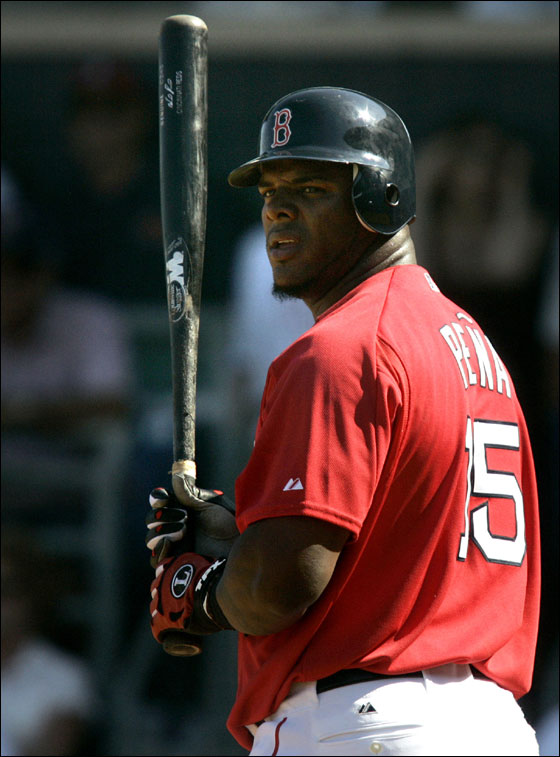 I was busy working on another story yesterday when I heard about the Wily Mo Pena trade. I pushed the "clear" button and began to try to make sense of Jim Bowden's latest deal.
The previous story dealt with Austin Kearns and Ryan Church. I was going to suggest that the only way the Nationals could become a contending team with Kearns and Church in the outfield would be for them to share the same position. Kearns is batting .302 with a .901 OPS against lefties, .239 and .663 OPS against right-handers. Church has a .279, .801 OPS against righties and just .229, .665 against lefties. Were the two to share right field next year, they could easily combine for a .290-23-90 or better.
I had written, "The Nationals have several outfielders who play well in certain situations. Now Manny Acta needs to put them in situations where they will succeed."
So what do they do? They bring in yet another "part" to the puzzle.
Pena, 25, does have tremendous potential. Thus far, however, he hasn't lived up to it. Pena's problem is the same as that of Austin Kearns; he can't hit righties. This year, he's hitting .279, .819 OPS against lefties, .229, .665 OPS vs. right-handers.
For now, Manny has said that he is going to platoon Pena with Ryan Church, which makes a lot of sense were it not for the fact that Austin Kearns will continue to flail against righties. If Kearns faced all right-h anders in a 550 at-bat season, his numbers would look like this: .239.. 21 doubles .. 0 triples .. 10 homers .. 51 RBI's .. 353 slugging %.
Kearns has never hit right-handers during his career. Neither has Pena. Unless the Nationals find another potent lefty bat to help out in right field, I don't see how the Nationals helped themselves with this move. At first glance, it seems as though the team did little more than bring in another broken part.
P.S. Jose Guillen is hitting .287-16-70 in Seattle. Just thought I'd mention it.
Chico Down, Not Out: Matt Chico has been demoted to Columbus where he'll start 2-3 games before returning when the roster expands September 1st.
This never would have happened if the Nationals had been as bad as everyone expected this year. If the team's record was, say 49-73, I doubt the team would have made this move. But because the team has the opportunity to surpass last year's record (and embarrass a lot of writers and journalists and fans), I'm afraid that the team is now beginning to place wins over continuing to grow their talent. Seems to me that Chico is better served working out his problems at the big-league level. There is a reason why so many players succeed in the minors while failing at the major league level. Who is to say that Chico's mechanical corrections in Columbus will return with him to Washington come September?
Tom Glavine went 7-17, 4.56 in his first year. He was never demoted. The Braves that year were much worse than the Nationals. Greg Maddux went 6-14, 5.61 in 1987 after being promoted from 'AAA.' He never went back down. The Cubs were much worse than the Nationals. The point is, Glavine and Maddux were promoted to bad rotations with the knowledge that they were going to have a difficult year. They learned from those difficult starts and I'm sure you'd agree that they have both had rather successful careers. Why then, does Matt Chico go down, replaced by Mike Bacsik of all people?

I thought we were all prepared to go through growing pains this year. What happened?
Oh My Gosh! So, what's needed to turn the current group of Nationals' players into a contender? Three players. Add Aaron Rowand and Adam Dunn (which the team can afford) and the team will be soooo close to contending for a playoff spot next year.
A starting pitcher would just about cinch it, but the going rate is just rediculous. If Barry Zito's $18 million a year didn't bother you, how about Carlos Zambrano's new deal with the Chicago Cubs. Zambrano, with 72 career wins, has earned an $18 million per year conract over five years.
It sounds as though it's going to take that much to sign any pitcher worth signing. That is, why spend $12 or $13 million dollars for a guy who's barely (if at all) going to win half the games he starts.
No. Looks like it's going to be aquisition via trade, at least for now.
WILY MO? I DON'T KNOW
 [August 17th] -- The Nationals just announced that they have traded for Red Sox outfielder Wily Mo Pena for the proverbial player to be named later.
As usual, I don't know how I feel when Jimbo brings in another one of his old Reds' pieces form the old days. No doubt, a focused and healthy Wily Mo Pena can do a lot for the Nationals.
I'm just not entirely sure the team still needs to be collecting talented players who are not performing.
Manny Acta has announced that Pena will platoon with Ryan Church in left field, at least for the time being. At first blush, this move makes sense. Pena has a career .248 batting average vs. lefties, .271 vs. righties. Though Ryan Church has hit both well during his career, he's having trouble this year against lefties. I think Church has proven that he's not an everyday player, I'd rather see him platoon with Austin Kearns than Pena. Kearns hits .253 vs righties, .295 against lefties.
Kearns has proven he's not the electric bat all of us thought he would be in the outfield. Church has proven the same thing. Pena, on the other hand, has proven nothing yet. Why not platoon Church and Kearns, leave Nook Logan in center (until the end of the year at least) and let Pena do his thing in left for the last six weeks of the year.
JOHNSON OFFICIALLY DONE
 [August 17th] -- So now it's official. Nick Johnson will not return to the Nationals this year. Now, don't get me wrong; not having Nick at first for the rest of the year won't hurt the team -- in fact, a rusty Johnson at first instead of Dmitri Young would probably have cost the team a few wins over these last six weeks. But we needed to see Nick out there for twenty or thirty games, not for this year, but for next. Can Nick Johnson return to his pre-injury form? Can he still field flawlessly, can he hit .290-25-90 again? If he could prove it now- even for short periods of time - the Nationals would feel far more comfortable penciling his name into the lineup card for next year. Jim Bowden could then begin the task of fixing the holes in the outfield for 2008.
But now, well, now we just don't know. Nick might return to first, or he might not. Dmitri Young might play first, but then he might not. And we all know he really can't play left for extended periods of time. Do you remember Daryle Ward last year in the outfield? Bowden now has to work around yet another question mark for 2008.
Though I love Nick, I'm beginning to believe that the team needs to move on without him. Even if he recovers from this injury, who's to say that he's not going to go down a month later, or even a week later? Johnson's doctor said this past spring that Nick was having a difficult time recuperating because he is a "slow healer." I think Dmitri can probably hold down first for another year, but the team will have to look elsewhere by 2009.
Ugly Loss, Good Outing. There was another bright spot among the ugliness last night at RFK. Joel Hanrahan continues to impress. He allowed two runs and four hits in five innings. The four walks weren't particularly pretty, but man, those eight strikeouts were very very impressive. Hanrahan's ERA went up just a tinch to 2.95.

The former 2nd round pick of the Los Angeles Dodgers is still just 25, and has been successful at every step along his career. He had a record of 67-49, 4.19 in eight minor league seasons. He allowed just eight hits per nine innings while averaging almost eight strikeouts per nine. His problem has always been his control, however. The four walks given up last night was typical of a Hanrahan outing. He's averaged 4.5 walks per nine innings in the minors and 4.2 walks per 9 during his time with the Nationals.
John Sickels said the following about Hanrahan in 2004: "Hanrahan is a physical pitcher with good size and stamina. His fastball has sinking action, and usually runs in the 89-91 range, occasionally hitting 92 mph. He throws strikes with it, and has enough self-confidence to throw the pitch on hitters' fists to back them off the plate. His second pitch is a nasty slider with good bite. He also has a changeup that he is using more this year, and shows an admirable feel for keeping hitters off-balance and mixing his pitches well. His control is solid, not outstanding, but good for a young power pitcher.He profiles out as a solid No. 2 or 3 starter if he stays healthy and maintains his command."
There is every reason to believe that Hanrahan can be a mainstay in the rotation for another five or six years. He's going to average close to fourteen baserunners per game - that's just the way he pitchers. However, like Livan Hernandez, he's shown the ability to pitch around those runners.
I feel comfortable that both Hanrahan and Tim Redding have the talent to remain in the rotation for some time to come. Neither will dazzle the opposition, but both can be counted on to eat innings and give the Nationals an opportunity to win. At 29, though, Redding will be more of a stop-gap than Hanrahan.
I Hate McGeary: Bob Carpenter and Don Sutton interviewed newest National Jack McGeary during Thursday night's broadcast. I hate him. He's handsome, talented and extremely articulate. He seemed more like a Stanford graduate rather than an incoming freshman. I think I remember when I was that young. I wasn't any of those things. Except young, I mean.
Photo credit: Hanrahan (yahoo news).
SO IT GOT ME TO THINKING ....
 [August 16th] -- The Nats' Nation is content today. A year into the Lerner regime, Nationals' fans were ready to support - or turn their backs on - the team based on what happened to Jack McGeary. As it turns out, all that yackity-yack about reducing payroll and spending it "elsewhere" turned out to be true.
That wasn't a wind that swept across the city this morning; that was a collective sigh of relief.
We're on the right track.
That got me to thinking. We know that the Nationals farm system went from one of the best in the major leagues to one of the worst under the stewardship of Bud Selig and his merry minions. The team was under strict orders to not spend a dollar over slot value on drafted players. Add that to a skeleton scouting staff and therein lies your recipe for disaster. Not enough scouts, and not enough money leads to poor choices.
Take 2002 for example. The Montreal Expos, with the 5th pick in the draft, took Texas schoolboy Clint Everts. Prior to the draft, ESPN.com provided an analysis of the the forty or fifty players thought to have a chance to be taken in the first round.
Everts was nowhere to be found. He was drafted by the Expos because 1) he was signable and 2) a less-than-accurate assessment was made of his abilities.
Take a look at other first round picks who were taken after Clint Everts:
- #6 - Zach Greinke (KC) ... 19-33, 4.92 in 4 seasons
- #7 - Prince Fielder (MIL) ... .279-66-479 in 3 seasons
- #9 - Jeff Francis (COL) ... 43-30, 4.69 in 4 seasons
- #11 - Jeremy Hermida (FL) ... .266-10-36 in 79 games this season
- #12 - Joe Saunders (PHI) ...13-3, 4.41 in 3 seasons
- #13 - Khalil Greene (SD) ... .251-66-262 in 4 seasons
- #15 - Scott Kazmir (NYM) ... 31-27, 3.69 in 4 seasons
- #16 - Nick Swisher (OAK) ... .254-35-95 in 2006
- #17 - Cole Hamels (PHI) ... 22-13, 3.86 in 2 seasons
- #19 - James Loney (LAD) ... .311 in 3 seasons
- #22 - Jeremy Guthrie (CLE) ... 7-4, 3.22 this year
- #23 - Jeff Francoeur (ATL) ... .260-29-103 in 2006
- #24 - Joe Blanton (OAK) ... 37-32, 4.16 in 4 seasons
- #25 - Matt Cain (SF) ... 19-25, 3.79 in 3 seasons
- #28 - Mark Teahen (OAK) ... .274-30-173 in 3 seasons
The other rounds weren't much better. The Expos took Darrell Rasner (2) instead of Brian McCann, Larry Broadway (3) instead of Curtis Granderson, John Fefoldi (4) instead of Lance Cormier, Chad Chop (6) instead of Scott Olsen, (though Mike O'Connor was a good choice in round 7). No question, not every one of these poor choices can be attributed to money and bad scouting. But there is a pattern, a pattern that destroyed the team.
The funny thing is, the team is still making unusual choices. The good news is, however, these days it's for the better. Jack McGeary in the 6th round? Every other team believed that the kid was going to go to Stanford and were unwilling to take a chance. Everyone but the Nationals. Chris Marrero was projected as a high first rounder last year but a "disappointing" senior year allowed him to drop to #16. This year, it was Michael Burgess that dropped because of a sub-par senior year and the Nationals took him at #49.
Remember, Burgess comes from the same high school as Doc Gooden and Gary Sheffield. Burgess' coach at Hillsborough High in Tampa said that Burgess and Sheffield were similar players "except Burgess had more power than Sheffield." In June of 2006, Baseball America listed Burgess as the 4th best hitting prospect in the entire draft. But he tinkered with his swing and he didn't live up to his press clippings.
So, the Nationals really ended up the draft with the equivalent of FOUR 1st round players (Detweiler, Smoker, Geary and Burgess). Based on 550 at-bats this is how Marrero and Burgess' numbers would look based on this year's production to date:
- Marrero: .281-30 doubles-28 homers-106 RBI's
- Burgess: .325-22 doubles-31 homers-135 RBI's
In the last two years, the Nationals' farm system has gone from barren to blossoming. I've decided it's much more fun to watch a flower grow in your yard rather than to buy one from the store and plant it.
The plan. Don't watch baseball without it.
No Mo Wily Mo? Looks like the Boston Red Sox have designated-for-assignment Wily Mo Pena. Now, this should be interesting. There is no doubt that Jim Bowden sees him self as Dr. Frankenstein and his old Reds' team as the monster, and not a day goes buy without the good doctor trying to put the pieces back together again. Is Wily Mo one of the parts that still works or has is he too decomposed to do any good? Well he's still young (25), but his numbers continue to decline. He hit 26 homers in 2004, 19 in 2005, and just 11 last year. He's hitting just .225-5-17 in 2007, leading to the DFA.
Thanks, but no thanks. I think we've seen enough of players in their mid 20's who should have begun a very promising career, but haven't.
Time for our guys to get the chance. I'd rather see what Chris Marrero can do in September rather than Wily Mo Pena.
That said, it is Jim Bowden we're talking about here ......
OVERALL, A PRETTY GOOD DAY
 [August 16th] -- For the better part of a year, I have done my best to support both the Washington Nationals and "The Plan." To be sure, I believed everything that Stan and Jim and Mark told us. They paired the payroll and told us not to worry, that they were watching out for us. Sometimes, however, there wasn't a whole lot of certainty in my words. I hoped that what I was telling you was the real deal.
I never worried about Jeff Smoker. I knew that the team was going to sign him; they had to. They made all those promises, remember? When they took Jack McGeary in the 6th round, I didn't give it much thought either. "Window dressing," I thought. Showmanship. Nothing more.
I was thinking the same thing you were when Nationals.com reported earlier today that McGeary was returning to school. The team probably made a token offer, just enough so they could tell us that "we tried" but not enough to succeed in signing him.
Then came all the bad press this week about the Lerner's and how cheap they were, that if they weren't willing to pay for chairs and tables and desks for the new stadium, then they weren't willing to pony up the dough needed to sign guys like Jack McGeary.
Then came St. Barry and his "it aint over 'till the fat lady signs" post yesterday. Seems it was never about money; it was about whether or not the Lerner's were willing to spit in the face of the man who made sure that they were able to buy the team. Would they stand up to the bully and say, "Listen you jerk, we wouldn't have to pay first-round money for a sixth-round pick if you and your minions hadn't have raped the franchise when you owned it!" Most believed they wouldn't bite the hand that blessed them.
Think again.
The Washington Nationals signed each of their top twenty picks.
Including one Jack McGeary.
Reports are that it took $1.8 million dollars to sign him. That and cost of tuition and books and the agreement that McGeary will be allowed to play baseball AND go to school in the winter. Every other team believed that he was going to attend Stanford, and every other team believed that no amount of money would get the kid to change his mind.
Let's be clear; Jack McGeary isn't a "can't miss prospect." The Massachusetts player of the year went 6-1, 0.88 while striking out 80 in 4o innings last year. That said, he was listed as the 18th best pitcher in the draft, the 27th best player overall. Josh Smoker, by comparison, was listed as the 11th best player available. However, he's a "character guy" in the mold of Ryan Zimmerman. From "Baseball Analysts:"..."This kid is very poised, polished and advanced for his age. Many young prospects have good arms but are still just young kids. Jack McGeary is a young man who shows command of not only pitches but of himself. He is an excellent representation of his family, his school, his team and his community. He will be a success in more than just baseball. He is a true leader. It will be fun to follow his progress in either college or pro ball."
The Nationals walked away from the 2007 amateur draft with three - count'em, three - first round picks in which they chose three -count'em, three - left handed starting pitchers.
It really doesn't matter if McGeary becomes a major leaguer for the Washington Nationals. It doesn't matter how well (or poorly) he pitches in the years to come. What is important is that, when push came to shove, the Lerner's listened to their baseball people and dug a little deeper into their pockets. They said to all of the neysayers who questioned their motives, "screw you!" We now know that if a move makes sense, the Nationals will persue it.
They have bought our trust.
All that said, I'm beginning to wonder just how badly the team needs starting pitching.
- Shawn Hill: 3-3, 2.41
- Tim Redding: 2-3, 2.88
- Joel Hanrahan: 2-0, 2.76
- John Lannan: 1-1, 3.00
- Matt Chico: 5-6, 4.85
- Jason Bergman: 2-5, 4.56
Redding pitched another solid game last night, allowing just two runs and three hits while striking out seven in six strong innings. At 29, he's not young, but young enough to provide the Nationals a veteran presence at little cost for years to come.
Amazing. Anyone want to grouse about those stinking chairs now?
This 'n That: The Nationals signed their "big three" picks for just under $6 million dollars. The Baltimore Orioles, on the other hand, signed their top pick, Matt Wieters, for $6 million dollars. Tell me again which franchise has the bright future? ... Seriously, some of these first round bonus dollars were ridiculous. Tampa Bay paid $11 million over six years. The Yankees #30 pick, Andy Brackman, received almost $5 million. I hope - I pray - that the Nationals never allow themselves to be held ransom by the likes of these types of players and agents ... Nook Logan doubled and raised his batting average to .275. Is his late season surge helping he Nationals or hurting them? If he continues to play this well, will the Nats forgo any attempt to sign a big-name free agent this winter and give him the position? Though I'm beginning to really like the kid, the only way the team can afford to keep him would be to sign Adam Dunn and platoon Ryan Church and Austin Kearns in right .... Ryan DeLaughter, a powerful outfielder who in his two years with the Nationals hasn't hit very well in the minors was demoted from Vermont to the GCL Nationals and took the mound yesterday. DeLaughter was a high school pitching phenom with a fastball in the high 90's. I don't know if it was a one-time deal or whether he's given up hitting for pitching. I'll let you know what I find out ... 19 year old Mike Burgess hit his 7th homer of the year yesterday. Based on a 500 at-bat season, the kid would be on pace for a monster year: .325-32-125 with a .434 OBP. Did I mention he is 19? ... Remember the Shairon Martis for Mike Stanton deal last summer? Seems to be working out pretty well. Martis, a name not normally mentioned as one of the team's favored pitching prospects, is now 12-7, 4.49 for Potomac. Did I mention he's 20?
I think it's time for Nationals fans to do several things. First, we've got to show some support - and perhaps even a little bit of blind faith - in the team. Though I think it's great that Nats' fans aren't running like lemmings to RFK regardless of the product provided, the events of the past few day (as well as a very entertaining team) should lead to increased attendance. There's no reason that the team can't average 30,000 per game from now until season's end.
I think it's time that we begin to say thank you, don't you?
GREAT START OVERSHADOWS BAD END
 [August 1th] -- Superman is back in the building.
I have to admit, I am stunned. I wrote yesterday that I had grown weary of counting on players that were always injured to help lead the Nationals to the promised land. Regardless of how good Shawn Hill can be, no matter how many times that Manny Acta says he is "the ace," I went into last night's game expecting to see a struggling pitcher. Like Jason Bergman before him, I thought that Hill, 26, was going to prove his early season success to be nothing more than "beginners luck." I mean, the Nationals just don't have quality pitchers fall into their lap like that.
My bad.
Hill was brilliant, allowing one hit (which really wasn't) and one walk while striking out seven. He was unhittable. It was as if the past three months were but a moment in time, time that changed nothing in the young man's now valuable arm.
ANOTHER HILL TO CLIMB
 [August 12th] -- A quick check of my favorite Nationals' watering holes on the internet indicates that Tuesday night's game against the Phillies has a whole lot of people pumped and excited.
Seems the second coming of Cy Young returns from the disabled list.
At least, that's what I've been reading.
Manny Acta said yesterday that Hill, 26, has nothing to prove, that regardless of how good (or bad) Hill pitches during the remaining one-and-a-half months of the year, he will be the team's "ace" heading into 2008 and the new stadium.
Now wait a minute. Didn't we say the same thing about John Patterson during spring training?
I have grown weary of hitching my star to players who can't stay healthy. He very well may be the Nationals' best pitcher, but what does that say about the team's chances over the next few years? Hill was a 6th round selection in the 2000 draft, and pitched very well during his years in the minors, going 35-28, 3.08 in 95 starts. That said, it took him six years to reach a major league team bereft of any real pitching talent. And when he finally made it to "the show," he has developed arm and elbow problems. 2007 is the third year that Hill has missed significant time.
Why then, should we count on Hill to be anything other than a pleasant surprise come 2008? Look what happened when the Nationals counted on Patterson this year. Disaster.
No, assume the worst and hope for the best for Hill, and for John Patterson. Jim Bowden should craft together a solid starting rotation without our two injured starters. If they are ready, if they can pitch, then the Nationals will have an embarrassment of riches. If they can't answer the bell, then, in basketball vernacular, "no harm, no foul."
Another worry. Remember how Manny Acta said that Hill was the team's "ace," by far and away the best pitcher on the team? Well, TSN (and other scouting services) lists Hill as a "decent mid to late rotation" starter. That means that are ace would be buried on most other team's rotations.
If that is indeed true, then the Nats might be better served spending some of that $30 million pot of money set aside for free agents on another pitcher.
One that won't break down every year.
I'LL TAKE THIS LOSS ANY DAY
 [August 12th] -- It wasn't too long ago that a Google Search for John Lannan brought up images such as this one. When you're playing in the low minors, you just have to get used to stuff like this.
Especially when your stats were as bad as the picture.
And Lannan's were.
Playing for Savannah in 2006, Lannan went 6-8, 4.70, allowing nearly 14 base runners per 9 innings. He looked like just another guy in the Nationals' minor league system who had no real hope of being a factor in the major leagues.
Then came 2007.
Sure, the Nationals lost to the Arizona Diamondbacks last night 1-0, and have now lost two games in a row for the first time since late July. But you had to figure that was going to happen seeing how the team was going up against Cy Young Award winner Brandon Webb who just happens to be in one of those consecutive scoreless inning streak that happens once every few years. Going into the season, we all said that wins didn't matter; it was all about player development. Well, meet John Lannan, the first real product of that development process. After three starts, Lannan is 1-1, 3.00 in 24 innings. Even more impressive, when you throw out that first "weird" game, Lannan has allowed just two runs in 14 innings.
The sample for Lannan is still quite small, so I'm not getting myself all in a tizzy over the kid. Remember Mike O'Connor's start last year? He was unhittable. That is, until he became very hittable after a half-dozen or so starts. But if he continues his solid play, the Nationals' rotation seems to have a great deal of potential heading into next year. If Shawn Hill, Jason Bergman, Matt Chico, Lannan, Ross Detweiler come through, well ..... wow. And if a couple of the bargain-basement pitchers (Redding, Bacsik, Simontacchi, etc.) continue their solid pitching into next season, the team might even have what could be termed an embarrassment of riches.
If.
And if pigs could fly .....
The End Of Days: The signing deadline is almost upon us and it's still very uncertain as to whether Josh Smoker and Jack McGeary are going to sign. McGeary, a sure 1st round pick that slipped because of the near-certainty of his going to Stanford, would be a coup. No question, he would be "the" signing of 2007 if the Nationals cough up 1st round money. Will they? I hope so. That would be a wonderful way to show the fans that they are indeed going to invest in the team's infrastructure. I hope they sign one of the two - either one will be fine. If they don't, "the plan" gets pushed back a year as the Nats recoup the lost picks next year.