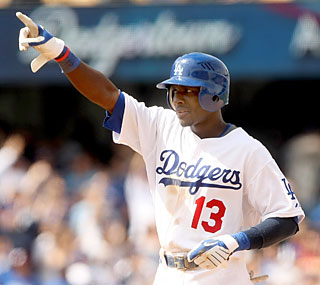
BERGMAN FINALLY BEING NOTICED
 [May 15th] -- So, all of a sudden, Jason Bergman is a hero?
Listening to all of the highlight shows last night, I was stunned at how Bergman's near no-no was spun. Here was this guy, who had never shown any real talent during his time in the major leagues, who out of the blue spun a gem against the Atlanta Braves.
I don't buy it.
Bergman had a very solid minor league career, fashioning a 32-30, 3.42 ERA in 415 innings. He allowed only 7.75 hits per 9 innings, a very low number. Hitters have always had difficulty catching up to his stuff. His problem has been location; he allowed more than 4 walks per 9 innings while in the minors.
Granted, he had a lousy 2006 season (0-2, 6.68 in 64 innings), but his 2005 was very impressive. He went 2-0, 2.75 in 19 innings, including one outstanding start late in the year. I wrote several articles that winter singing the virtues of Bergman and anointing him as Esteban Loiaza's replacement in the starting rotation.
Okay, 2006 didn't exactly go as planned.
But 2007, well, 2007 is going just as I had imagined 2006 would look. After doing his part to make that opening series against the Diamondbacks look miserable, he's easily been the team's best pitchers, with apologies to Shawn Hill. His shortest outing has been six innings. Other than the Cubs game (he gave up 8 hits), he hasn't allowed more than 5 hits in any start. In his last 37 innings, he's struck out 42 while walking only 14.
But really, 2006 wasn't as bad as it seemed. In two games, he gave up 13 hits and 8 walks in 9.2 innings and had a pretty lousy 8.80 ERA. In the other 5 games he pitched, however, he gave up just 13 hits and 12 walks in 31 innings while striking out 27. His ERA for those games was a very acceptable 3.77.
2005 was a solid year for Jason Bergman. 2006 (save two outings), was a solid year for Jason Bergman. And 2007 - if he can keep it up - will be a superb year for Jason Bergman.
Perhaps he's been a stud all along and we just never noticed.

MAXWELL'S TURN TO SHINE
 [May 12th] -- When the Washington Nationals played their inagural season in 2005, I payed close attention to the National's minor league teams. Oh, I didn't look at the individual players; there wasn't anyone to keep tabs on. No, I would check in and see how the teams were doing in the standings. These days, however, things are different. I couldn't care less about team records. Each evening, I scour the box scores to see how our prospects are doing. So far, the boys in Hagerstown are playing some very impressive baseball. On Friday, Chris Marrero hit two homers and drove in six. On Saturday, it was Justin Maxwell's turn to hit two homers. The difference is that Marrero, a first rounder, is supposed to be a star. Maxwell, on the other hand, has been a very big question-mark since he joined the organization.
The Nationals signed outfielder Justin Maxwell in the 2005, the team's second overall pick, taken in the 4th round of the draft (The Nationals lost their 2nd and 3rd round picks when the signed Cristian Guzman and Vinny Castilla). Maxwell, who graduated from the University of Maryland, had rebuffed the team's efforts to sign him because of the contract's structure and not its financial considerations. Team officials described the negotiations as "amicable." My guess is the contract addressed his injury plagued seasons of 2004 and 2005. Injuries in those two years robbed Maxwell of what would have been a sure first round selection in the amateur draft.
An inside fastball during spring practice in 2004 broke a bone in his forearm, forcing him to miss the entire season. He tried to play in the Cape-Cod League that summer but broke a finger there effectively ended his year.
Seven games into Maryland's 2005 season, he broke a bone in his hand, ending his collegiate career. Nationals GM Jim Bowden drafted him not on what he had done during his career, but rather what he could do. The term "high risk, high reward" fits Justin Maxwell perfectly.
Maxwell has been a star at every level. He played in the Cape-Cod League in 2004 and hit .307 with 47 hits and 2 home runs. In his abbreviated 2005 season at Maryland, the 6'5", 220 lb outfielder batted .455 with 3 home runs and 10 RBI's. He started the 2006 season at low-A Savannah, but struggled, hitting just .172 in 58 at-bats. And those struggles weren't surprising considering how few games he had played over the last four years. He joined Vermont when their short season started, and played very well, batting .269-4-33 with 20 stolen bases. The Lake Monster's general manager told me last winter that Maxwell was his favorite player.
This year, Maxwell started slowly and batting average was .231 just last week. He's been hot recently, however, and is now batting .263 and is on pace to hit more than 30 homers and steal 20 bases.
He was drafted in 2001 by the Orioles, and again in 2004 by the Rangers. Texas scout Grady Fuson called Maxwell "one of the top college players" in 2004, and said that Maxwell "could very well be one of our most important selections in some time." Maxwell didn't sign with the Rangers.
Maxwell is both powerful and fast, and is often compared to former Met great Daryl Strawberry. His swing has a high arc, allowing him to not only drive balls, but drive them very high and very deep.
While his physical tools might be compared to Strawberry, his personality is more like Cal Ripken, which is good for him and great for the organization. Sean Welsh, GM of the Bourne Braves, a summer-league team Maxwell played for two seasons ago, said that he's as apt to be reading his Bible as he his sanding his bats in preparation for the next day's game.
Things could change, but - for now anyway - Justin Maxwell is looking to be more "reward" than "risk."
MARRERO SHINES IN HAGERSTOWN
 [May 11th] -- After Ryan Zimmerman, Nationals' fans expect a lot from their first round draft picks. Zimmerman, who just missed being named NL Rookie Of The Year in 2006, made it to the major leagues just four months after being taken in the first round of the 2005 amateur draft.
Last year, with the 16th pick, the Nationals took a high school 3rd baseman, Chris Marrero.
No doubt he's not going to make it to the major leagues anytime soon, but he's showing that when the time is right, he just may be the impact player that the Nationals so desparately need.
Marrero, a 6'3", 210 lb right-hander, batted .309 with 16 RBI's in 81 at-bats last season with the Nationals' team in the Gulf Coast League. It was a solid effort, though only 9 of his 25 hits went for extra bases.
A lack of power isn't a problem this year.
Playing with Hagerstown, the 18 year old hit two homers and drove in six runs Friday night. He's now batting .302-6-27. Take a look at his projected stats for 2007:
Hits:129 - 2B:21 - 3B:0 - HR:26 - RBI:116 - BB:17 - K:76
About the only negative is a relative lack of plate discipline; he's walked only 4 times this year. He's batting .310 against lefties, .280 against righties. A natural 3rd baseman, he was switched to the outfield last year, but scouts described him as only "adequate." He is showing a natural talent around the first base bag, however, and it looks like that's where he'll play as a major leaguer.
Chris Marrero. Remember the name.
SILVER LINING STILL THERE
[May 9th] -- Hi y'all (my mother was from Texas -- somethings just never leave you).
I miss posting 10 to 15 times a week like I did the first 2 + years of The Beltway Boys. It was fun being able to write a 10 paragraph story on the way "Nationals" was written across the front of the home jersey. To those of you who continue to email and ask, I am feeling better, and one day - soon I hope - I'll be able to return to daily blogging. Thank you so much for sticking with me.
With the semester finished (and one more to go to finally get that elusive degree), I have taken a summer job at the local Convergys call center here in Pocatello. It's a great job, really. Our facility takes virtually all of the incoming calls from Directv customers. It's a sit-down job, which doesn't stress my heart any more than it already is. But the best part is I get to work from home. They provide a computer here at my house; I just go into my den, close the door and take calls. The pay isn't bad and Directv provides the equipment and the programming for free. Every channel that a customer can get I get at no cost (it's the $100 package) plus I get all the NFL and MLB games as well. So while I'm talking to those of you with Directv, I'm surfing the computer with my left hand while changing the tv channel with my right.
Sometimes, the right situation does come along in life when you need it most.
But lets talk about baseball ...
Heading into tonight's game, the Nationals are 9-25 and are showing no signs of turning their season around. I think we all expected something like this to occur, but not in the way things have played out. It was the pitching, and not the offense, that was going to doom the Nationals this year. Thus far, the pitching has been okay bordering on not-to-bad. The team's ERA heading into tonight's game against the Marlins stands at 4.67, good for 23rd in the league, but better than seven teams, including the Yankees, the Mariners and the Blue Jays. Over the last 30 days, when part of that horrid first week is discounted, the Nationals' ERA is 4.18, 18th best in the major leagues. I think any of us would have taken a "middle-of-the-pack" ERA last fall.
While the pitching has been a pleasant surprise, the offense has been hard to understand. Only the Chicago White Sox has a worse team batting average than the Nationals' .227, and no one has fewer home runs, RBI's and runs scored. Only the White Sox and Pirates have a worse on-base percentage.
That said, let not your heart be troubled Nationals' fans. Brian Schneider, Ryan Zimmerman and Austin Kearns will hit much better the second half of the season, and Nick Johnson will add another badly needed professional bat by the end of next month. If Ryan Church and Felipe Lopez continue to hit well, and if Manny Acta wises up and puts Ronnie Belliard back in the starting lineup, the team will hit well enough to win some games. If Acta plays his eight best hitters, and if the starting pitching remains healthy, the Nationals could win 35-37 wins during the second half of the season.
Whether or not the Nats have a "historically" bad year will depend on what they do from now until the All-Star break. If we assume 35 wins after the break (giving them a second half record of 35-46), the Nationals will have 44 wins in the books with 47 games left to play. If they play .500 ball from now until July, they'll end the year with 67 victories, a number similar to last year's 71 win season. But they aren't going to win half their games over the next three months; you know it and I know it. 19 wins are more likely, which would give the Nationals a final record of 63-99.
So there you have it. If the Nationals' pitching staff continues to be "okay," and if the team's bats start to hit like they are capable by the All-Star game, the team might, just might, avert a 100 loss season. That said they could just as easily lose 107 games.
It's all up to the offense right now.
There is also lots of talk about Stan Kasten and Mark Lerner promising more money for free agents next year. I believe them. My guess is the Nationals will end up with two starting pitchers and a starting position player to enhance the new park experience in 2008. Add a powerful center-fielder and two "15 win" type starters, and the Nationals could have easily have a winning team in 2008.
Don't sell the Lerner's short. They are very smart and the know exactly what they are doing. Remember how painful this season has been, and will be, because I doubt we'll ever seen anything like it again for many years to come.
CHAD'S BAD, BUT IS IT FIXABLE?
[May 7th] -- I love the Washington Nationals. Really, I do. After thirty three years of quiet nights at RFK, bad baseball is far superior to no baseball at all.
That said, that doesn't make this hurt any less.
Was there really anyone watching Sunday's game against the Chicago Cubs who believed - really believed - that Chad Cordero was going to come out of the 9th inning with a save? If you looked at Cordero's countenance, the way he held himself on the mound, it was obvious that even he didn't think he had a chance. Six balls and some poorly placed pitches cost Shawn Hill, who is quickly becoming the team's only shining light in an otherwise dreary darkness, the win. The message boards are abuzz .... either Cordero has been figured out by the competition or he's just in a slump. I tend to lean towards the "he's been figured out" side. Even during his magical 2005 season, he was still letting runners get on base on a regular basis -- the difference is that he was able to get out of those jams back then. I remember one game against the Angels in Los Angeles when he loaded the bases with no one out with just a one-run lead before slamming the door and earning the save. In his first season with Montreal, Cordero gave up less than seven base-runners per 9 innings. This year, he's up to 2.1 base-runners per inning.
His fastball has remained constant since 1994; it's his location that is causing him angst. It's not that he's allowing more walks than before, but rather he's getting behind early and often, and hitters are learning to wait for that one "batting practice fastball" Cordero must throw to get a strike -- it's then that the trouble begins.
I'm sure that he'll get better in the coming weeks. In all likelihood, he'll have an ERA of 3.50 or so - perhaps he'll even save 20 games. But I just don't know if he can be counted upon again as that dominating force out of the bullpen, that guy that is feared by the rest of the league. It happens more often than one might think. In 2005, Derrick Turnbow saved 39 games with the Milwaukee Brewers while crafting a 1.74 ERA. After a decent first-half of 2006, however, he began to get hit hard, and finished with a 6.87 ERA. I'm not suggesting that Cordero will fall that far, but I doubt we'll see 2005 again.
Luckily, a bunch of blown saves don't mean very much this year. I am wishing, however, that Jim would have traded him last fall, before "this" could have happened. He'll be worth very little in trade, at least for the foreseeable future.
Here's hoping that Chad returns to form. Until then, however, the Nationals have learned yet another way to lose.
Other Stuff....
Position by position, things are looking bad. Brian Schneider has never hit well in April. Dmitri Young is slumping. So is Felipe Lopez. Cristian Guzman is back, and that's really bad. Ryan Zimmerman isn't hitting and committed his 7th error of the year (he made 15 all of last year). Everyone who has played in left has sucked. Ryan Church and Austin Kearns are the only two who have been relatively consistent since opening day. And the pitching? Outside of Shawn Hill and Jason Bergman (and a few relievers), things have looked really, really bad.
It's scary.
There are several nuggest of hope in the farm system, but virtually all of them are at Hagerstown and Potomac (with just a couple at Harrisburg). We're a few years away from seeing our babies grow up.
My oh my ....
LEADING TEAM IN HITS GETS YOU BENCHED
[May 1st] --  I knew it was going to happen, but I was hoping against hope that it wouldn't. Ronnie Belliard, by far the best free agent signing of the 2007 season in the major leagues (when comparing cost versus production), is one of the Nationals' best and most consistent hitters. Heading into Wednesday's game with the Padres, Belliard is batting .298-1-9 with a team high 31 hits. Once manager Manny Acta moved him to the #2 slot in the lineup, the Nationals began to play .500 ball (or rather, as close to .500 as the team will ever play this season).
That said, I knew that Cristian Guzman would be returning to the team in early May, and although he deserves to sit on the bench, there was no way that was going to happen. The Guzman signing, by the way, cost the Nationals their 3rd round pick in 2005 - the Twins used the pick to choose Brian Duensing, who has a 9-13, 3.21 career record in Minnesota's farm system.
Guzman, who had perhaps the worst season of any regular major leaguer in 2005, and who missed all of last year with a shoulder injury, and who has never been an all-around offensive player, will return to the starting lineup within the next week. From Bill Ladson's article, "But manager Manny Acta pointed out that Guzman has two years left on his contract with the Nationals, and the skipper wants to see if Guzman can be the player that helped the Twins win three consecutive American League Central titles." Acta then went on to say that we needed to "fix" Guzman.
If we can't score with Ronnie Belliard in the lineup, how in the world are we going to score with him on the bench and Cristian Guzman at short? Come the end of the season, Belliard is going to hit somewhere near .275-13-60. Guzman? If he's lucky, he'll come in somewhere near .250 with no power and one of the worst on-base percentages on the team.
I have supported Guzman from day one because, frankly, we had no one better. But now we do. And playing time shouldn't be about money. Maybe Stan Kasten can use just a smidge of the $33 million he saved on payroll this year and eat Guzman's contract, and then sign Belliard to a 3 year, $10 million dollar deal.
"Batting second, playing shortstop, Cristian Guzman...."
Sigh....
Nats Notes:
Jason Simontacchi looked tremendous in his first rehab start for Columbus last week, giving up just one run in five innings. Then he took the mound this afternoon at Cooper Stadium in Columbus: 5.2 innings, nine hits, six runs, a walk and three strikeouts. I am assuming that he will be taking Jerome Williams' place in the rotation when he comes off the disabled list. Will he be better for the Nationals? Simontacchi, 33, has a 20-10, 4.77 major league record with a 39-38, 4.22 minor league minor league record. I don't think we'll see much of a difference, really.