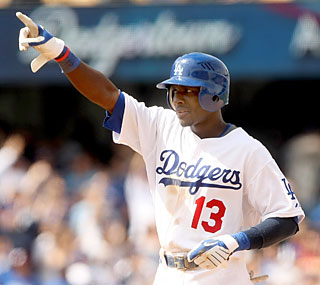
ROTATION SET: AT LEAST AT THE BELTWAY BOYS
[March 1st] --  Beware the Ides of March. Romans. Julius Caesar. You dig? I thought using the "Beward the Ides of March" thing would be apropos considering that - probably - March isn't going to be particularly kind to the Washington Nationals. But then I remembered from an Ancient History class I took a few years ago that the "ides" of March is specifically the 15th of the month.
Never mind.
So, after two intra-squad games, I'm ready to name the team's starting pitchers. I don't want to wait and see how they do in spring games - that would muddy up my thought process with facts.
- John Patterson (15-13, 3.66): Finally, his breakout season.
- Jerome Williams (11-15, 4.22): I know, these numbers look very similar to what Ramon Ortiz produced last year, but with Williams, he'll put up better numbers as the team gets better over the next few years. Williams has sucked because he was injured; Ortiz just sucked.
- Tim Redding (11-13, 3.88): For a while, he and Roy Oswalt were co-studs for the Astros. Things have changed, however. That said, he's come back from mediocrity and had a nice little season last year, going 12-10, 3.40 with 'AAA' Charlotte. If he regains his confidence, he could be a solid #3 starter for the Nationals for years to come.
- Joel Hanrahan (10-10, 3.89): I don't care that he's never pitched a day in the major leagues; a career 62-45 career record in the minors shows he can pitch. The variable is his control (he averages four walks a game). If he finds the strike zone, he'll do well. If he continues to have difficulties, he'll get rocked. Look for Mr. Hanrahan to impress.
- Beltran Perez (8-10, 4.11): I really like Perez, and I think he can do much better than this, maybe 12-9, 3.80.
There are other possibilities, of course. Jason Simontacchi has impressed some of the coaches, and Brandon Claussen has a real potential if he can regain his health. And I don't even think the team's best pitcher will even make the opening day roster. Matt Chico has the potential to be very special, but why put him in the rotation to open the season? A few weeks, a couple of months at Columbus can only make him better and more prepared for the major leagues. Were he to make the team, the Nationals would likely have to waive one of the veterans trying to make the club. Why not give them a chance before cutting them? If they do poorly, get rid of them and recall Matt Chico. If they do well, give Chico more seasoning and then - perhaps - trade one of the veterans for draft choices. That said, I'm going with my guys until Manny Acta tells me I'm wrong.
And he probably will.
Why Nook Logan will make the All-Star team: Because in the long run, things have a way of evening themselves out. How many years in a row can a major league team make the same mistake with the same position? First it was Endy Chavez, and then it was Brandon Watson. The names changed, but the superlatives remained constant. Fast. Good defender. Only has to get on base. He could add 30 points to his average by bunting more often. Those remarks could just as easily have been said about Nook Logan. Wait, they were. There is absolutely no reason to believe that Nook Logan will succeed where Chavez and Watson failed.
And that's why he will. I mean, what's the chance of the team being wrong three years in a row?
Oh wait ....
Seriously, Nook Logan hit a home run in Wednesday's practice game. And from the left side, no less. Hopefully, that one lucky drive won't turn him into another Willy Mays Hayes with the leagues best warning track power.
That said, I bet Mitchell Page was smiling like a new papa.
Things Are Quiet: I am very surprised at the general lack of interest in the Nationals, at least based on reading some of the other blogs. Over the first two springs, all of us were churning out stories daily. This year, however, some of the blogs (including me) don't seem quite as excited. Even the major message boards have less postings that this time last year.
Perhaps it's because we all see a long road ahead? I hope not. Wins or losses aside, this should be a fun year.

WHAT'S WRONG WITH THIS PICTURE?
 [February 26th] -- This post might not keep your attention unless you're old enough to remember A. B. & W., the WPGC money car, Mal Campbell and Resurrection City.
One of the first things that Bob Short did after buying the Washington Senators in 1968 was to travel to Florida and sign Hall-of-Famer Ted Williams as the team's new manager, replacing another slugger, Jim Lemon (who replaced another slugger, Gil Hodges).
I was 13 in 1969 and I clearly remember the excitement when Ted Williams took the field for the first time in a Senators' uniform. Pompano Beach was abuzz with reporters. That said, I don't recall ever seeing a photo from spring training that year, and television coverage of the Grapefruit League was still a couple of decades away. So the first time I actually saw Williams wearing his Senators' uniform was on opening day in 1969 (the Senators lost something like 8-3 to the New York Yankees. It was a dreary and rainy day; the game likely w ould have been called had it not been opening day. The only highlight was Frank Howard getting a kiss from "Morganna the Wild One"). In his three years as manager, Williams wore but one home uniform, the one we old folks remember clearly; creme white with no pinstriping or piping around the sleeves or neck. Simple yet attractive.
So it came as a real surprise when I came across this magazine cover featuring Ted Williams in his home Senators' uniform. His home pinstriped uniform.
Huh?
That uniform was worn from 1963-1968 ('63-'67 with a blue cap, '68 with red cap). Short didn't care for pinstripes however and helped create the uniform that we remember today.
So if the Senators never wore that uniform after the end of the 1968 season, and if Ted Williams joined the Senators after the uniform was "retired," exactly why is it that Williams is gracing the June 1969 cover of Sport Magazine wearing that old uniform?
All I can figure is that this photo was taken during spring training (though the background doesn't look like anything I ever saw at the Senators' spring training complex in Pompano). Perhaps the new uniforms hadn't arrived yet and the team was forced to wear the previous years uniform.
That's certainly plausible.
However, if that's true, then Williams is wearing Frank Howard's uniform (remember, Hondo graciously gave Ted his #9) and though Williams is a big man, he wasn't nearly as large as Frank. That uniform should be hanging loose on him.
Any ideas? I really don't have a clue. I'd be curious to find out.
BE FRUTO AND MULTIPLY
 [February 25th] -- It's begun already. Coaches, general mangers - heck, even team presidents - are doing it. "Man," they begin, "I know it's early, but so-and-so looks like they can make an impact for us this year." Perhaps they are talking about a veteran, perhaps a rookie. It doesn't matter; the mantra is the same.
"I know we haven't played a game yet, but man ...."
Look, I'm happy that Emilano Fruto is impressing the heck out of everyone and that his stuff is so good that he might end up in the Nationals' rotation one day. Sure, he looks good against batters who haven't picked up a bat in six months, but it's hard to forget his 5.50 ERA last year.
Spring Training camps are littered with the bodies of players who looked goo d early. Sparky Anderson once anointed a young third baseman who burned up the Grapefruit League one spring as the "best baseball player I have ever seen." That I can't remember that guy's name today is a testament to his failure. The Washington Senators started the 1968 season with a second baseman named Frank Coggins based primarily on his great spring. He batted .175 in 183 at-bats before shuffling off to Buffalo, the Senators 'AAA' affiliate, never to be heard from again. The Senators plucked veteran 3rd baseman Joe Foy off the Met's roster and gave him a tryout in the spring of 1971. He didn't just impress, he blew everyone away. Even his foul balls sounded like rocket-shots. He started the first quarter of the season for the Senators, batting .234 with a .660 OPS. He was released in June.
I hope that Emilano Fruto is the real deal, I really do. The Nationals need him, and dozens more just like him. But looking good on a back-diamond pitchers mound doesn't amount to much. Fruto's problem wasn't his 'stuff' last year; it was his control. The 23-year old struck out 34 batters in just 36 innings. That's impressive. But he also averaged six walks per 9 innings pitched, and that just isn't going to cut it at the major league level. Standing behind him, his electric stuff is obvious. But how's his control? Is he catching the paint for a strike or is he still missing the strike zone? There's no one there to say one way or the other.
Spring Training isn't about making snap decisions based on three innings pitched here, or a half-dozen at-bats there. Fruto could look like Roger Clemens this spring and still blow chunks come April. Conversely, Shawn Hill could end the spring with a double-digit ERA and win a dozen games in 2007. You just never know, you know?
On Being Ronnie Belliard: The more I think about it, the less I believe that Ronnie Belliard is going to be part of the Nationals' bench this year. Without question, he is the team's best second baseman right now. Felipe Lopez is the team's best shortstop right now. What else is there to consider? That said, Jim Bowden is married to Cristian Guzman, or at least to his contract. He has no trade value. Belliard a bench jockey? No way. If Guzman and Lopez are to be the Nationals' Tinkers to Evers, then Belliard needs to keep his bags packed. Maybe April. Maybe May. It'll happen.
CATCHING UP
 So, it's been a week since I've last posted. This isn't uncommon, of course. All of us are afflicted at one time or another with writers block or general apathy. For me, it was a week of teaching 9th graders the inner workings of the Civil War. I stayed up nearly every night creating powerpoint presentations that wouldn't bore a bunch of 15 year olds; they aren't usually keen on student-teachers after all. Now I understand why some teachers use the same lesson plans year after year after year.
But, like I've said over the past four years, it sure beats working.
Okay, let's get back on topic.
I dug up these photos of some of our former players - Jose Guillen, Jose Vidro, Tony Armas Jr. and Alfonso Soriano. Take a look at the picture of Vidro. See all those balls behind him? I sure hope for the Mariners' sake that those aren't all the balls that got by him during practice. Vidro has been getting pointers on how to be a DH from former Mariner Edgar Martinez. I hope he takes them to heart. If he remains in the dugout, he has the chance to almost return to his old self offensively. How good can he be? Well, .300-13-80 wouldn't be out of the question if he bats 5th as Mike Hargrove has suggested. Reports out of Arizona indicate
 that Jose Guillen is 100% and is ready to replace Ichiro as the team's right-fielder (with Ichiro moving over to center). Guillen could easily hit .285-25-100 for Seattle in 2007. To some, the Vidro trade (and the loss of Guillen to free agency) might look very bad for the Nationals by the time October rolls around. Not me. Jose Vidro the second baseman would have fielded poorly in Washington, and wouldn't come close to the numbers he'll put up as an American League DH. And the Nationals are in much better shape in right field as well. Austin Kearns is as good a right-fielder (both offensively and defensively) as Jose Guillen, but he is a far superior as a human being. I haven't heard any stories about Kearns' teammates avoiding him after all. And from early reports, Emilano Fruto is wowing players and coaches alike with his mastery of his fastball, curve and change. He's looking so good that there are whispers that he might one day become a starting pitcher. A dominant starting pitcher.
 Who "won" the Vidro trade? Statistically, the Mariners will seem like the winner come the end of the season. But in the long run, having Emiliano Fruto and not having Vidro and Guillen will make the Nationals a farm better team.
Will Casto Lasto? I was stunned when Manny Acta announced that Nook Logan was the Nationals' starting centerfielder a month or so ago. With that surprise move, I figured the outfield was set with Austin Kearns in right and Kory Casto in left. Pretty much every beat writer believed that Casto would - save some implosion at Viera - be the starting left-fielder. So just when I was getting used to the idea of having Nook Logan in center, Acta says that Ryan Church is his first choice in left.
I think that pronouncement surprised everyone, especially Casto and Church.
After the Mexican bru-ha-ha, Church seemed destined to ride a rail out of town this spring, becoming yet another former Expo/National to become a star elsewhere. But St. Manny showed wisdom beyond his years and gave Ryan the chance to become a star right here in Washington.
So what does mean for Casto?I don't know. If Church wins the job, Casto will begin the season at 'AAA' Columbus and hope for the best. If Church, Logan, Kearns (and Alex Escobar and Chris Snelling) play well, he'll likely spend the season in the minors. If he does, he'll be 26 come next spring training. 26, and a rookie.
I feel bad for the kid. I'm sure he believed that he had as much of a chance to be the team's left-fielder as anyone. As it is, he's going to be getting most of his at-bats while playing 3rd base this spring.
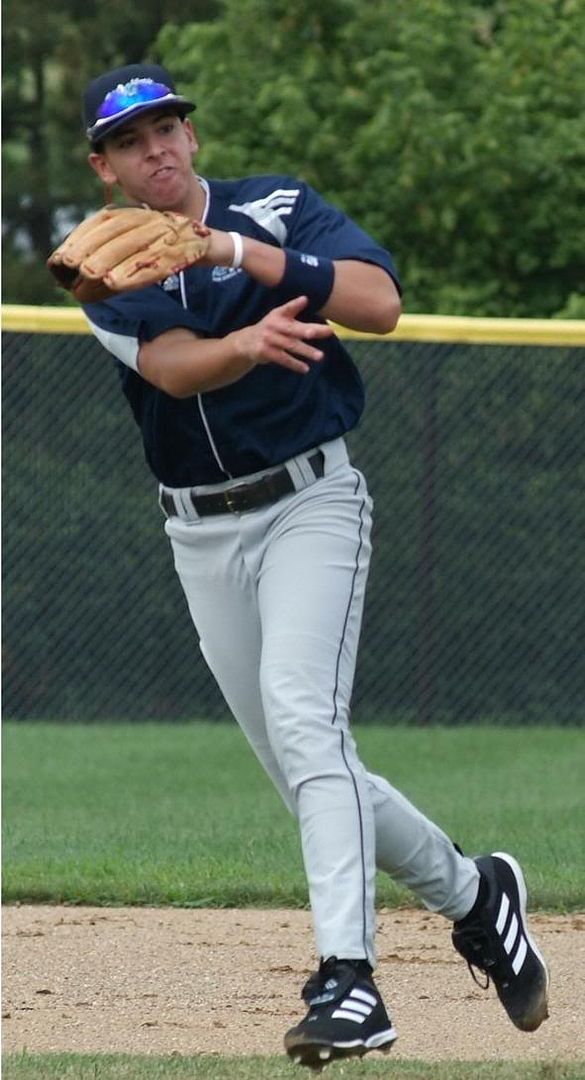 s been moved yet again. A natural 3rd baseman, he was moved to left after the draft for obvious reasons. The experiment was short-lived. Chris Marrero is now a 1st baseman. The reason? Reports indicate that Marrero was an "average" outfielder at best, and it's believed that his fastest track to the major leagues will be at first. If he continues to play at his current level, he'll probably be ready to play with the big club sometime in late 2009. Nick Johnson's contract ends in - you guessed it - 2009. This would seem to indicate that the team no longer considers Larry Broadway as any real part of the team's future. And though I am a Broadway booster, there is no doubt that Marrero's upside is far greater than Broadway's, and the team will be far better with him as Nick Johnson's heir apparent.
YEP. I'M WRITING ABOUT LARRY BROADWAY AGAIN.
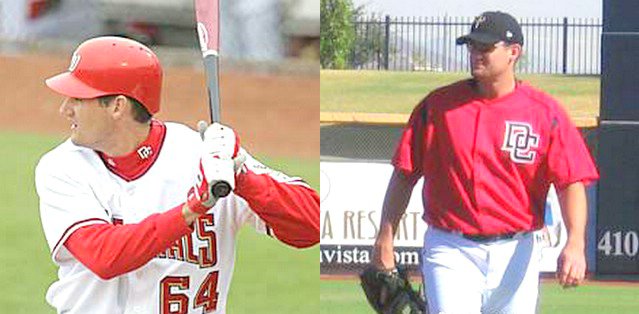 [February 19th] -- Larry Broadway was at a career cross-roads this past season. Blocked from the major league roster by Nick Johnson, Broadway realized that his future might lie with another organization. His hope was to prove himself at 'AAA' New Orleans in 2006 and then hope for the best. His season looked promising. After an injury plagued 2005 season, Broadway remained healthy for much of the year, batting .288-15-78 in 123 games before a late-season shoulder injury ended his season.
But is he good enough to eventually replace Nick Johnson? With more than 1,500 at bats in the major leagues, we can make some general conclusions about Nick's ability to help the Nationals in the long term. For his career, Johnson has averaged a home run every 27 at-bats, similar to John Olerud's 29.7 . Power-hitting first baseman typically hit a homer every 15 or so at bats. Jason Giambi (16.5), Albert Pujols (14.7) and Carlos Delgado (14.9) all fall within that range. Johnson never will never be a slugger. Assuming that Nick can stay healthy for an entire season, he would likely never hit more than 25 home runs, not enough for a team already devoid of power.
Larry Broadway's solid 2006 season, coupled with his proven success in the minor leagues, should provide him the chance to at least try to win a starting job - somewhere. Manny Acta said he's the first choice to cover for Johnson at first until he regains his health, and a solid effort there could allow Jim Bowden to trade him for prospects when Nick returns.
BELLIARD HEADED TO VIERA
 [February 18th] -- Someone needs to explain this to me. Ronnie Belliard, who has been one of baseball's most productive offensive second baseman the last four years, signed a minor league contract with the Nationals that will pay him $750,000 if he makes the team out of spring training. These kinds of contracts are usually reserved for players who, after a solid major league career, has had two or three off-years. Sammy Sosa and his contract with the Rangers immediately comes to mind.
But that's not Ronnie Belliard. Playing for both the Cleveland Indians and St. Louis Cardinals last year, Belliard hit a combined .272-13-67, very similar to 2005's .282-17-78. Over the past four years, he's averaged .280-13-67. No, his game isn't perfect. He has rather poor career on-base percentage, he has a bit of an attitude, he's not always in the greatest of shape and some of his teammates have described him as guy who doesn't always hustle.
But nothing in that synopsis indicates why a guy goes from making $4 million a year and winning a World Series ring to groveling for a minor league contract from one of the worst teams in the National League.
Maybe the extortion case scared off his suitors, primarily the San Diego Padres. Reports surfaced earlier this month that Belliard, a married man with two children, got a woman pregnant in the St. Louis area. A relative of the girl, either the father or an uncle, demanded $150,000 or they would take his affair public. Could this revelation, plus his cocky attitude, have scared away the rest of the teams?
Perhaps.
Belliard was an 8th round pick of the Milwaukee Brewers in 1994. He progressed through Milwaukee's minor league system over the next four years, joining the big club for good in 1999, when he was named the Brewers player of the year. Though he joined the Brewers in the middle of May, he nonetheless finished the year at the top (or near the top) in virtually every rookie offensive category. He had a poor 2002 season, however, and was non-tendered by the Brewers after hitting just .211. He was signed by the Rockies to a minor league contract and became the first non-roster player to garner a starting roster spot on Opening Day. He played well, batting .277-8-50. He signed with the Indians the following year as a free agent.
He played well the next two seasons, averaging .283-14-74 in 2004 and 2005. He was traded to the Cardinals in 2006 for infielder Hector Luna. Luna was a platoon player for St. Louis and Tony LaRussa wanted an everyday player at second for the stretch drive. The Indians acquired Luna to add to their bench depth. Belliard starred in the 2006 NLDS, batting .462 with two RBI's.
There were grumblings out of St. Louis that Belliard was an "offensive" player, that his defensive had hurt the Cardinals in several key games down the stretch. That is strange because most scouting reports describe Belliard as an "above average" second baseman. John Dewan's "The Fielding Bible" listed him as the 3rd best defensive second baseman, tied with Mark Grudzelaniek and Orlando Hudson. Said Dewan, "He is especially good at making plays to his right and has a good arm." Reverend Redbird called Belliard "a big upgrade at turning two" for the Cardinals last year. He plays a very deep second, perhaps as deep as anyone in the league, something he learned from Mets' coach Sandy Alomar Sr. Last season, Belliard averaged an error every 10.5 games, certainly an acceptable number for second baseman.
Why didn't the Indians keep Belliard and sign him to a long-term contract? Bud Shaw of the Cleveland Plain-Dealer said, "Belliard played well enough to keep the job, but not well enough to get a multiyear deal going into spring training at age 31 ... Trading him now says they were not going to keep him later."
Offensively, Belliard is a line-drive hitter with plenty of gap power. A right handed batter, Belliard has batted .292 against lefties since 2003 while hitting .273 versus righties. Both are good numbers, allowing Belliard the opportunity to play against all pitchers; Manny Acta won't need to protect him. His batting average is seventeen points higher at home over the past four years. 19% of his balls in play are line drives, 46% are ground balls and 35% are fly balls, similar numbers to former National Jose Vidro (LD:22%, GB:46%, FB:32%). He tends to start of the season slowly, and finishes poorly - he's averaged .242 the last month of the season since 2003.
This is what Jim Bowden says about the signing: "I think there is no doubt second base is [Belliard's] best position, and he can also play first base," general manager Jim Bowden said. "[He has] a good bat. It gives us protection in the middle, flexibility in the middle, depth. It gives us a piece like last year. With Daryle Ward, Marlon Anderson and Royce Clayton, we were able to trade [them] at some point later in the year to get Jhonny Nunez, Luis Atilano and Ryan Wagner. We got three young arms [by] having that depth."
It would seem, then, that Belliard is going to be a Marlon Anderson type of bench player, playing first, second and third as well as providing a potent bat of the bench. Come trade deadline time, he'll likely follow Anderson and Daryle Ward as trade-bait for prospects.
It's a great signing. Basically, the Nationals traded Jose Vidro and $4 million dollars of his salary and received in return Emiliano Fruto, Chris Snelling and Ronnie Belliard (because he cost the team nothing and can replace Vidro on the roster). There is little question that - today anyway - Belliard is as good a hitter as Vidro and could easily hit .280-14-65 for the Nationals if given he opportunity to play every day. The only way that would happen, however, is if Cristian Guzman blows up at short, forcing Felipe Lopez to return to his original position.
Will it happen? It's doubtful. Bowden doesn't want to bench, or cut, his first free agent signing as GM of the Nationals, and I don't think that he has any value in a trade. Plus, the team still owes Guzman $8 million over the next two seasons. That said, the Nationals will be able to get better quality prospects if Belliard plays semi-regularly.
It'll be interesting to see how it all plays out.
Andy Dunn Says "See-ya:" Bob Boone said on Sunday that he accepted the resignation of Andy Dunn, the team's director of player development. Said Boone on Dunn's departure, "I respect Andy and we'll move forward and build the best player development program in baseball."
He didn't say that Dunn's decision took him by surprise, or that he'd be missed, or that he attempted to talk him out of it. Does it seem as strange to you as it does to me that the guy who heads the team's player development would quit a couple of days after the start of spring training? It sounds more like there was a "difference of opinion" and someone had to go, and it wasn't going to be Bob Boone or Jim Bowden.
RONNIE BELLIARD?
 [February 18th] -- That was quite a "oh by the way" that Bill Ladson dropped on us on Friday at the team's website.
Oh by the way, the Nationals have an interest in Ronnie Belliard, who played for the Indians and Cardinals last year.
That the Nationals have an interest in Belliard isn't surprising. That Ronnie Belliard might have an interest in the Nationals is.
Belliard, 30, has been an offensive force since the joined the Colorado Rockies in 2003. Since then, he's averaged .280-13-67, though his .765 OPS since then isn't exactly star quality. The point is, the guy is still (relatively) young, and has shown that he is still capable of being an everyday major league second baseman.
There were grumblings out of St. Louis that his lack of defense didn't make up for his strong bat. Hector Lugo, traded to the Indians for Belliard, had less power but was far more able with the glove. Perhaps Lugo's better defense doesn't show in his statistics. Luga has averaged one error every 9.6 games while Belliard has averaged an error every 10.5 games. Jose Vidro made only 5 errors last year because he couldn't get to enough balls to make any more than that. Maybe that's the deal with Belliard.
So why does a guy who can hit like Belliard not have job in February? I don't know. Perhaps it's his recent legal troubles. Belliard is involved in an extortion case in St. Louis, where the father of a woman he got pregnant demanded $150,000 from Belliard to keep quiet. He is married and has two children. The Padres had been discussing a deal with the second baseman but seem to have bowed out since the extortion revelations.
I can't see this happening, unless his legal troubles have made him persona non grata around the rest of the league. If the Nationals do sign him, it would have to be for the purpose of trading him later in the year for - you guessed it - prospects. Belliard has been an everyday player for too long to be willing to play backup at both second and third.
We'll see. For now, it makes for an interesting story. Let's see how it plays out.
JOHNSON'S LEG STILL LOOKS NICKED UP
 [February 16th] -- So when is Nick Johnson returning to the Washington Nationals?
Nick gave an interview in Viera that was video taped and put on the Washington Post's website. A couple of things caught my eye during the interview.
He said that he was shooting for a "June" return to the Nationals. From the look on his face, I got the feeling that he didn't believe it. He shrugged his shoulders and raised his eyebrows and gave me the impression that he really didn't believe what he was saying. When a reporter asked him if he might miss the entire season as a result of his injury, his response that it he would be okay wasn't particularly forceful.
Once the interview was over, Johnson, turned and walked away. Well, he didn't walk way. He couldn't. What he could do was to gingerly slip-slide one leg in front of the other as he headed towards the dugout. He also told reporters that he has yet to be able to work out at all, that he's yet to break a sweat since the injury. He then joked that perhaps he'd eaten too well over the winter.
Jim Bowden said later that Johnson's June return date isn't based on any medical judgment that the team provided.
June is 3 1/2 months from now. Considering that the injury occurred 4 1/2 months ago, I'm not so sure that he's going to be strong enough to take the field that soon. And if you recall, initial reports after his surgery last fall gave Nationals' fans a virtual guarantee that Nick would be ready to go when spring training opened.
And that didn't exactly go according to plan.
I feel very bad for Nick. He's a great guy and a great player. But now it looks like 2008 will be his first opportunity to play a full season in the major leagues without an injury. Jim Bowden said yesterday that Larry Broadway has first dibs at becoming the teams temporary first baseman until Nick Returns. If things are heading the way I think they are, Broadway (or Travis Lee or Dmitiri Young) are going to get far more than than the 40 or 50 games at first that the team first suggested.
Are we looking at a all-star break return?
I'm really sorry, Nick. It's just not fair.
IS THERE ROOM FOR SEAN ASTIN ON THE ROSTER?
 So, I was wondering -- why is it exactly that all of us are expecting the Washington Nationals to be one of the worst - if not the worst - baseball teams in the major leagues in 2007? I understand that the team's only real hope of finishing with a winning record is to play in the International League, and even that might be a stretch. And sure, having thirty-seven guys try out for four slots in the team's starting rotation isn't exactly a good sign. And when Nook Logan is your de facto starting center fielder .... well ... I get the idea.
But I was watching "Rudy" this evening and I got to thinking .... if some underweight, pint-size no talent like Rudy Rudiger could work hard enough to be able to play a series of downs for Notre Dame, why can't this rag-tag bunch of no-names currently assembling in Viera play well enough to surprise the naysayers this year?
Many years ago, when both George Allen and Richard Nixon called Washington home, the Redskins used to hold a series of tryout camps in and around the district. No one believed for a second that any of those weekend warriors had any real chance of finding their way onto the 'Skins forty man roste r, but the whole process was more about meeting and greeting the fans than it was finding any capable players hiding behind a blue Giant Food apron.
But no one told Herb Mul-key that. Mul-key, an Atlanta native, had to borrow money so he could make it to D.C. in time to join more than 300 wanna-be's at Georgetown University. During time trials, he blew past coach Marv Levy, leaving a 4.3 40 in his wake. The Redskins signed Mul-key, who had no professional experience, on the spot. He was on the roster all year but didn't play until late December against the Cowboys. With Larry Brown hurting, Mul-key stepped into the backfield and stunned the Cowboys, their fans, and his Redskin teammates. Mul-key ran a kickoff back 102 yards for a touchdown and ended the game with 271 total yards, averaging 7.5 yards per carry. Mul-key started for Brown the following week against the Bills and totaled 123 yards. The Redskins as a team had just 177. Mul-key made the Pro-Bowl the next year as a special teams player and is second only to Bobby Mitchell in the Redskins' record book for best kickoff average (27.3 yards per return).
So, if Rudy could do it, if Herb Mul-key could do it, then why can't Ryan Church ... or Kory Casto ... or Joel Hanrahan? At every position, well almost every position, there is a player with the ability to produce at the major league level. There is no reason that Ryan Church can't hit 30 homers or Joel Hanrahan can't win 14 games this year. It's not that the Nationals don't have talent, it's that the talent they do have has yet to produce at the major league level. With a little luck -- no, with a lot of luck, and a little magic, the Nationals might have a respectable season. After all, the Kansas City Royals won 83 games a couple of years ago with a roster a lot like the Nationals.
Heck, if the 1969 Mets could win the World Series, anything is possible. Right?
NEW UNI'S BETER THAN EXPECTED

 [February 16th] --
 I was taken aback when I first saw the Nationals' new batting practice jersey for 2007 a couple of months ago. . Now, don't get me wrong; I'm a "Curly W" kind of guy. I was eight years old when the Senators wore their original "Curly W" cap so it has a great deal of sentimental meaning to me. But I was concerned as to how it would look on the front of a jersey. The block "DC" looked sharp mainly because it was square in design and fit "just right" on the jersey. I was worried that the inherent curly design of the 'W' would look out of place, perhaps even off-kilter.
I couldn't have been more wrong.
Based on the images I've seen thus far, the new jersey looks sharp. The lack of piping around the neck and sleeves gives it a very clean and inviting look. I never liked the wide stripes that separated the sleeves from the body of the jersey on last year's version; that style looks best on a football jersey a la the Indianapolis Colts. I do like the white and red panel that runs from the armpit to the belt though. It's designed to make the players look slimmer, and if it can make Jerome Williams look slender (above,) then it can make anyone look svelte. I do hope that the player's numbers are eventually added to the front of the jersey. That left panel looks a little barren, don't you think?
I don't care for the hats much, however. that red & white stripe that goes over the player's ear makes it seem as if all the players have pencils tucked neatly under their ear.
Overall, though, I think the new look is without question a step up from what the Nationals wore last season.
Ryan's Hope: Ryan Church seems to have come into spring training a new
 man. Or is he? Reading the Times' Q & A with Ryan, you would think that he has seen the error of his ways and is now learning the true meaning of the term "mea culpa." My only concern is that the things he is apologizing for - bad attitude, unwillingness to give a full effort during practice - are almost word for word the complaints that team management have been making since the day they sent him down last spring. Is Ryan Church simply saying what the team wants to hear to insure that he is the Nationals' starting left fielder, or has he truly turned a new leaf? I don't know for sure. Church is a deeply religious man and I tend to think that he says what he means. At any rate, I hope he believes what he says. A focused and un-flawed Ryan Church is capable of putting up numbers similar to those of Grady Sizemore in Cleveland, and that would go a long way to making Nats' fans forget about last year's left fielder. What was his name again?
 Larry Broadway gets no respect: For two years, I have been touting the value of the Nationals' first basem
 an, and for two years, readers have been gently suggesting that I'm out of my gourd. Perhaps I am. But I still see Broadway as a potential long-term solution at first base. No, he doesn't have a lot of power, but he has gap power, an above average OBP and a solid glove. Sound like anyone we know? If that type of production is good enough for Nick Johnson, that shouldn't it be for Larry Broadway?
Runs: 78 - Hits:157 - 2B:34 - 3B:1 - HR:24 - RBI:88 - Ave:.284 - OPS:.842
Runs: 117 - Hits:166 - 2B: 34 - 3B:1 - HR:22 - RBI:98 - Ave:.294 - OPS:.929
 ther than that, the numbers - especially the power production - are very similar. And Johnson, as slick a glove at first base as you'll find, committed 64 errors during his time in the minors.
 MAKING PREDICTIONS
 [February 14th] -- The hand-wringing is over. The gnashing of teeth has come to an end. None of us can read one more story written by an out-of-town writer proving that they have no clue as to what the Nationals are attempting to do with "the plan."
It's time for us to stop saying how badly the team will do and let them show us how right (or wrong) we were.
The gates of Spacecoast Stadium are now open, and the pitchers and catchers are working off their winter fat.
It's baseball season.
Here are my "Top Five" predictions for the upcoming season. No, I have no particular talent towards clairvoyancy, but I did predict that the 1969 Washington Senators would have a winning season. Hey, that's something!
#1: Cristian Guzman will make up for what happened in 2005:
I don't know if it's possible for a veteran player to have a worse season than Cristian Guzman had in 2005. There was no question that his offense was going to suffer away from the Metrodome's quirky Astroturf; there was no way that he was going to come close to matching his .279 batting average from 2001 through 2004. But general manager Jim Bowden didn't sign the then 26 year old to lead the offense. Guzman committed a combined 35 errors in his last three years with the Twins. By comparison, Felipe Lopez made 28 miscues last year alone. No, had Guzman hit somewhere in the .250 - .260 range and played his normal flawless defense, Nationals' fans would have been very happy with him. Of course, that never happened. Guzman batted .219 with a horrid .574 on-base percentage. Those terrible numbers did overshadow his good year in the field (he committed only 15 errors).
Guzman has a repaired shoulder, new eyes and a smaller waist. He'll do in 2007 what he was supposed to do in 2005. He'll hit somewhere around .260 ... he'll have a the worst OBP on the team, and he'll team with Ryan Zimmerman to be part of the league's best defensive shortstop - 3rd base combination.
#2: One of those 37 pitchers Bowden signed will have a breakthrough year:
The starting pitching - without a doubt - has caused the Nationals the most consternation during the off-season. Most of those pitchers - bodies really - will explode into flames during spring training, but a few will show promise. At least one of them will become a dependable pitcher for the Nationals in 2007.
It might me Tim Redding. It might be Joel Hanranan. Perhaps it'll be Jerome Williams. But one of them (or one of the many non-roster invitees) will step up and have a breakout season, something like 13-10, 3.70.
This isn't a hard prediction to make. The sheer number of pitchers alone suggests that one of these guys will get lucky and become an effective major leaguer.
#3: Nick Johnson will not be the first baseman after August 1st:
Nick is healing slowly and the May 1st return date is looking very iffy. Based on others players who have gone through this type of injury, it might be late May or early June before he's fully healthy. He's likely to miss fifty to sixty games. In his place, Larry Broadway will likely be given the chance to prove that he is in fact a major league first baseman.
What if Broadway is batting .280-6-25 come June 1st (.280-18-75 over a full season) and Nick Johnson returns to the starting lineup. What then? The Nationals certainly aren't going to send him back down to Columbus, but neither are they going to want make him a bench player.
This injury wasn't Nick Johnson's fault. That said, last year was yet another season that he couldn't complete due to injury, and 2007 will be yet another season in which Johnson will miss significant time. At some point, the Nationals have to give up and move on.
If Johnson shows that he is indeed healthy, look for a July 31st trade to a contending team in return for yet another basket of prospects. If, that is, Broadway proves his worth at the major league level. If Travis Lee wins the starting job come opening day, I can't see the Nationals moving Johnson for a failed prospect like Lee.
#4: Ryan Church has a breakout season:
I'm a little unsure as to how this will happen, but it will happen. Austin Kearns is the right-fielder. Nook Logan is the center-fielder. Kory Casto was to be the left-fielder. That said, new manager Manny Acta has promised Church the opportunity to win the left-field starting position with a solid spring.
Church has promised that he has learned his lessons from 2006, that yes, he was having problems focusing, and yes, he had problems with off-speed pitchers, and yes, he's corrected both problems. It sounds like the whole "Mexico breaking-ball" thing has been put to bed and management is again supportive of Church.
How good will he be? His last couple of seasons point to .275-28-100 if he gets 550 at-bats. He hits left-handers as well as he does righties, so if he starts the season hot, it'll be difficult to get him out of the starting lineup.
#5: Ryan Zimmerman won't reach stardom in 2007:
Many are predicting that Ryan Zimmerman will have his breakout season this year, that .300-30-120 wouldn't be out of the question. They say that Zimmerman is "slump-proof" because he hits to all fields and has a personality that doesn't get too high or too low.
Two words: sophomore slump. It happens to the best of them. No, I'm not saying that Zim is going to hit .220-10-50 -- to that extent, he is slump-proof. But history shows that a player's second year can be difficult as league pitchers and coaches have had an entire off-season to work on finding a player's weak points.
In Washington, a reduction of an increase is called a cut. Because so much is expected from Zimmerman this year, a repeat of last year's numbers would be considered a bad year. Look for Ryan to finish the year somewhere around .275-15-75, certainly good numbers but not what some are predicting. The good thing about sophomore slumps? The player usually has a killer year the following season.
Additions to the Nationals' family: Jimbo announced today that the Nationals have signed Dmitri Young and Tony Batista to minor league contracts. The signing of Batista made no sense when I heard about it and makes less sense now. He was the Expos 3rd baseman in their last year in Montreal, batting .241 with 32 homers and 110 RBI's - good - and a .272 OBP - bad. He spent '05 in Japan before crapping out with the Twins last season. If he makes the team, the Nationals are in far worse shape than I thought.
But Young, well, he's another story. After injuries and personal setbacks got him a pink-slip from the Tigers last fall, he's healthy and happy and ready for another shot at the major leagues. He has a decidedly Daryle Ward feel to him, but with more offense. He's hit as many as 29 homers in a season, and batted .271-21-72 in 2005. He could easily be the team's opening day first baseman and - if given the chance to play everyday - hit .270-23-88 over a full season.
My take? Young is the team's first baseman until Nick Johnson returns, then gets traded for prospect(s) a la Mr. Ward last summer. I think this means that Travis Lee doesn't have much of a chance of sticking with the team now and Larry Broadway just may get his chance to show his talent at the major league level.
In Cincinnati. Or Seattle. Or Atlanta. Or .....
SLEEPING IN. AND IN. AND IN ....
[February 10th] -- It's been almost a week since I've posted here at The Beltway Boys, the longest period since this same time last year.
No, I'm not sulking about the "Ladson thing," and no, I'm not dead. I just don't have anything of significance to say. like I said, this seems to happen to me in the days leading up to the beginning of spring training. After posting virtually every day during the off-season, I'm drained, and I've run out of interesting things to write about.
The Nationals' bags are in Vierra and the clubhouse guys are working very hard to have everything ready when pitchers and catchers report later this week. Let me see somebody - anybody - in a Nationals' uniform; that's all I'll need to recharge my batteries.
And until then? Well, a few days off never hurt anyone.
THE MEANING OF SPRING TRAINING ...
 [February 5th] -- Over the next week or two, stories about spring training will become a "target rich environment." Professional scribes like Jayson Stark, as well as amateur word-crafters like jammingecono will begin to pen stories about the meaning of spring training. With eloquence, terms like "spring cathedrals" and "memories of my youth" will begin to dot the landscape of baseball blogs and magazines of every make and manner. Craftily worded metaphors will connect baseball to all things right and righteous. Concepts like patriotism and a strong work ethic will flap in the breeze of their pleasant prose. Word-pictures will tell the stories of both the grizzled veteran sweating off his winter fat as well as the chiseled youngster with an ego as vast and as deep as his untapped potential. We will read these stories and they will make us smile, because they will reflect memories of our childhood, a kind of "Field of Dreams" flashback but with real players and real fields and embedded dreams from our youth. And like in the movie, the promise of "If you build it, he will come" still rings true.
For they built it. And I came.
I left D.C. a half-decade after the Senators did. Washington just didn't seem the same after RFK went dark during the city's hot, humid nights. I lived a few years in Denver, watching The Denver Bears play at Mile High Stadium. One night, their second baseman, 35 and old for 'AAA' ball, was given an award at home plate. He had just graduated from law school. When the master of ceremonies asked the player what he was going to do next, he replied that he'd like to manage in the big leagues one day. His name was Tony LaRussa. I joined the Air Force in the late 1970's and spent my first tour-of-duty in Japan, and learned that baseball was indeed a universal language. I saw Sadaharu Oh drive a ball deep over the right field fence at Korakuen Stadium in Tokyo. Following my discharge in the early 1980's, I saw Carl Yaztremksi play at Fenway Park, Carlton Fisk squat behind the plate at Comisky Park, and watched a woeful Mariners' team draw but a handful of fans to the cavernous Kingdome. Kirk Gibson impressed me as he roamed the outfield at Tiger Stadium, covering the same turf that Al Kaline once did. And, of course, there were the games in Baltimore, but I try to forget them as best I can.
As much as I loved watching summer baseball, I desired to experience it's prequel, it's birth, it's beginning. I wanted to experience spring training. Not just a game, or a series, mind you. I didn't want to be baseball's guest; I wanted to be it's neighbor and friend. By 1985, however, it seemed that it would never happen.
I was living in St. Louis, emersed in both mortgage and marriage. My children kept me busy and my job kept me chained to a nine to five routine that never seemed to change. Most every night, Jack Buck and Mike Shannon would send 50,000 watts through my radio receiver, electrifying both me and the city of St. Louis.
My only outlet, as it had been my entire life, was baseball. I was in St. Louis that magical year of 1985 when the two Missouri teams met in the World Series. Bush Stadium rocked with "Whitey Ball," Whitey Herzog's "run and gun" Cardinals that featured solid pitching and seven players capable of stealing 30 bases. The Cardinals, however, weren't really a baseball team. They were a compilation of speedsters who learned how to make a baseball do strange things on plastic grass. Bad, plastic grass. I was saddened by my first view of the field at Busch Stadium. I entered through a portal on the first base side to find that the field wasn't green at all. A decade of abuse by both Cardinal teams and the hot Missouri sun left the first generation Astro-turf a color more resembling white than green. This wasn't baseball. Men in tight double-knit uniforms springing accross an asphalt blacktop covered with a 3/8" pad and a 1/4" turf couldn't be the same sport that once featured heroes in baggy flannels playing on dew covered grass. But it was.
My daughter Kendi was three at the time. She was severely and profoundly handicapped, and in need of constant care and medical attention. Her mother and I almost lost her just before Christmas. Her fragile little body couldn't handle another St. Louis winter. The doctor broke the bad news in her hospital room. "I'm sure you love living here in St. Louis, Mr. Rushdi, but for the sake of your daughter's health, you need to move to Florida."
Two weeks later, we were on the road. The pavement remained snow covered and the sky remained gray and silent until the Georgia border. By Atlanta, the sky was blue. By Jacksonville, the temperature began to rise. When we pulled into our new driveway in West Palm Beach, it was January. January and 74 degrees. As my wife began to make sense of the boxes and baggage that littered our new home, I made a quick run to the Home Depot by way of the West Palm Beach Municipal Stadium. The gates were open and the grounds inviting. I walked in.
The grounds crew was milling around the infield, working in new dirt around the third base bag. I took a walking-tour of the complex. There were three batting cages and two regulation size fields. In the back of the complex was two diamonds with no accompanying outfields. "For infield practice" a worker told me. The Atlanta Braves and Montreal Expos shared th e facility, and employees from both teams scurried about, painting and hammering, grooming and renovating. It was less than a month before players reported. I returned home and helped my wife unpack. Spring training hadn't even started yet, and I was hooked.
I made sure that I didn't start my new job until well after spring training began. I arrived at the complex close to 8:oo every morning and stayed until the players left, usually around 3:00 or so. A very elderly man from New York told me that I'd see more players on the golf course than on the ball field. He laughed as he said it. In his mouth was a pipe with a cigar pushed into it's bowl. I asked him about it. He smiled and winked. In a gravelly voice worn rough by a life fully lived, he said in the most stereotypical of New York accents, "My doctor, he said that never again a cigar should touch my lips. On that day, he said, I should die." He bent his head a little to the left and finished, saying, "Kid, it 'aint touching my lips." That was his last spring training.
One day, I had just gotten out of my car, and was heading towards the right-field fence when I saw Bobby Cox, then the Braves general manager, pull up next to me. "Hiya Bobby!" I shouted. He paused and looked at me, then broke into a toothy smile and waved as he walked towards the players entrance. He was five years away from winning his first championship with the Braves. Another day found Dale Murphy surrounded by a throng of star-struck kids. He signed and signed until they all left with their small pieces of baseball history. He looked up at me and smiled, looking for something to sign. He cocked his head and took a second look and said, "Don't I know you?" Dale Murphy and I attended the same church. He had seen me there. Once. And he remembered. He asked me how my daughter was doing. He remembered she was in a wheel chair. He asked if he could help give her a blessing. Later that day, He hit a 470 foot home run off of Tippy Martinez of the Orioles. I saw him at church that Sunday. "Aw, he just got it up a bit" was all Murph would say.
I visited Ft. Lauderdale and watched the Royals take on the Yankees. I saw George in the owner's box. Charley Leibrandt was warming up for Kansas City in the 6th inning. At that time, the bullpen was along the left field fence next to the stands. The pitcher's rubber was four feet from the fence. As I leaned against the chain-link, I could have reached out and touched him on the shoulder. He pretended I wasn't there. I pretended I was him. I saw the Reds in Plant City, and the Twins in Orlando. I took in many Expos games in West Palm as well. Watching the games was fun, but watching the practices was even better. I saw a tall 25 year old pitch six solid innings against the Orioles. He struck out six and walked one, giving up only a run scoring double. His name was Randy St. Claire, the current pitching coach of the Nationals.
In the third inning of a game in Orlando, I left my wife for a few moments to use the rest room. On my way back, I stopped and asked the blue-haired lady in the concession stand if they sold "authentic" Twins caps. She said no. As I turned to walk away, an athletic young man asked me if I wanted the "real thing." "Sure," I said. He walked me towards the clubhouse door, which was a simple metal door along the side of the stands at Tinker Field. He opened it and motioned me inside. It was the middle of the game and no one was there. He pulled a uniform out of a locker and grabbed a hat that was emblazoned with the "O" "T" lo go for the Orlando Twins. The jersey belonged to a Minnesota Twins player. "I'll give you both for $25" said the young man. "Won't they be missed?" I asked. "Ah, I'll tell 'em someone stole them." I returned to my seat with a brown paper bag that contained my prizes. The jersey number was 21. To this day, I have been afraid to look up whose jersey I stole / purchased. Somethings are better left unsaid.
When my daughter's health permitted, my family left Florida and relocated to the mountains of SouthEast Idaho. I can't say that I necessarily miss spring training, because I saw all there was to see, did all there was to do, and learned all there was to learn about the shadow-side of baseball's annual rebirth. It was a joyous time, though. Spring training touched my heart as I thought it would, and allowed me to understand baseball from a uniquely different perspective. I was able to observe first hand not the joy on the face of the fans, but on the players themselves. They were the kids, they were the ones living vicariously through their heroes as they did when they were little. The smiles never left their faces.
Spring training was everything I hoped it would be. Fans and players were friends. More than once I saw a player having a catch with a young fan in the stands. Memories that would last a lifetime were created a hundred times a day in a dozen cities throughout the state. I don't want to go back, though. My spring training doesn't exist any more. Today's spring training is carefully choreographed and sold to the highest bidder. Tickets are priced not for the average fan but for the "exclusive" groupy-fans that follow them each February. My spring training was innocent and open to the public for free. The stands were full with fans both too young, and too old to drive. No longer is the game available to the average pensioner. My game day was about $4.00; $6.00 if you include the dog and the Coke.
They were the cheapest memories I ever purchased. And they were the best.
RIGHT PLACE, FUN TIME
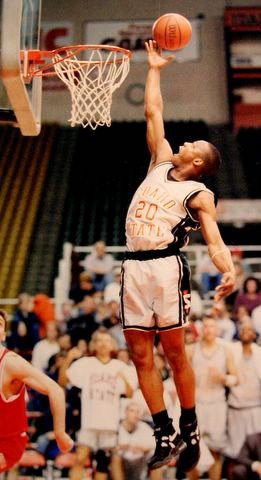 [February 3rd] --Most any person who loves photography, and who loves sports, would like nothing better than to be able to take photographs of sporting events. When you live in the "big city," however, getting noticed is very hard. I mean, how many amateurs with a Nikon digital camera would love nothing better than to be courtside at a Terrapins' basketball game? When I was in high school, a sports editor for the Northern Virginia Sun came to my high school and asked for a photographer to take photographs at that nights football game against the Annandale Atoms. I was literally the only kid in school that day with a camera hanging around their neck. I got the job sight unseen and spent the next few years taking sports pictures for the Sun Newspapers at $15 a pop. Right place. Right time.
It was many years later that I got the opportunity to photograph big time college football (and yes, I realize that some of you might say, "Idaho State University? Big time?"). I met the new head football coach of Idaho State University, Brian McNeely, at my camera store. He needed a photographer and videographer for his team, and he gave me the job because he didn't know another soul in town at that time. I followed the team for five seasons, from 1992-1997. These pictures were hardest to take because of the lighting c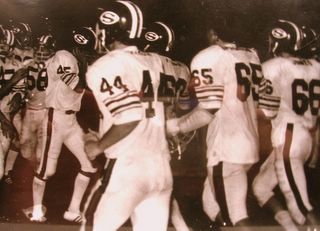 conditions and fast movement, yet football was my favorite sport to shoot. I began taking the pictures for the ISU mens basketball team the following year. Right place. Right time.
In 1993, the Salt Lake Trappers were forced out of their decaying stadium and moved north to Pocatello for a year. I stopped by the park to introduce myself to the general manager. I came away as the team's "official photographer." Right place. Right time.
I even got the opportunity to be the public address announcer for the Idaho Falls Braves, Atlanta's rookie league club in 1988 and '89. I stopped by the stadium to try to sell the players boom boxes (I figured 18 year old kids needed boom boxes) and the team's general manager, Rai Haninger, told me his PA guy just quit and moved to Portland, and did I want the job? I was a boom box salesman, not an announcer. "No problem" said Rai, adding "you'll do fine." I got paid $25 a game to sit in the best seat in the house and say, "Leading off, and playing centerfield..." Rai once showed me a box of audio cassette tapes that doctors and lawyers sent to him each summer. They were demo tapes of them in their best "public address" voice. They offered to come out to Idaho Falls from Indiana and New York and Washington and do my job for free. Kind of a "field of dreams" moment for them I guess. I got to work with the San Diego chicken one night, and watched some guy blow himself up at second base (which he did at over 100 minor league games every year). Right place. Right time.
You would think that a guy who can list "professional sports photographer" and "professional baseball announcer" would have had to work his way up from the bottom, spending years honing his skills before getting to work for Division I schools and minor league baseball teams. Nope. Right place. Right time.
And I can sure live with that, too.
ARMAS A PIRATE
 [February 2nd] -- The Tony Armas Jr. era has come to an end in Washington. The Pirates signed the former National to a one year, $3.5 million dollar contract after going 9-12, 5.03 last year for Washington. Get rocked in a pitcher's park, get a $1.4 million dollar raise. Hey, it worked for Ramon Ortiz ....
No doubt, you're as happy to see him go as I am. How many games could we watch, after all, where Armas threw 90 pitches by the 4th inning. There was talent and potential behind every pitch he threw, yet game after game, he frustrated his manager, his team and his fans. Potential doesn't always equal success.
Why didn't he make good? Was it injuries? Attitude? Bad luck? Perhaps equal amounts of all three. Perhaps we'll never know. Google search his name, and you'll find stories that cover two main themes: promise unfulfilled and never-ending injuries.
But to understand his future, we have to review his past.
It was the last spring training game of 2003. Tony Armas squinted in the Florida sunshine as he leaned in towards catcher Michael Barrett to get his sign. The Mets' Jason Phillips danced off of third base. Armas came set and snapped off a curve ball that caug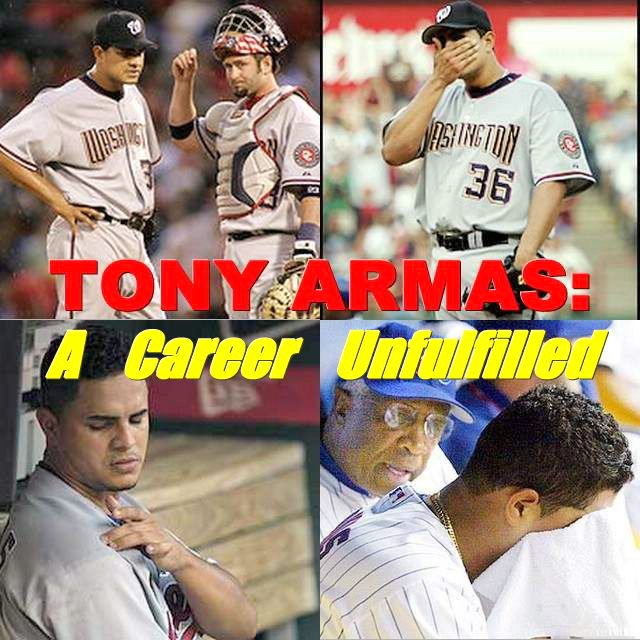 ht Ty Wiggington looking. "Strike three -- three outs!" bellowed the umpire. His day done, Armas began to run laps in the outfield, satisfied with both his outing that day and his effort during the spring. In 19 innings, Armas had given up only 3 runs while striking out 21 batters. Finally, the potential that had caused first the Red Sox, and then the Expos to acquire him, had been transformed to success on the field. He was confident that 2003 was going to be his breakout season.
Manager Frank Robinson certainly thought so, and tabbed the then 25 year old as the team's opening day starter against the mighty Atlanta Braves, who had just won their 12th consecutive division title. Armas would face four-time Cy Young award winner Greg Maddux.
It wasn't close.
Orlando Cabrera's two out, two on, two run home run opened the flood gates as the Expos scored four runs in the first inning, allowing Tony Armas to cruise to a 10-2 victory over Atlanta. Armas pitched 6 innings, giving up only 1 run on 5 singles. During the post game interview, Frank Robinson told the press that Armas had "turned the corner," and would finally develop into the dominant pitcher the team had always envisioned he would become.
His second game, against the Mets, wasn't quite as good. He gave up 3 runs in 5 innings in a 3-1 loss to New York. His next start, against the Cubs, was as dominant as the National League had seen that season. In 7 innings, Armas gave up only 3 singles while striking out 11 in a 7-1 pasting of Chicago. Game four was a rematch against the Braves in Montreal. Armas threw another seven stellar innings, giving up only 3 hits in a no-decision loss to the Braves in 10 innings. His fifth start, against the Reds in Puerto Rico, wasn't nearly as pretty. Although he gave up only 8 hits in 6 innings, 4 of them were home runs (one to current team-mate Jose Guillen) as the Reds be at Armas and the Expos, 7-5. After 5 starts, Armas had a record of 2-1 with a solid .261 ERA. In 31 innings, struck out 23 and walked only 8 batters. He dominated in 4 of his 5 starts.
A dejected Armas boarded the team plane as it warmed it's engines on the tarmac at Marin International Airport in San Juan. He reached his seat and opened the overhead bin and, grabbing his travel bag with his pitching arm, threw it into the bin. He felt a sharp pain shoot through his shoulder. When Armas awoke the next morning in his Montreal apartment, he couldn't lift his arm. It happened again. Armas had torn both his rotor cuff and his labrum. He was done for the season.
The Expos/Nationals' franchise understood the fragile nature of Tony Armas Jr. His father, slugger Tony Armas Sr., missed more than 300 games in his career due to injury. In 1998, the Expos micro-managed their budding star to the point of forbidding him to throw certain pitches for fear of injuring his arm. He was tabbed as the Eastern League's best pitcher the previous season, and the Expos wanted him protected.
It didn't help.
Armas had sprained his elbow during the 2000 off-season, and was held back during the first part of spring training in 2001. When he was finally allowed to throw hard, he developed tendonitis in his shoulder. Because the arm trouble limited the types of pitches he could throw, batters were waiting on his fastball, and he was hammered hard all season. Armas went 9-14, 4.03 in 2001. He stayed healthy in 2002, and won 12 games for the first time in his career
Armas began spring training 2004 believing that he was 100% healthy. Frank Robinson wanted Armas to re main on the disabled list and continue to regain his strength, but Armas believed he was ready to pitch again. Frank was right. Halfway through the season, Armas developed a tired arm and was only able to start 16 games, going 2-4, 4.88. He came into the Nationals' initial spring training in 2005 fully healthy for the first time in several years. The team, and all of baseball really, believed that 2005 would be Armas' "breakout" year. That lasted until March 28th, when a pulled groin put the 27 year old on the 15-day disabled list. He rejoined the Nationals in May having missed 31 games. He started 19 games, going 7-7, 4.97. In September, he re-injured his groin and was listed as "day to day." A week later, the team placed him on the 60 day DL and he was lost for the season.
The Nationals weren't interested in re-signing Armas after the 2005 season. They  believed that several teams would take a chance on the talented but oft-injured pitcher, and they just didn't have the payroll to take a chance on him. It was thought that Armas would get a contract that called for $4-6 million per year. He got nothing. Oh sure, the Rockies were interested, but playing a season in Denver wasn't going to do much to help him get any type of significant contract in 2007. He ended up re-signing with the Nationals for the 2006 season for about $2.1 million. The Nationals hoped that he would remain healthy and starts 30 games last year. Armas hoped that he would remain healthy and pitch well enough to garner a multi-year free-agent contract for 2007.
Both sides were dissapointed.
So Tony Armas Jr. is in Pittsburgh now, and he'll likely drive their fans as crazy as he drove us. And that's really too bad. He could have been very good, maybe even great. Usually, you never want your teams former players to do very well once they left -- kind of makes your GM look bad and makes you wonder "what might have been." I mean, how would you feel if Armas goes 15-6, 3.77 with the Pirates? That said, I truly want him to succeed, to have a major league career that he can be proud of. I've always liked Armas, just not the way he pitched.
Good luck, Tony.
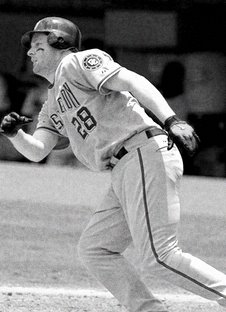
KEARNS GAINS LONG-TERM CONTRACT
 [February 1st] -- The Nationals are finally "talking the talk" after months of "walking the walk."
Austin Kearns, who was arbitration eligible, has instead signed a three year extension with the Nationals on Thursday. The team has a club option for 2010.
Very nice.
When it became apparent last year that the Lerner's policy was going to build-from-within, I pleaded in one of my posts for the team to do what the Indians did a decade ago, to lock up the young stars to long-term deals. If you recall, it didn't take long for Manny Ramirez, Carlos Baerga, Jim Thome and the rest of the team to mature and become one of the American League's dominant forces for six years.
But know that I applaud the policy but not the contract itself.
While I enjoy what Austin Kearns brings to the Nationals, he is not a star. His stats - until the trade - had been inflated by Cincinnati's bandbox of a ballpark.
Kearns' numbers would have looked like this last year had he stayed with the Reds all year (using his Cincinnati stats multiplied out to 550 at bats): Ave: 274 - 35 doubles - 2 triples - 27 homers - 85 RBI's - 90 runs scored. This is how Kearns' numbers might have looked had he played with the Nationals all year (again, using his D.C. stats multiplied out to 550 at bats): Ave: 250 - 32 doubles - 2 triples - 21 homers - 97 RBI's - 90 runs scored.
Don't get me wrong; I'm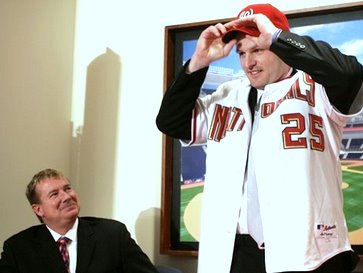 not complaining. But a guy who hits .250-21-97 is part of a good team and not someone that you build around. The Austin Kearns that Washington watched was similar in a lot of ways to Brad Wilkerson, and Bowden ended up trading him away. He's a nice piece of the team's future but certainly not the future of the Washington Nationals.
There were just too many strikeouts, too many popups to the right side, to say that this is a "great day" for the Washington Nationals. But Kearns is a solid player, someone who will make Ryan Zimmerman and Ryan Church better. And considering that the contract will pay Kearns just $16.5 million over the next three years, the Nationals are certainly not overpaying for having some stability in right field.
I do worry about Kearns sometimes. The reason that Ryan Zimmerman seemed almost slump-proof last year was his command of the strikezone and his ability to hit the ball the other way with power. Kearns does not have that type of talent. When he loses sight of the strikezone, he can go into prolonged slumps, the 0-20 or 2-30 with a dozen or more strikeouts type that can really hurt a team.
I love the move and I can live with Kearns as a long-term solution in right. Bowden went out of his way in the press conference to underscore Kearns' character and integrity. He told reporters that - yes - he was shocked when he was traded to Washington, but he has grown to like the area and now feels very comfortable here.
Kearns is happy, and so are the Nationals.
And really, so am I.