GIVING LOVE TO AN OLD FRIEND
 [February 1st] -- Bud Selig wanted to make sure that there was no misunderstanding. A caller from Falls Church asked Selig, who was a guest on XM's MLB Homeplate program a while ago, "Commissioner, you could have moved the Expos to Norfolk, or Portland, or New Orleans, or any other city that doesn't have a baseball team. Why did you choose Washington? Did you feel guilty that we've lost two teams and you were trying to make things right?" There was a pause, then Selig replied, "We moved the Expos to Washington because D.C. had a stadium that was close to being major-league ready. None of the other cities had that."
Next question!
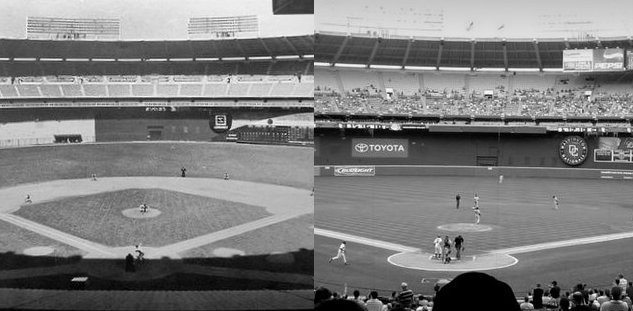
We owe a deep debt of thanks to RFK for bringing baseball back to town. Since opening day of 2005, however, it's been called "dilapidated," "decrepit" and "unworthy" to host major league baseball games. True, it wasn't in the best of shape, but the $18 million dollar face lift it received made it adequate to its detractors, and a "great place to watch a game" for we baseball purists. Today, RFK Stadium is nothing more than a stop-gap, a place to play until the next greatest park is built, but when it first opened its doors, it was the most high-tech, state-of-the-art stadium in the United States. 
Griffith Stadium was one of the first steel and concrete baseball stadiums ever built. It replaced American League Park, a wooden structure that was at the time only three years old. By the 1950's, haphazard expansions and the Griffith family's tight-fisted nature made Griffith Stadium an eye-sore and a terrible place to watch a game. Congress began to consider the possibility of building a new, modern, dual purpose facility for the city, the first stadium specifically designed for two sports. Everyone loved the idea. Everyone except Calvin Griffith that is. The Griffiths owned both the Washington Senators and Griffith Stadium, and received a very nice income from the rent and concession and parking revenues generated from the Washington Redskins as well as other events. By playing in a new city owned stadium, Griffith would not only lose revenues but would also have to start paying rent, something the team had never had to do. Griffith asked for, and received permission to move the team just a few months after construction began on what would eventually become known as "D.C. Stadium." Upon hearing that news, Congress immediately threatened baseball with the removal of their anti-trust exemption and, almost immediately, the city of Washington was granted an expansion team to play in the new stadium.
City officials wanted the new stadium to be "first class all the way," and engaged Osborn Engineering to build the structure. Osborn was the "HOK" of their day, having designed and built both Fenway Park and Yankee Stadium. You just can't get any better than that. City officials stressed that they didn't want an urban, quirky stadium with an unusual footprint.
Washington was a city of symmetry, and Osborn was given the task of coming up with something that mirrored Washington's uniqueness.
Congress gave the Washington Fine Arts Commission final authority in all construction and design decisions. The commission was created in 1910, and charged with "meeting the growing need for a permanent body to advise the government on matters pertaining to the arts; and particularly, to guide the architectural development of Washington." Fountains, statues, monuments and memorials were all under the pervue of the commission. The height and size of buildings were strictly regulated. The commission looked at the new stadium as but another federal building in need of its guidance.
It became a nightmare.
Osborn would deliver designs to the commission who would then change much of what the architects had envisioned. The original light towers, for example, were "red lined" because they interfered with sightlines from the roof. By the time construction began, in July, 1960, the two sides were barely talking.
Fifteen months later, the stadium was complete and ready for use.
D.C. Stadium was like no other facility when it opened. Unlike the other baseball parks, which were all built before there was a National Football League, D.C. Stadium was built with the Redskins in mind. The third base stands were built on a roller system which allowed the stands to be moved into centerfield for football games, lining both sides of the football field with high priced seats. There were broadcast booths for both sports, behind home plate for baseball and at the fifty yard line for football. The light banks were designed to illuminate both fields independently. In 1963, the $400,000 scoreboard was installed behind the right field fence.
D.C. Stadium remained unchanged throughout the mid 1960's.
The name was changed to R.F.K. Memorial Stadium after the Senator from New York was assassinated in 1968. Following the assassination of Martin Luther King, the Senators chose to play many of their games during the day to placate their jittery suburban fans. Virtually no one showed to those games, forcing an already poor ownership group to sell the team (to you know who). In 1970, Vince Lombardi, new head coach of the Redskins, asked the D.C. Armory Board, managers of the stadium, to replace the grass field with astro-turf. They approved the request, but Senators' owner Bob Short refused, citing cost as the reason. The Senators left following the 1971 season, leaving the stadium to the Redskins. Over the next fifteen years, the stadium was kept clean, but little was done to keep the facility up to date. The "movable" stands rusted in place. A new scoreboard was installed in the right field upper deck, but was very plain when compared to the other NFL stadiums. When the Redskins left in 1997 for their new facility in suburban Maryland, D.C. United became the prime tenant. The city, and the soccer team, were unwilling, perhaps even unable, to invest any money into repairs and renovations for the now thirty-six year old stadium.
R.F.K. Stadium cost $20 million dollars to build in 1961. The city of Washington sank $19 million into the facility earlier this year just to bring it up to code to placate the fire marshal as well as making it "good enough" for Bud Selig and major league baseball.
Just "good enough?" RFK was so good that cities all across the country copied the stadium's design. Atlanta, St. Louis, Pittsburgh, Cincinnati and Philadelphia built near carbon copy facilities, and New York, San Diego and Houston created stadiums in part based on RFK's design.
So many cities copied RFK that the term "cookie cutter" became synonymous with RFK's circular symmetry and clean lines. All those parks are now gone, and cookie cutter refers to all of the new, "old" look parks that have been built in the last decade.
RFK was the best of the circular stadiums. It wasn't patterned after anything else. It was unique. It was special. It was one of a kind. Just like the city it represents. I'll miss it when the Nationals move on.
That's roughly 425 days. RFK is a lot like Frank Robinson. Old. Out of date. Rusty. Yet, it needs to go just like Frank Robinson. It wasn't fun when Frank left, and it won't be fun when we leave RFK.
I guess we'll miss both of them, warts and all.

ON THE REBOUND
THE END OF EN ERA?
 [January 21st] -- I knew - I knew - that my Bill Ladson column would bring with it, what should I say, consequences? And consequences it has. A few bloggers have confided in me personally their sadness at what a few have written. And I really appreciate that.
I began to think about this in detail after hanging up with Bill. My guess was that that if given the opportunity, the same bloggers would come after me just after they went after bill, although none of them would ever claim that they were doing anything other than their journalistic duty.
So I took what I really believed, juiced it up a little bit, aligned myself with Bill (by the way, it's just as 'acceptable' to be pro-Bill Ladson as it is to be anti) and pushed the publish button. I went out of my way not to attribute any of Bill's concerns towards any specific blogs (though he told me which ones they were). I just didn't see how that would have helped the story in the long-term. I knew the story would draw a response, but not like the one it received.
What did I hope to see? Well, Banks Of The Anacostia and Nats 320 come to mind. Both wrote stories, disagreeing, and agreeing, with what Bill and I had said. It worked out well. Then, seeing the firestorm burning across the blog-o-sphere, Banks wrote another story today saying that perhaps there were reasons I didn't get it right. But he began with this: "The other topic I wanted to address was the minor blog storm that has erupted over Farid's and Ladson's comments about Nats bloggers in general in his interview yesterday. First off, let me state for the record that I think that Farid is one of the nicest bloggers out there. In every interaction I've had with the guy, even when we disagreed, he's been nothing but unceasingly cordial. That's a good thing. I think he genuinely dislikes controversy and aggressive opinionating, which is in plentiful supply among Nats bloggers. Again, nothing wrong with that. In the South, and we have a word for men like Farid. It's "gentlemen." Then he went on to hit me fairly and accurately. I guess this is how I had hoped our blog-0-sphere would react, a place where respect and kindness never left, never went away. Jamming could have torn my heart out and placed in on a pole, but he made it clear it wasn't personal. Thanks, buddy.
Amusingly, this wasn't even the first time that I ran into a problem with this story. The first came before I ever wrote it. 'Mr. Anonymous' and "Yuda" left some comments on my site suggesting that I had already told my readers that the Ladson column was finished on Friday. When I quoted one the specifics of my post, the other then suggested that perhaps didn't I really just go back and clean up the post?
Yeah, really.
The most - um - strong reply came from Distinguished Senators, the blog that rose from its own ashes. Now, to be frank, I'd never really read his work very much. From the very first time I visited, it was obvious that my view on covering the Nationals and his view of covering the Nationals were two very different things. No problem. Each of us have cultivated our own garden as it were. That said, after reading his story on Ladson, it became quite clear that I was the story now.
Here are a couple of excerpts from his (well written) story, and yes, if he feels comfortable cherry picking my prose, I'll return the favor:
- "What I haven't yet come to terms with, though, is Farid's sycophantic attitude, his willingness to take Ladson' preposterous claims at face value, and his genuinely insulting generalizations about "bloggers."
- "Examples please. And not just examples from your writings, Farid. You're calling out "bloggers" here. I'm a blogger, and I assume that I can write with impunity because I'm protected by the First Amendment. And since Farid understands the inner motivations of bloggers, perhaps he can show me the stuff I didn't believe myself when I wrote it."
- "Right. And my common sense is doing a fine job. I don't need yours."
- "The obvious response is that Farid isn't talking about any criticism, just the personal stuff. But given Ladson's ridiculously self-serving idea of what a personal attack is and Farid's sycophantic willingness to go along with it, it's clear what's meant. You agree with Bill Ladson, dammit, because he knows better than you."
On and on it went. Why, at one point he even got a little disagreeable about my penchant for hyphenations. His slice-and-dice attempt to get at the truth reminded me a lot of Saturday Night Live's Bass-o-matic '76 (for those of you with a few years of age on you). But even at that, no biggie. Sticks and stones, baby. Sticks and stones.
But I did make one very large mistake, which I guess I should apologize for. See, I got a call from my doctor to come back in and see him, on the day of the interview. Turns out my routine physical wasn't routine at all. When you're 50, you've gained wisdom but lost proper function in all parts of your body. So I wrote the rest of the story with a sense of finality throughout every word and paragraph. And it showed. It had a real "can't everybody just get along" quality, didn't it?
So, what does this mean? Well, you know how we've all laughed about not living long enough to see "the plan" come to take shape?........ Well .....
If I do stop blogging immediately, it certainly had nothing to do with what Distinguished Senators said. At least until he starts using smaller words so I don't have to keep using the dictionary. But if I do, it's because health, and life, force me down a path less "fun." As of a couple of weeks ago, TBB was #11 nationally on striketwo.net and the #1 Nats' blog, so it's been a good run regardless. Nats 320 and Banks will do a superb job replacing me if needed.
There is something that Bill told me that rings so true is all of this: it's fine to disagree with him, but email him first -- get to know him so you can understand why he wrote a particular story or feature. There just isn't much journalism required in typing.
A couple of years ago, I came up with a second site for the Nationals' minor league teams. I named it something that ended up sounding almost like Nationals Farm Authority (I can't remember exactly what it was any more) The Yudites went crazy. One morning, I must have received twenty comments and was stunned to find out they were malicious, viscious and attacked just about every family member but my dog and parakeet. By back-tracking the posts, I found myself at Yuda's, a place I never knew even existed. And there, line and after line, were people who had never talked to me, who didn't know why I had done what I did, doing a very good job of destroying my name. Oh, there were two guys there trying to defend me. Basil from Federal Baseball and Brian at NFA. They knew me. "I've talked to him a few times and he sounds like a nice guy" said Basil. Brian said that "I've talked to him before on other matters, and I can't believe this is someing he meant to do" (or thereabouts - like I said, it's been two years).
So what makes more sense, then? Copying and pasting a post from another site so, like a dead corpse, you can disect it and eviserate it to the point of it being nearly non-recognizable to the writer, or leaving a comment on that site and saying, "Hey, I've got some real concerns with your column -- okay if you email me so we can talk about it?"
This was exactly the point Bill tried to make. I don't care what you think, Bill told me. But contact me for my side before you start chewing on my rear end. One blog wasn't particularly happy at my attempt to separate bloggers from journalists. This is just why I did so. So many of our beloved blog sites are now going straight to the horse's mouth to get it right. It can be done. To not contact Bill, to not contact me, and then still launch such a pejorative attack? Forget ethics. It's about being fair.
For my friends, I'll return very shortly with an update as to where we're going with "all of this." It came out of the blue for me too.
Thank you for your good wishes,
Farid
IT'S BILL LADSON'S TIME TO SHINE IN THE BLOGGER'S SPOTLIGHT
 [January 24th] -- (Here is the - nearly - finished interview. There may still be a few typos, but I'll fix those later. It's time to post NOW).
After getting off the phone with Bill Ladson - who graciously gave up more than an hour of his day to be interviewed by a blogger - a couple of things struck me. First, Bill is a genuine and decent man with a depth of baseball knowledge I have seldom come across. I mean, he was able to tell me the career batting average of long-forgotten 3rd baseman from the 1970's - that is, forgotten outside of New York City and a few really really fanatic Indians' fans. Bill seems to remember every game in every year in every city he's visited. It's a lucky thing that I can type 100+ words per minute or I would never have been able to keep up with him.
The second thing that struck me was how much damage bloggers can unintentionally (and sadly, sometimes intentionally) cause to not only the truth, but to the good name of those that we cover. Bloggers sometimes assume that we can write what we want with impunity because the only people that read our work are fellow fans who understand they are reading subjective rants, some of which we didn't believe ourselves when we wrote it. Simply, it made for good copy.
Wrong.
Bill was able to not only name the majority of Nationals' blogs but also the names of the bloggers who write them. I could tell that Bill is a writer because he never used sweeping statements that were so inclusive as to be as right or wrong as the reader desired. When discussing the types of blog entries that he found unfortunate, he not only named the blog but also named the specific entry by title. Bill knows us and reads us.
Uh-oh.
When setting up the interview a couple of weeks ago, Bill told me that it irritated him to read bloggers report that he is a Nationals' "insider," that he has some secret password or unlisted cell phone number that leads him directly to Jim Bowden or Stan Kasten. "Nothing could be further from the truth," Bill told me. I agreed that this wasn't good reporting - that is - printing assumptions as fact. As I prepared for the interview, I searched his name on my site to review the things I had written over the past couple of years regarding him. I found a story I had forgotten about, one where I talked about a "phone call" to Jim Bowden that gave Bill a scoop on a story.
Shoot.
When I fessed up to this mis-deed before beginning our interview, Bill said, "Oh I know. I read the story." So after cutting his feet out from under him with my assumptions , he returned the favor by graciously allowing me to interview him.
Bill was fair in all of his answers, but quickly corrected me when a question I asked was based on a false premise - you'll see several of those. When he corrected me, though, it wasn't personal. It was about baseball. That's the way Bill Ladson thinks it should be done.
Bill, your a class act. Thank you for the opportunity.
From a fans perspective - and after all, that's what blogging is all about - I have always been curious as to the behind-the-scenes aspects of baseball life. Sure, I know that Bill is the team's beat writer, but how did h e get the job? Turns out it was all about desire. "I was on the desk at mlb.com when I found out that the Expos beat writer was leaving," Bill told me. "I sent an email to my boss telling him I was very interested in the job. I liked the Expos because of their run in 2002 and how competitive they were at the time. Remember, that was [manager] Frank Robinson's and [general manager] Omar Minaya's first year in Montreal. Everyone expected the team to lose 100 games and they ended up finishing second. I told the editor I wanted to be part of this and I started in 2003." Reader "Tony C." asked which job has been Bill's favorite besides working for the Nationals. "This is my favorite all-time job," he said. "I thought I'd be on a desk for all of my career. I really enjoy covering the team."
Basil in Midlothian Virginia [Federal Baseball] wanted to know who inspired Bill to become a journalist, and who might have mentored him in the beginning. Bill answered without hesitation. "There were two guys and one musician. In sports, Bill Madden was my favorite, when he covered the Yankees. It appeared he was the only one who got George Steinbrenner [to talk] on a regular basis. Art Rust Jr. was the only African-American to have his own sports talk show in the early 1980's and he was an inspiration to me. As far as work ethic, it was Otis Redding. The way he went on stage, the way he approached his job was all-out. I wrote a story on the 20th anniversary of his death [it was Bill's college paper] and everyone I spoke to, Issac Hayes, his managers, the one thing that stood out was that he wasn't afraid to work. I want people to say that about me."
The Expos weren't Bill's first foray into journalism. Before joining the Expos/Nationals, he worked for Sport Magazine. "I was an editor before I was a beat writer for Sport Magazine. I was even the hockey editor. I followed the NHL for five years. I was based in Los Angeles during the time Wayne Gretzky was with the Kings. I really enjoyed it.
I have always wondered about the demise of baseball in Montreal. Certainly the Toronto Blue Jays have been extremely successful the last two decades. If Toronto could support a major league franchise, then why couldn't Montreal? Through the late 1950's, Montreal was a tremendous 'AAA' baseball town, regularly packing the 20,000 seat Delorimier Stadium. So I asked bill if he saw any scenario - any circumstance - in which major league baseball could have thrived in the city of Montreal. I was surprised by his answer: "Yes! People blamed the fans because of the lack of turnout but that was just plain wrong. In my opinion, corporate Canada wasn't interested in baseball in Montreal. There were also tough stadium issues and no television money. The strike in 1994, followed by the breakup of the team did the real damage."
The Expos initially played in Jarry Park, a 3,000 seat amateur facility tha t was quickly renovated an
 d enlarged to seat 28,000 by opening day in 1969. After the Olympics in 1976, the Expos moved into the cavernous Olympic Stadium. We've all heard the jokes about the stadium, that it looked like a frisbee, that the roof was a broken as the team that played in it. I asked Bill if Olympic Stadium looked as bad in person as it did on television. Another surprise followed: "I have to tell you that if you look at it on television it doesn't look pretty, but the first time I went to the stadium in 2003, I thought it was one of the most underrated stadiums I had ever seen. I loved it! I thought it was a great stadium to play baseball in." This surpised me. No, I have never been to Olympic Stadium, but pictures I have seen and stories I have read indicate that it was a hell-hole to play baseball in. But I've never been there, and Bill has.
A reader left a question asking if Bill knew about the move to Washington before the media did. No, he didn't. "I learned like the rest of you. We didn't know anything until the last week of the season. I got a hint though when during the 2nd half of the season, some of the beat writers stopped traveling with the team. It was me and a writer with Canadian Press."
I had always believed that Major League Baseball had never really considered the other cities - Portland and Norfolk specifically - as potential new homes for the Expos. Washington was the only city, after all, who had a stadium that could be quickly brought up to MLB standards. But Bill assured me that - yes - the other cities were viable alternatives and that the league took a serious look at them [ I personally think that RFK is what brought baseball back to D.C. If Norfolk had a large enough temporary stadium, I'm afraid they might have been MLB's top choice] Regardless, the team ended up inside-the-beltway. Many believed that Washington just wasn't a baseball town, and would struggle one more time in winning fans and filling RFK Stadium.
Not Bill.
"No. With a new team, and the fact they were competitive, with Frank [Robinson] being there, and with his connection to Baltimore and the D.C. area, I thought it would thrive, which it of course has." I wouldn't have thought that Robinson's relationship with the Orioles would have helped to any significant degree. Growing up as a Senators' fan, I hated Frank Robinson because he - and the Orioles - were so much better than the Senators. Hindsight tells me however, that Bill is probably right.
I was interested to see what Bill thought of the new stadium. "I haven't seen it yet," he said, adding "though I will on January 29th. I think it will do a world of good and do nothing but help the team." Ever the journalist, Bill wasn't interested in giving his opinion based on just the drawings and renderings. I'll check back with him in early February and get an update on the stadium.
I changed gears just a little bit at this point and asked him a question that needed to be asked before getting into the 'meat and potatoes' part of the interview. "Do you work for the Washington Nationals? - the assumption, of course, is that he does and this helps him gain insights into the team that other beat writers do not have. Bill was adamant on this. "No, I work for MLB advance media." He chuckled for a moment and added, "If I worked for the Nationals, they would tell me what to say and what to write. If that was the case, I wouldn't have people in the organization mad at me sometimes!" This surprised me, because all of us have seen that little disclaimer at the bottom of some of the articles on all of the team's websites that says, "[This writer] is a reporter for MLB.com. This story was not subject to the approval of Major League Baseball or its clubs." I asked Bill about that disclaimer and the confusion it can cause. His answer was firm: "Stan Kasten and Tony Taveres and Omar Minaya before him, and Frank Robinson and Jim Bowden and the PR staff have never told me what to write. I think I've been fair and balanced. Every story I've ever written has either been mine or my bosses. And trust me, if my boss wants a story on Ryan Zimmerman, he gets a story on Ryan Zimmerman."
I don't think there was a single blogger who wanted Frank Robinson to return as manager in 2007. Oh, most of us felt bad that he's not coming back and especially for the way the team treated him, but a change needed to be made. I asked Bill for his perspective: "A change needed to be made for whatever reason. From the second half of 2005, the team stopped responding to Frank .. for whatever reason. Frank was reluctant to make changes. I didn't understand why he wouldn't bench Vinny Castilla, Preston Wilson and Cristian Guzman. The team had alternatives. In Montreal, for example, when Vlad Guerrero missed two months in 2003, Frank had no alternatives to replace him. He had Ron Calloway who did an okay job, but in 2005, Frank had Ryan Zimmerman, Jamey Carroll, and Brandon Watson. Last year, well there was Damian Jackson, who fundamentally just wasn't there, for whatever reason. Frank wasn't willing to make changes when they were needed." I asked Bill if he ever confronted Robinson about not benching the veterans and he said that he had, that Frank simply said that he was being loyal to those players that helped the team stay in first place for so much of the season
 .
.
Pro-planner. Anti-planner. Yada-yada-yada. It began in the blog-o-sphere and has since permeated the mainstream media. Are you pro-planner or anti-planner? It's almost like being a Republican hissy-fitting with a Democrat. You can be one, but not the other. So I asked Bill if he thought one side, or the other, or both sides, were right. "The pro-planner side is right, because if you look at the last 1 ½ years, the team has fielded mostly veterans and have two 5th place finishes to show for it, so why not make the team younger and build from within." Bill then spoke of the team's recent history in the minor leagues. "That's been a problem since I've been covering the team. For the first time, we have starting pitchers to talk about in the farm system. That's the right way to go. Look at the last twenty years, most teams have won because of their farm system. The Marlins. The Tigers. They won because of their farm system."
Okay. The time had come for a hard question. "What does Manny Acta see in Noo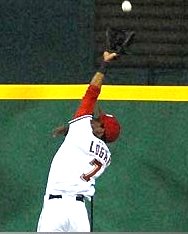 k Logan that we don't" I began, "enough to name him the starting centerfielder? Isn't he another Brandon Watson or Endy Chavez?" Now, I've got to tell you that I believed wholeheartedly that I was right about this, that Acta has made a big mistake. I tried to impress Bill with my knowing Logan's embarassingly low minor league on-base percentage and batting average. Hah! I thought. Wiggle out of that one, Billy boy!
And wiggle, he did.
"I'm really surprised by the Nationals bloggers reaction regarding Acta's announcement," Bill told me. "I mean, what games have you been watching? Before Nook Logan, this team had real problems in center field, fielding and hitting. Ryan Church didn't do well in center; he was misjudging a lot of fly balls and let's face it, Nook Logan is an excellent center fielder, and bad defense is why we had a 5th place finish last year. I don't have a problem with Nook being a starter. No question, he has problems with hitting. From the right side of the plate, he's a major league hitter. It's the left side where he gets the most at-bats, where he has problems. He can bunt, but he can't hit as well. But I think that Mitchell Page will work his magic on him." I asked him who had the most upside between Logan, Watson and Chavez. He said "that's a good question." FINALLY! :) He sees Logan with a much higher upside than Brandon Watson and about the same as Chavez when he had his strong September in 2002.
In this instance, I hope Bill is right. Looking in from the outside, Logan looks like just another broken center-fielder that has yet to make good. I mean, we got the guy from the Tigers "for cash considerations." He's thrown off their forty man roster and ends up a week or two later as the Nationals' starting center fielder? Bill (and the other beat writers) see so much more than just stats because they were there every day watching these players. I hope I will have to email a note of apology to Bill come September, when Nook Logan proves all the bloggers wrong. That said, I hope you don't mind if I don't write the first draft until after spring training.
We began to talk about the Nationals' minor league system. I asked him if the farm system had really improved, or was it just an improvement based on the fact that it had nowhere to go but up. "It's much better than it was in 2003-2005. Once the Lerners took over, and they haven't wavered - and shouldn't - the farm system is much better. I'm writing about starting pitchers in the farm system again. Of course, they need hitters too. After Kory Casto and Larry Broadway, there is no one ready for the major leagues. Right now, there are more pitchers ready."
Speaking of prospects I asked Bill about Kory Casto. My concern has been his inability to hit left-handers, so I wondered if Casto would ever be more than a major league platoon player: "Casto (pron ounced Kos-to) is ready for the big leagues and it's time to give him a chance. The Nationals have had nothing but veterans the last two years and it hasn't worked out. I think Kory is ready to take over in left - I think he just needs a chance. By being the minor league player of the year the last two years, he deserves the chance to win the job." Yeah, but he can't hit lefties. Will he ever? "It's too early to say whether he can or can't hit lefthanders. In a perfect world, I think his highs would be, say, .280 with 20 homers and 100 RBI's. He has great patience at the plate and a high on base percentage."
Since Bill told me there are no hitters anywhere near being ready for the big leagues besides Casto and first-baseman Larry Broadway, I asked about the Nationals' 'AAA' first sacker. "I've been a fan of Broadway since 2004, and thought he should hav e been given the chance to start in 2004 when Nick Johnson started the season on the DL. He had a great spring training, but because he played at 'A' ball the previous year, Frank was afraid to rush him. It would have been interesting to see how he could have handled big league pitching then." Will he ever play for Washington? "I don't know if he'll get a chance. It's safe to say he'll need a great spring to make the team. Sadly, he's had some injuries and slumped at the wrong times. Bob Boone and Dana Brown and Manny Acta still believe in him though. I think he could put up numbers around .290 with 80 or 90 RBI's, maybe 17-20 homers." Hmmm. Don't those offensive numbers seem comparable to Nick Johnson??? I like Broadway too, and also believe he deserves a chance. As I've mentioned every month since I started this blog in 2004, Nick (when finally healthy) should be traded for prospects and Broadway given a chance.
We had to talk about Ryan Church. Again, he is one of my favorite players and believe he hasn't been given  much of a chance to show what he can do on a consistent basis. I told Bill that I thought Church could outperform Austin Kearns as the team's right-fielder, pointing out that Church hits lefties and righties equally while Kearns only batted .236 against righties last year.
Big mistake. I got pounded by Bill's knowledge stick.
"There is a reason that Church isn't on the 'A' list over the last two years. The organization felt at times that he should have played through the pain in 2005 - he had a toe injury and a tight groin. Also, he slumped at the wrong time in spring and also early in the 2006 season. I can understand the demotions to the minors. His hitting improved when he returned but his defense in center still wasn't very good."
"As far as Kearns, you can't just go by the stats. The first thing I look at is heart. Does he have heart? Kearns has heart. Kearns led the team in GWRBI, even though he didn't play the entire season in Washington. He is a clutch hitter."
"I grew up in New York, and the best third baseman I ever saw was Graig Nettles. I never looked at his stats. He was a lifetime .248 hitter. But he was a great fielder and an excellent clutch hitter. I don't just look at batting average and stats. When the chips are down, does the guy come through? Austin Kearns does."
I still don't know about this one. While Bill is certainly right, I tended to see an upper-cut swing missing inside fast-balls more than I did his heart. Again, I have never watched him play, so I'll hold my view on this one in abeyance.
But I still like Ryan Church.
Jim Bowden gets as much bad press in the blog-o-sphere as Bill does. Has he done a good job since becoming the team's general manager? "Bowden has done an excellent job because of the limited budged he has. It's not like he has $100 or $200 million to work with. He's no different from Omar Minaya, who did a great job too. You try to make a team better with limited resources. I've agreed with every move that he's made except sending Jamey Carroll to the Rockies, and even then I understand why he did that. I even agreed with the Ohka trade. Everyone told me when I started in Montreal that Ohka was better than Javier Vasquez! I never saw it. He was an inconsistent pitcher for 2 ½ years."
Okay, speaking of Omar Minaya, I went on a rant about his trading away Jason Bay and Grady Sizemore and Cliff Lee and Brandon Phillips and Cliff Young in return for - at least today - nothing. Without those bad trades, the Expos would have been a much better team, perhaps a great team. So how can Bill think Minaya did an excellent job during his tenure with the Expos? I mean, am I just not seeing something? "It's something you're not seeing" (ouch!). "First, they thought the team was going to be contracted and number two Minaya was going to be judged by what he did on the major league level, not by what he did in the minors. It's the same thing with Bowden - he was in the same boat - but he's no longer being judged by what he does at the major league level only. Minaya was judged at the MLB level and he did a helluva job, and because of that, he was given a chance to become the Mets' general manager. I say k udos to Minaya."
Bill certainly makes sense when he says that the assumption was the team was going to be contracted. Minor leaguers have no value, so why not trade them for veterans who could be sold in a dispersal draft? And I understand that Minaya was in essence showing himself off as a potential general manager for another team. Got it. That said, we're talking about Jason Bay [.286-35-109], Grady Sizemore [.290-28-76, 22 steals], Brandon Phillips [.276-17-75, 25 steals], Chris Young [11-5, 3.46] and Cliff Lee [14-11, 4.40]. In the real world, Bill is probably right, but that doesn't make losing these players - for nothing -hurt any less.
Okay [sigh] -- let's talk about Nationals' bloggers. I assumed that a proficient writer like Bill Ladson wouldn't waste his time reading what hack-reporters like us wrote about the team. Surprisingly, as I mentioned earlier, he not only knew all of our blog names but the names of the bloggers too. I really wanted to know what he thought about the Nats' bloggers, but wasn't sure if he was willing to tell me.
Oh yes, he was willing.
"I don't have problems with the bloggers overall. I do have a problem with some of the bloggers. For instance, I don't have a problem when "Miss Chatter" says she disagrees with me, and I don't have a problem with Nationals Enquirer spoofing my mailbag - that cracks me up actually. I do have a problem with some of the bloggers who act like they're in the know, in the locker room, and act like they know everything. I can't stand that fact that they get personal. One blogger actually said that he hacked into my computer and said that I "googled" myself all the time. That's just not true. Another blogger said I was the only beatwriter in Washington who used the word, source, in my stories. He also said that I never quoted anybody. Both statements are lies. I emailed another blogger just before the Superbowl last year and asked him why he attacked me. He still hasn't told me the reasons." In part of another question, Bill continued: "Often, blogers have legitimate points. Sometimes, they don't think before they write. It's fine that they disagree with me but all they would have to do is email me with a question and I'd tell them why I said something. They all just say that Bill does this "because" without even talking to me. If you email me I WILL respond. "
Note to all bloggers. Bill Ladson assured me, promised me, that he is sincere when he says that all you have to do is email him and he will reply, he will explain, he will help you understand his positions regarding the Nationals. His tone changed when we talked about what some of the bloggers have said, things that had nothing to do with baseball. The problem here is that bloggers are like journalists only in that we write words that end up being published somewhere. Unlike the mainstream media (at least those who are honest), we don't have set of rules to follow, we don't have an editor (other than our own common sense) to say, "Dude, that's going too far." Now, I'm not talking specifically about any blog, but in general, we could do a much better job of being fair to those we write about. Like I mentioned, I took a cheap shot at Bill without ever thinking it unfair at the time. And please, don't get me wrong; I'm not suggesting that anyone should change their styles based on what I say. To us, talking bad about Ladson or Bowden or Kasten is like talking badly about our sister when she's in the other room. They aren't listening, so it won't hurt them.
But Bill is listening. I know for a fact Stan Kasten is listening. I know for a fact that several players are listening. I think that puts the onus on us to be as professional as the paid writers are required to be.
So, a little levity. "Bill, are you a "Curly W" or a "block DC" kinda guy? "You know what, I went to a game at RFK in 1971. My dad bought me the "Curly W" hat, and I'm telling you, I loved that hat, so I'm a "Curly w" type of guy for sure.
I knew I liked you, Bill.
Ryan Zimmerman, at least right now, is the Washington Nationals. I was curious as to how Bill sees the young star and how great his future might be. I was curious as to how well Bill thought Ryan would do in 2006. "You know, the beat writers all predicted what he'd do in 2006, before the season started, and I said 15 homers, 110 RBI's and a .345 average . Unlike most rookies, he wasn't pulling the ball and really has no flaws. He's an excellent defensive player [as a rookie] and was even better than Vinny Castilla." Okay, Bill - you came close on those predictions. What do you think his stats will look like in, say, 2010? "I think when it's all said and done, Zimmerman will hit .340 (because he can hit to all fields), with 30 homers and 110-130 RBI's - he's an RBI machine. He'll be just a good a hitter as Chipper Jones though he's much better defensively right now."
What about John Patterson? He's the team's number one starter because there is no one else. Is he really a number one starter? "There is no doubt about that. He is the best pitcher they have. When healthy, he's dominant. His past physical problems were flukes and probably won't happen again. And Nick Johnson's injuries were flukes too. With Patterson, he'll be healthy and having the surgery when he did for his forearm was a great idea. He'll be ready."
John scares me. He's had one solid season, and yet the Nationals are pinning their hopes on a guy who doesn't have a track record that includes any consistency. I believe John has the talent to go 15-10, 3.50, but like Nick Johnson before last season, I'll have to wait to believe it when I see it.
I've been hopin g that Jon Rauch would end up a starter for the Nationals. Everyone says he has the talent, but yet there he is, year in and year out, in the bullpen. Why? "I think Rauch is happy as a bullpen guy. He has found his niche, his success. In terms of control, he is one of the best on the team. Let's face it. Rauch is almost dominant as a setup guy." Yeah, but what about Luis Ayala? He's the team's setup guy when healthy? Bill thinks that, coming off of Tommy John surgery, Ayala won't be ready to take over that roll again for quiete some time. Looks like it's Rauch, at least for the forseeable future.
The Nationals are of course building for the future. I asked bill what the Nationals needed more, an all-star closer or more prospects, and if Cordero were traded, who would likely take his place? "They need to continue to improve their farm system. The process is far from done. They need as many minor leaguers as they can get. Should Cordero get traded [and Bill never suggested he would], Ryan Wagner or Rauch would replace him. Wagner has a blazing fastball and strikes out lots of batters."
I was surprised to note that Bill suggested in one of his mailbags columns that Joel Hanrahan (at the time he wrote it) was a leading candidate to earn a spot in the starting rotation. What about that? "I spoke to people who saw him pitch in the Dodger organization and they told me that this guy could really be a star. I guess he was out of the loop in the Dodger organization. But that's what the scouts told me." Scouts are smarter than bloggers. Look for Hanrahan in the rotation.
Felipe Lopez hit 23 homers while playing in that band-box in Cincinna ti. I asked Bill if that was a product of the stadium, and if he'd ever hit those many again with the Nationals: "It was funny, but the way he swung the bat in DC was almost as though he understood where he was playing and was just trying to get base hits." That's a good thing to hear. I like players who play within themselves and work to help the team win, and not to pad their stats. Good for you, Felipe.
A TBB reader left this question for Bill last week: Bill, who is your favorite prospect. I don't want to know who you think is the best, but rather who you like the most: "Larry Broadway. I Saw him play in spring training in 2004 and saw him hit a mammoth homer against the wind at the Orioles' spring training complex in Fort Lauderdale. I Became immediately impressed." I'd tell you yet again that I'm a big Broadway fan, but I think you've already got the idea there.
Any interview wouldn't be complete without a question regarding Alfonso Soriano leaving Washington. I asked Bill if the Nationals did the right thing in letting him stay on July 31st and then letting him go this past winter. "No question, they did the right thing, because Bowden made it clear, they wanted top prospects in return, and it appears no one was willing to give them those type of prospects. It would have been foolish to get second-tier prospects for Soriano. If they had, fans would have asked why they didn't get something better. The Nationals were being offered what the Mets got from the Reds many years ago for Tom Seaver. (June 15, 1977 - Seaver was traded by Mets to the Cincinnati Reds for Dan Norman, Steve Henderson, Doug Flynn and Pat Zachry). There were no Howie Kendricks in the group."
We've all seen the attacks Bill prints in his "Mailbag Column." Why the negativity? I asked. "Look, I'm not a stat geek, and some bloggers talk about OPS and that stuff, but when I cover teams, stats are important, but heart is the most important. Jamey Carroll isn't Ryan Zimmerman in terms of talent but he has the heart of a winner."
I asked Bill which players he'd feel comfortable marrying his daughter or a family friend. "Jose Vidro and Jamey Caroll. When I think of those two guys, I see their honesty and their integrity. If you went to them and said something is wrong with the team, they'd say 'You're right, something is wrong with the team.' Vidro was class all the way - he didn't try to dodge questions and I always respected him for that. I approached him twice about his defense and he acknowledged both times - yeah - something is wrong. He admitted there was a problem."
Speaking of Jose Vidro, did the Nationals get more or less from the Seattle Mariners than Bill was expecting? "I think we got more than I expected. We were able to shed a big salary, and were able to get a pitcher in Fruto who could have an impact. With Snelling, you just don't know. But yeah, I think it was great." I asked Bill what Vidro was like as a player before all of the injuries, but he said he never saw him pre-injuries. Only glimpses. Sad ... really sad.
As we began to wrap up the interview, I asked Bill if he saw any scenario where Stan Kasten wouldn't succeed in Washington. His answer was firm: "No, I can't see it. How can you go against Kasten with all his success in Atlanta? He is doing the same thing here. Remember, the Braves didn't sign a single significant free agent until Greg Maddux, and that was after going to the World Series twice [Terry Pendleton was coming off a bad year in St.Louis and wasn't considered a major signing at the time]. "He believed defense wins games, defense and pitching. Look at that starting eight in their first title year in 1991: Sid Bream, Mark Lemke, Rafael Belliard, Terry Pendleton, Greg Olsen, Dave Justice, Otis Nixon and Ron Gant. They weren't a great hitting team, but they could play defense. If that worked for 14 years in Atlanta, why not try it here?"
This is my argument when discussing "the plan." It's worked before, so well in fact, that no one else but Kasten's Braves won the NL East division for fourteen years. Let the team build and strengthen from within, and then go out and fill holes with 2010's version of Greg Maddux or Gary Sheffield. It just makes too much sense.
I was curious as to the relationship between the team's beat writers: "The relationship from what I see is great. I think Barry is a wonderful human being and I sit next to Todd and he is great to talk to. Mark Zuckerman is a great guy. It is competitive but not what you'd call cut throat."
The Nationals' fans were merciless in their rejection of Cristian Guzman in 2005. It was one of the worst seasons by a player in several years. How did Guzman handle both the bad season and all the boos? "He took it very well. I think it was obvious that he wasn't in denial - he had laser surgery [to improve his hitting] but then he had the shoulder injury last year, and that could explain the hitting problems in 2005. Guzman is a much better defensive shortstop than Felipe Lopez was. "
I think it's safe to say that all of us saw the summer trade with the Cincinnati Reds as a steal. How'd Bill see it? "I thought it was a steal too. They were getting younger hitters and preparing for the future and it wasn't like a trade for 2006. I wish that Bill Bray wasn't part of that deal though. He has the talent to be a great closer." But what about Ryan Wagner? He looked pretty good there towards the end after all: "Ryan Wagner will be a sleeper. Improvements were made after he arrived. He had a great 2nd half, returning to the person he was when Jim Bowden drafted him. They moved his delivery back to ¾, which is what Bowden saw when they drafted him."
Here are some quickies that finished the interview:
- "I get more than 120 questions for the mailbag column each and every week."
- Regarding the Jose Guillen trade in 2004 and the loss of Juan Rivera who had a great season in 2006: "In 2004, it looked like Rivera was getting his game together. I think people believed that he'd have a breakout year [sooner or later]. The Yankees saw it in him. It's safe to say that - in 2004 - he was the team's best hitter. "
- Regarding Ramon Ortiz's chances in the Metrodome in 2007: "That's going to be interesting, he's going to a hitters ballpark. If he didn't have success in a pitchers park, it's going to be interesting to see what he does in Minnesota."
- "I'm going to have to see Nick Johnson myself and see if he's ready for opening day or even May 1st. Travis Lee or Larry Broadway could take his place. It's just too early to say anything about him."
- Regarding the Nationals unclear starting rotation, and whether this is unheard of so close to spring training, "You just have to go back to the Marlins in 2006. Everyone was thinking that the team was going to lose 100 games. Still, even though they'd picked up all those prospects, no one thought they would be contenders. Never say never. The Marlins have done it twice."
There you have it, my friends. Bill was a fountain of baseball information. But I learned far more than just baseball during our interview. I learned that bloggers have a responsibility to be fair to those they write about. Oh sure, we can haggle all we want about the "who's" and "what's" and "when's" of baseball, but when it comes to reporting, it needs to be fair and it needs to be accurate. It's easy to take a swipe at those in the public eye, guys like Ladson and Bowden and Kasten. To us, these are nameless, faceless men, which makes it much easier to be less than fair when writing about them. But they aren't faceless and nameless. They are guys like us, writing about the Nationals. The difference, however, is that they are professionals, and this is how they earn their living. We can disagree with them all we want, and we can even be forceful in how we disagree.
But getting personal? Nah. That's just no good.
Some of you might see this as a "fluff piece," a "I love Bill" story, and you'd probably be right. I intended for it to be a hard-hitting interview. But I learned something since talking to Bill. I'm not a journalist. I'm a guy who writes about the Nationals. In talking with Bill, my amateur status became clear, both by the questions I was asking as well as how I was asking the questions. I'm going to be a teacher. I'll never be a journalist. And I'm going to stop pretending. Oh sure, I'll keep TBB alive and it'll still grow and flourish, but it's a hobby. I'm not the next Damon Runyon.
Thanks, Bill, for helping me remember why I write this blog. And thanks for your efforts on behalf of all the Nationals' fans.
LOOK FOR LADSON'S STORY THURSDAY
MEDIA NOT REPORTING NATIONALS 'PLAN' FAIRLY
 [January 22nd] -- There are some members of the main-stream media that get it right. There are others who get it wrong but aren't particularly malicious about. Others are just plain mean and write whatever they want regardless of the truth.
I was listening to "XM This Morning" on MLB Homeplate on my way to school. Mike Patrick and Oreste Destrade were talking all things baseball when the Washington Nationals came up in the conversation.
"And as much as we've heard about the Red Sox during the off season, one name we've never heard is the Washington Nationals." Of course, what they said was absolutely correct in that regard. The Nationals - outside of a few very minor transactions - have watched on the sidelines as many of the other major league teams got better. He was right, but for the wrong reasons.
Patrick said that "Stan Kasten and the Nationals are saying to their fans that, in essence, guess what? You're going to hang with us and wait until the new stadium opens." He also mentioned that the Nationals "cut payroll" to the point that they will have one of the lowest in the league. Again, it's true that the Nationals will have one of the lowest payrolls in the league, but to say it was "cut" implies the Nationals are purposefully and with disregard to the future reducing operating costs to increase their bottom line. Patrick never mentioned that the Nationals' ownership committed - how much was it? - $30 or $35 million to enhance the fans experience at the new stadium. He never mentioned that the Nationals "plan" - for good or bad - is to restock the team's minor league system by trading costly veterans and allowing the kids an opportunity to take their place on the major league roster. When added to the discourse, those two bits of information give credence to the belief that the lack of free-agent signings and the reduction in payroll are simply byproducts of Stan Kasten's desire to rebuild the team's infrastructure.
But the baseball fans listening in to Patrick and Destrade never heard that. They heard instead the borderline contempt in their voices as they implied that these decisions are based on short-term savings and not long-term benefits.
Again, I don't believe for a minute that either of them meant to give such a one-sided view of the Nationals' off-season moves (or lack thereof). They simply reported what they believed. And that's sad. Stan Kasten has a history of building a team the right way; why now would he suddenly choose to move away from his management style that helped the Atlanta Braves win fourteen consecutive division championships, especially when he has a financial interest in the team?
It sounds as though the media isn't going to give the Nationals any slack as they morph from a bad veteran team into a solid young one. My guess is, however, that when the Nationals make their first serious playoff run, they'll all say they predicted it in the winter of 2006.
That's just the way it works.
Ortiz To Twins: Ramon Ortiz must live right. After a really bad 11-16, 5.57 2006 season, the veteran right-hander earned a $600,000 raise, signing with the Minnesota Twins. Is he really expected to replace Brad Radke? More than any other signing, Oritz's contract shows how screwy-rompus the free-agent market has been this off-season. I hope the Twins' fans realize that their new starting pitcher is going from a pitchers park to a hitters park. If Oritz gave up 5 1/2 runs per game pitching half his games at RFK, what do they have to look forward to in the "friendly confines" of the Metrodome?
Lawrence to Rockies: It's funny, really. The Nationals lose a pitcher to the Rockies, and yet we never saw him pitch. Not once. The Rockies signed Lawrence to a one year contract with a club option for 2008. Lawrence is a ground-ball pitcher, so he should fair well at Coors' Field. If I had to guess, I'd say that Lawrence will outperform Ortiz in 2007.
Ohka Still Choosing: The Nationals, Blue Jays and Pirates are the finalists for Tomo Ohka - the best average pitcher still remaining in the free-agent market. I think if Toronto offers a two-year deal, he's moving to Canada. If it's a choice between the Nats and Pirates on a one-year deal - and the money is close - I would guess that he comes to RFK and tries to bump his numbers in a pitcher's park before re-entering the free-agent market next year. I like Ohka. If the Nationals can sign him, the team should be able to repeat last year's 71 win total.
ALL'S QUIET ON THE BASEBALL FRONT
 [January 20th] -- I have always prided myself on finding things to write about during the off-season. In fact, I think it's fair to say that I write with more frequency during the winter than I do during the summer. I do this because I hated - hated - all those winters in the 1960's when baseball in Washington was all but forgotten.
But now - with less than a month until pitchers and catchers report - I am all out of ideas. Oh sure, my interview with Bill Ladson will be published in a few days, but other than that, I think I've said all there is to be said.
So - and I'm really scraping the bottom of the barrel - here is a few non-related things I've been thinking about but haven't found a place to add them.
Team Name: Though I like "Nationals," my first choice wasn't even considered. I wanted the team to be known as the "Washington Federals," like the USFL team that (tried to) play football at RFK two decades ago. I even liked the that team's colors - green and black - the color of money. I also think the name "Beltway Boys" would have been fun, though there is no chance it would have been used. "The Boys won today, 4-2." I kinda like the sound of it. When the Padres were set to move to D.C. in 1973, I liked the name "Metros," in honor of the subway that was being built in and around the city. Too close to Mets, though, now that I think about it.
Favorite player on Senators I: Harmon Killebrew. Nice guy. Great hitter. And oh, by the way: he's from IDAHO. He was a bonus baby and was stuck on the major league roster for a couple of years (without playing) before being allowed to mature in the minors (players with big bonuses had to remain on the major league roster for two years). That really set him back. Hopefully, Jesus Flores won't stagnate on the bench like Killebrew did.
Favorite Uniform Of All Time: St. Louis Cardinals (the one they wear today). Just beautiful. The uniform they wore when I lived there (mid 1980's) was horrid. The double-knit design didn't do it justice. Least favorite? The 1979 Pirates with the gold jersey and pants with the really wide black pinstripes and squared off box cap. It made Dave Parker look like a gangster.
I know -- it's not much, but it beats a blank sheet of paper. Keep an eye out for Ladson's interview. It's a good one.
CASTRO KNOWS BETTER
 [Januiary 20th] --This is not a political commentary. I have worked hard to keep politics away from the Beltway Boys. That said, sometimes anyway, politics transcends all else.
TRAVIS LEE IS NICK JOHNSON'S NEW YORK LIFE
 [January 17th] -- Well well, a signing that makes sense. Among the flotsom and jetsom signed on Thursday by general manager Jim Bowden was former Devil Ray Travis Lee.
Lee, the 2nd overall pick in the 1996 amateur draft, was supposed to have been the next great first-baseman in major league baseball in the late 1990's. And, for a time, it looked as though he was going to be just that. A year after hitting 32 homers in his first professional campaign, Lee batted .268-22-72 as a rookie for the Arizona Diamondbacks. Since then, he's had a couple of decent years, but overall, his career has been a bust.
Last year, Lee hit .224-11-31 for Tampa Bay. You know you're at the end of your career when you sign a minor league deal that will play out only if your team's star first-baseman isn't healthy and their top prospect won't hit during spring training.
Like I said, it's a positive move by Jim Bowden, but I've got to say that I'm a little surprised by his reasoning. "Nick Johnson is hurt..." began Bowden, and he's absolutely right. We wanted to believe that Nick could return by opening day so badly that we didn't consider the obvious, that Johnson might not be 100% healthy until the all-star break. But then Bowden finished by saying, "and Larry Broadway is not hitting in winter ball."
What?
Excuse me?
Larry Broadway has played 500 games in the minor leagues and has amassed 1771 at-bats, garnering a .284 career minor league average. Prior to that, the lanky left-hander batted .327 in three seasons at Duke University.
And yet, with all of that evidence showing Broadway can hit, Bowden is going to make a move based on a few at-bats in a single season of winter ball?
Plu-ease.
If the Washington Nationals are indeed committed to "the plan," then Nick Johnson's injury was perfectly timed. Larry Broadway deserves the chance to get those 100 or so at bats to prove - one way or the other - if he is a major league first baseman.
Lee is a good insurance policy in case something happens to Broadway, but the only way he should lose the chance to play is if he breaks his leg too.
The plan is the plan is the plan.
LADSON INTERVIEW READY TO ROLL - LAROCHE DEAL DONE - WOMACK TO D.C?
 [January 17th] -- I just got off the phone with Bill Ladson and we have finalized his interview with The Beltway Boys for Friday morning. I expect it's going to take a few days to make it available. I hope to have it up on the website on Monday or Tuesday.
Several of you left questions for me to ask Bill late last week, and now that the interview is finalized, this is your last opportunity to leave a question for the Nationals.com beat writer.
As previously mentioned, I will pass along any question regardless of content as long as it's respectful in nature.
I wish you could have listened in to our conversation this afternoon. Bill is a genuinely decent man who was asking me as many questions about my life as I was about his. He was funny and he was honest in his replies to some very tough questions. Though our discussions were general in nature, I can assure you that you are going to enjoy Bill's insight into the world of the Nationals.
I'll keep you informed as to the interview's time-table. One thing is for sure; you're going to enjoy it.
Pirates Finally Get Adam LaRoche
After two months of haggling, the Pittsburgh Pirates and Atlanta Braves finally pulled off their "Adam LaRoche for somebody" deal. LaRoche, who had his breakout year in 2006, was traded to the Pirates for closer Mike Gonzalez. Each team threw in a prospect.
I don't think this was one of John Schuerholz's better moves.
LaRoche, 27, finally lived up to his press clippings after two years of coming oh-so close. LaRoche batted ,285-32-90 with a career high .354 on-base percentage. Scott Thorman, who batted .234-5-14 in limited duty with Atlanta last year, will likely take over at first base. He hit .298-15-48 in 81 games with Richmond. The guy has potential.
Gonzalez, 29, had a great year for the Pirates, going 3-4, 2.17 with 24 saves in 24 chances. In 168 major league games, he has a career 2.37 ERA.
My problem with the trade is Gonzalez's relative lack of experience as a closer. Prior to 2006, he only had four career saves. What's to say that 2006 wasn't representative of his capabilities? Even stranger, the Braves traded a very good first baseman for a pitcher who isn't even going to close this coming year. Bob Wickman, obtained from Cleveland during the season, has re-signed and will be the closer for at least another year.
Would we trade Chad Cordero for Adam LaRoche? Of course we would (assuming we needed a first baseman), and Chad has a longer track record than Gonzalez.
That's a pretty hefty price to pay for a setup pitcher.
Tony Womack To Be Nats New 'Mr. Everything?'
Tony Womack? Looks like the Nationals are going to sign former "pretty good" infielder Tony Womack to a minor league contract that includes an invite to spring training. If he makes the team, he'll be this year's version of Marlon Anderson and 2005's Carlos Baerga. Playing for the Reds last season, Womack batted .264 splitting time between the Cubs and the Reds last year.
50 YEAR OLD SENIOR BEGINS NEXT ROUND OF STUDENT TEACHING
 [January 17th] -- I'll be gone from my computer most of the day -- it's my first day teaching at our local high school and it's time to play grownup. Off goes the jeans and t-shirt and on goes the suit and tie.
I'm not particularly enamored with the lesson plan, however. I'm teaching 9th grade history, and right now they are just beginning "The era of good feelings," not one of of my favorite times in American history. I can assure you though -- I'll figure a way to work baseball into the lecture at least two or three times.
In fact, baseball never strays far from me when I'm teaching. I walk around the classroom and hold in my hand a soft, squishy ball that looks just like a baseball. The only person who can talk is the one holding the baseball. If a student wants to ask a question or add to the class discussion, they have to raise their hand. I throw the ball towards them and once it's in their possession, they can talk. When they are done, it's thrown back to me. This accomplishes two things. First, the students know when they can and can't talk in the class, and they get a kick out of catching and throwing the ball. Even the quiet kids get into the act.
Though I've enjoyed returning to college, I'm ready to put my education to use. I thought that having a degree would make me smarter - even an intellectual, but nothing much changed in that regard. The main difference from me today and me four years ago is that I now have a more open mind. Four years ago, I thought I knew everything and was right about everything. Now, I appreciate other viewpoints and consider them before making a decision.
Between student loans and tuition costs, that may turn out to be a very expensive lesson.
Yes, but one well worth the money.
Wish me luck.
Morning update: Turns out I have an hour between classes so a bit of news to report. The Minnesota Twins have re-signed Matt LeCroy to a minor league contract that will be worth $500,000 if he makes the team. The Twins realized that LeCroy was a solid clubhouse guy and can give them a big bat off the bench against lefties. He can still, of course, do some designated hitting as well.
LeCroy was the right player in the wrong situation last year. After hitting .260-17-50 in 2005 - mostly as a DH - LeCroy was like a fish out of water in Washington. His defensive liabilities are what made him a DH in the first place, yet the Nationals planned to use him as a backup first-baseman and catcher. Catcher! We all remember what Frank Robinson was forced to do last summer after LeCroy allowed seven stolen bases by the 6th inning.
LeCroy would have made a decent right-handed bat in a firstbase platoon, but Nick Johnson hits lefties as well as he does right-handers, so the former Twim was limited to catching. He ended up hitting just .239 with a couple of home runs for the Nationals before being outrighted and ended up at 'AAA' New Orleans.
Matt LeCroy was one of my favorite players. I had hoped early in spring training that Jim Bowden would have traded Nick Johnson for pitching help and platooned Daryle Ward and LeCroy at first. The two of them would have easily hit 25 homers and drove in 90 runs (though the defense would certainly have suffered).
Don't blame LeCroy for his bad 2006 season. Blame the Nationals. It was the ol' "square peg in a round hole" scenario.
SPRING TRAINING SURE HAS CHANGED
 [January 16th] -- Space Coast Stadium is in the middle of its remodel that the country promises will be completed by February 14th, the day that pitchers and catchers report to spring training.
The stadium's teal seats are gone and replaced by blue ones that represent both the Nationals and the Brevard County Manatee's color. The hand rails will be painted red.
Opened in 1993, Space C oast Stadium is one of the older Florida facilities. That said, it is still - fourteen years later - a magnificent place to watch a ball game.
I'm not sure exactly when spring training began to morph in to the cash cow that it is today. Last  year, my son-in-law took my daughter to see a few Red Sox games at City of Palms Park in Ft. Meyers. Virtually the entire spring was sold out and he ended up having to buy tickets from a scalper.
For a spring training game!
My family took a vacation to Florida a few years after the Senators left for Texas. I pleaded with my father to stop in Pompano Beach so I could see the team's former spring training facility. I was expecting to see a smaller version of Baltimore's Memorial Stadium, nice, clean and major league quality.
Nope.
The Senators trained at a 4,500 seat municipal stadium built in the days preceding World War II. Today, it wouldn't pass for a rookie-league facility. No seats were located behind home plate, just a ticket booth. the stands were little more than high school bleachers. Only one section of the left field stand had a roof.
It's hard to believe that all my heroes, Mike Epstein, Frank Howard, Dick Bosman, trained at this rinky dink little field.
My, times have changed.
Paging Mr. Snelling: The Nats signed newby Chris Snelling to a one year, $450,000 contract on Tuesday.
Snelling is the 'X' factor in the Nationals outfield. Alex Escobar will not be ready for the start of spring training, and Ryan Church will likely be traded before opening day. With Kearns ensconced in right and - sadly - Nook Logan set in center, the left-fielder will come from Kory Casto, Mike Restovich and Chris Snelling.
Of course, Restovich - if he makes the team - will at best be the right-handed bat in a platoon. So who do you choose, Casto or Snelling? If Casto is the guy, then it has to be a platoon; he's proven throughout his minor league career that he can't hit lefties. His best case scenario in 2007 would be .270-20-70 or thereabouts. Pretty good. But Mariners' fans had believed that Snelling would become a superstar - that is - until the injuries began to mount. Snelling's minor league numbers average out to single season numbers of .312-14-96. He can hit.
I'm rooting for Kory Casto, mostly because he is a power hitter but also because he is a Nationals' farmhand, someone I've watched developed for the last couple of years.
If Nick Logan is the team's center-fielder, then the Nationals need power from both of their corner outfielders, and that's just not Chris Snelling.
Endy Gets Mets-Love: From the go figure department: When Endy Chavez was sent down to New Orleans after being given a chance to be the Nationals' everyday centerfielder in 2005, I thought his major league career was over. Done. Stick a fork in the guy. He was traded to the Phillies a month later and played even worse. No way we'd ever see him again -- or so I thought.
Then, out of nowhere, Chavez batted .306 with 42 RBI's and 12 steals for the Mets last year. In the playoffs, he made one of the two or three best catches I've ever seen in the post-season.
The Mets rewarded Chavez with a one year, $1.7 million dollar contract on Tuesday. Go figure.
That said, he still has a career .310 on-base average. Remember, Omar, one year does not a career make.
ANYONE REMEMBER THIS?
 [January 16th] -- It's a slow news day, so I thought I'd take a moment and pick the brains of those of you old enough to remember the Nixon Administration.
These pictures are taken from my 1973 J.E.B. Stuart High School yearbook. Our band was part of history that year. The Raider marching band, in conjunction with (as I remember) all the other high schools in Fairfax County, marched in Richard Nixon's second inauguration. Nearly 2,000 high school musicians paraded their way past Nixon's viewing box. I remember there being a comment attributed to Nixon in the next day's Washington Post about that "long, long band."
Though I was there, I remember very little about that day. It was cold -- freezing; I remember that. We had to get there early and stayed pretty late into the afternoon. I wasn't in the band - I was the photographer for the yearbook and newspaper.
Do any of you remember anything about that day? Perhaps someone was there, or was part of the "longest band ever to m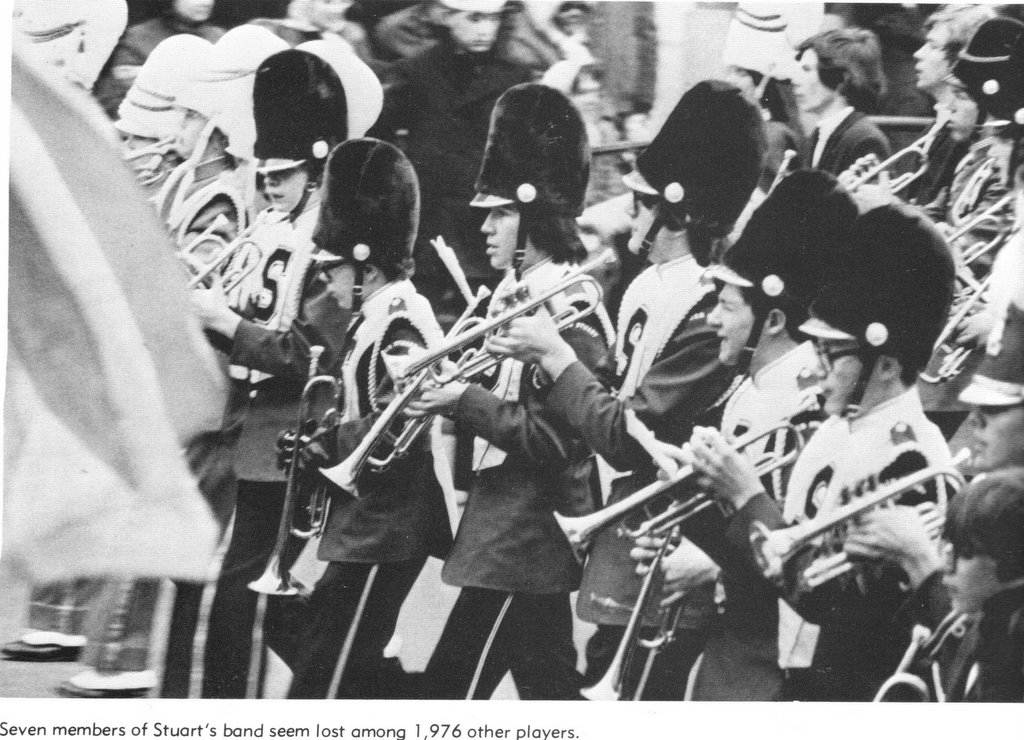 arch together?"
That was a pretty special day and I darn well should remember more than the weather and the fact that I was tired when I got home.
The above picture shows Paula Sykes glancing up at the president as they marched by. I think they were told not to look but obviously at least one of them didn't get the message.
Leave a comment if you remember something. I'd appreciate it.
Something I found Interesting: Now, before I begin, I'm not taking sides. Nope. Not gonna do it. Wouldn't be prudent at this juncture. Eve n though that taking sides inside the beltway is not only common but encouraged, a baseball blog isn't the proper place for it. You come here to discuss baseball, something that is far more important than politics. What if you found out that I was a *gasp* a Republican or *geez* a Democrat and pushed my beliefs here at TBB? I'd lose a lot of you.
See?
And - this is for you Basil - there ARE Democrats in Idaho. There's Steve Johnson in Boise, Nora Smith is in Idaho Falls, Terri Lynn's over in Rexburg and Ezra Thompson lives in Arco. There's five democrats. No wait; Ezra died last fall. Make that four.
The point is, this is more of a "I find this interesting" than "how dare he say that" story. Okay?
I was reading Rich ard Nixon's '72 Inaugural Address seeing if there was something he might of said that could jog a memory or two. There were a few things in there that became ironic with the advent of Watergate, but that was about it. I pushed a wrong button and came upon James Earl Carter Jr.'s Inaugural speech. I found a couple of things interesting. First, he didn't just mention God, he thumped his Bible and quoted scripture like a minister during the "Great Awakening." Check this out:
"Here before me is the Bible used in the inauguration of our first President, in 1789, and I have just taken the oath of office on the Bible my mother gave me a few years ago, opened to a timeless admonition from the ancient prophet Micah: "He hath showed thee, O man, what is good; and what doth the Lord require of thee, but to do justly, and to love mercy, and to walk humbly with thy God." (Micah 6:8)
Think a president could get away with this today? Ronald Reagan mentioned in passing a generic God a couple of times. George Bush said that "My first act as President is a prayer. I ask you to bow your heads..." and then proceeded to offer a fairly lengthy (but still generic) acknowledgment of God. Bill Clinton saved his recognition of the almighty to the very last sentence in both of his addresses. The current George Bush made a couple of innocuous referen ces as well.
I find that interesting. As the nation began to accept is diversity of religion, our presidents stopped thanking one specific God and instead used the nonspecific "God" or "Almighty."
Kudos, guys. At various times in my life, I have been a Mormon, a Muslim and an Athiest, so Jimmy Carter would have offended me seven different ways from Sunday.
But that wasn't the paragraph that really drew my attention. It was this one:
"We have learned that "more" is not necessarily "better," that even our great Nation has its recognized limits, and that we can neither answer all questions nor solve all problems. We cannot afford to do everything, nor can we afford to lack boldness as we meet the future. So, together, in a spirit of individual sacrifice for the common good, we must simply do our best."
Republican or Democrat, few people I know said that the period during the Carter presidency was a particularly fun time to be alive. Look, of course Carter was 100% right in everything he said in that paragraph. Too much sometimes is too much, that America isn't the answer to every question, and that we should sacrifice and simply "do our best."
Yeah, but he was the President. He's supposed to give us all those lofty goals and then we don't come anywhere near following them. That's written somewhere; the Constitution I think. That's how it works. But when he began his administration by acknowledging the limitations of the country he was to lead, it was all pretty much down hill from there.
During those four years, Carter told us - in essence - not to eat so many doughnuts, and that driving a three year old car was just fine. When heating oil became scarce, he came on TV wearing a red sweater and told us to "sacrifice," -- to turn our thermostats down to 60 degrees at night.
What? I slept in the buff back then. That was just too much to sacrifice.
Then came the "malaise" speech (which is funny because he never actually used the word), and then the "new" relationship with the Iranians.
"I'm Ted Koppel and this is "The Iran Hostage Crisis - America Held Hostage: day 320." And Nightline was born.
Of ourse, the 18% interest rates and double digit unemployment was just the icing on the "I hate all this" cake.
By the end of his term, I was tired of white-knuckling my way through the bills and my job. I was tired of feeling bad because I had two cars and some family in China didn't have any. Why did I have to feel bad to live in a successful country?
Ronald Reagan, of course, brought back all the confidence with his "Morning in America" mantra. He told us to not only eat all the doughnuts, but to go back to the store and buy another dozen. The first thing I did after the election was to turn my thermostat up to 85 degrees for the rest of the day, a kind of "in your face" to Jimmy boy. Reagan told us that we were great, we were deserving and that we were feared. Sacrifice? I felt comfortable enjoying the bounty this great country provided. We could do anything, he told us.
Of course, he lied. All presidents do. He lied and didn't mean much of what he said, but we believed in it and began to believe in ourselves once again. We started buying stuff we didn't need, and put it all on credit. Soon, factories were open again and everyone was enjoying their life. Yuppies were born and Chrysler was saved.
Carter told the truth and he suffered for it. Carter was a good man but he didn't understand how to lead 250 million Americans. He thought by telling us what not to do, things would improve. Reagan succeeded by telling us what we could do.
Life was no fun under Carter and life was sweet under Reagan. Now, I promised this wouldn't be political, and it's not. Life was great under Clinton too. But I think each president who has come since has adhered to the "Carter rule," which is to not, not - not - tell the American public to acknowledge our limits and deficiencies.
It makes for a very grumpy electorate.
In the end, Carter's "individual sacrifice" way of seeing things backfired. Perhaps appreciating the president's astonishing frankness, the public rewarded him with higher approval ratings in the days that followed. But then, as historian Douglas Brinkley notes, "it boomeranged on him. The op-ed pieces started spinning out, 'Why don't you fix something? There's nothing wrong with the American people. We're a great people. Maybe the problem's in the White House, maybe we need new leadership to guide us.'" Historian Roger Wilkins concurs: "When your leadership is demonstrably weaker than it should be, you don't then point at the people and say, 'It's your problem.' If you want the people to move, you move them the way Roosevelt moved them, or you exhort them the way Kennedy or Johnson exhorted them. You don't say, 'It's your fault."
This paragraph culled from a PBS special says it all:
"A little more than a year later, Ronald Reagan defeated Carter by offering Americans a vision that was as optimistic as Carter's was pessimistic. Every four years thereafter, the Republicans' traditional refrain equated Democratic leadership with the notion that America was in decline and needed to reign in its famous appetites. The fact that ... Carter may have been right, in some sense, was almost beside the point. "If you are president and you're going to diagnose a problem, you better have a solution to it," Hertzberg notes. "While he turned out to be a true prophet, he turned out not to be a savior."
Number of Republican presidents given "good press:" One. Number of Democratic presidents given"good press:" One. Number of bad presidents getting "bad press:" One.
See? It all works out.