JULY 31ST: A GOOD DAY AFTER ALL
 [October 31st] -- Tick-tick-tick-tick .... the clock's minute hand moved efficiently and mechanically towards it's target. Tick-tick-tick-tick. Once the sweep-hand reached the "12" at the very top of the dial, the once-a-year craziness that permeates Major League Baseball -- that period that sweeps away inhibitions and intelligence for a short period of time -- would suddenly cease (sounds like "Return Of The Archons" from Capt. Kirk's Star Trek, doesn't it??). As the managers and players and owners and fans started to shake the remaining stupor from their minds, they began to take a look at the "lay of the land" to see who survived this year's baseball trading deadline and who was a casualty.
Greg Maddux didn't survive. Sean Casey didn't survive. Ben Broussard and Julio Lugo -- they didn't survive. But Alfonso Soriano, perhaps the greatest follower of Landru -- the one most apt to be exiled by the Archons, remained.
Turns out (and this pains me to no end to say) that he just may have been right.
There was an assumption by Nationals' fans (myself included) that the players being offered were all "can't miss" prospects, players that would have magically changed our pretenders into contenders. Word out of Detroit had Joel Zumaya and Craig Monroe (and possibly others) being offered to Washington for Soriano. Having watched the playoffs, having seen what Monroe and Zumaya can do / did do, does anyone really thing that GM Jim Bowden was offered that level of talent for Alfonso and no deal could be consumated? It was more likely that the Nats 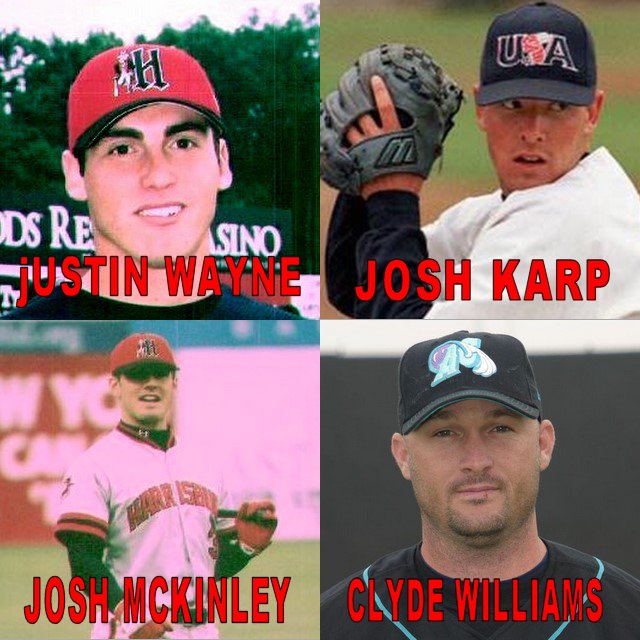 were offered something more along the lines of what the team received for Livan Hernandez, pitchers like "Chico and the Mock" (though perhaps in more quantity). An assumption has to be offered, then, that the reason no trade was made at the deadline was because the team received nothing of value for Soriano (or not enough value) and that Stan Kasten and Jim Bowden would rather choose their own replacement players through the draft rather than accept another team's "throw always," players the team obviously had no real desire to keep.
- [CF] Curtis Granderson (.260-19-68)
- [RF] Alex Rios (.302-17-82)
- [2B] Chase Utley (.309-32-102)
- [3B] David Wright (.311-26-116)
- [LF] Garrett Atkins (.329-29-120)
- [CA] Brian McCann (.333-24-93)
- [1B] Prince Fielder (.271-28-81)
- [SS] J.J. Hardy (.242-5-14)
And this starting rotation wouldn't have been to bad, would it?
- Barry Zito (16-10, 3.83)
- Jeremy Bonderman (14-8, 4.08)
- Dan Haren (14-13, 4.12)
- C.C. Sabathia (12-11, 3.22)
- Josh Johnson (12-7, 3.10)
I would think that this version of the Washington Nationals would have played into October, and could easily have been the World Series champion. The Nationals wouldn't have had to trade for, or sign as free agents, any of these players -- all they would have to have done is to choose them in the amateur drafts from 1998-2002. Each player listed was available in one of the first four rounds of each draft after the Expos made their selection.
Incredible, huh?
In the first round of the 2000 draft, the Expos chose pitcher Justin Wayne, bypassing Utley and outfielder Rocco Baldelli. In 2001, with Aaron Heilman, Bobby Crosby, Jeremy Bonderman, Noah Lowry and David Wright waiting to be chosen, Montreal went with pitcher Josh Karp. In 1998, infielder Josh McKinely was chosen ahead of Brad Lidge, Jeff Weaver, C.C. Sabathia and Aaron Rowand. Three rounds later, first-baseman Clyde Williams, was taken by the Expos instead of Zito, Mike Maroth and Ryan Langerhans.
2002, however, was the worst. With one of the top picks in the draft, Montreal chose pitcher Clint Everts, a pitcher today still toiling at the Class-'A' level. In that same first round, however, they could have chosen Zack Greinke, Prince Fielder, Jeremy Hermida, Khalil Green, Scott Kazmir, Nick Swisher, Jeff Francoeur or Matt Cain.
There can be only two possible conclusions for the team picking lumps of coal for their Christmas stockings when candy and toys were still available. Either general managers Jim Beattie (1995-2000 and Omar Minaya (2001 - 2004) were stupid and couldn't find a major league prospect in a barrel of fish or they were told by owner Ebeneezer Scrooge to draft "signable" players and not the best player available.
I vote the latter.
Jeff Loria was so cheap and difficult to work with that the city of Montreal withdrew it's funding for Labatt Park, the stadium that was to keep the team in Quebec. The following season, no English speaking radio station would carry the Expos games for what Loria demanded. Today, Loria is the owner of the Florida Marlins, and his 2005 fire sale has shown bottom lines still take precedence over wins and losses.
Both owners, then, saw the amateur draft as a drain on resources, and told the team's general manager to only draft players that would sign within a particular financial parameter. That kind of draft philosophy destroyed the team's farm system, once one of the richest in the major leagues.
Justin Wayne (#1, 2000) is out of baseball having fashioned a 25-34, 3.97 career record. He started only eight games in the major leagues. Tom Mitchell (#5, 2000), the guy chosen over Garrett Atkins, never played professionally. Josh McKinley (#1, 1998), the 11th player chosen, never made it above 'AA' and retired in 2004.
Josh Karp is the poster-boy for the team's low-budget draft philosophy. Karp, a 6'5" right-hander, was drafted in the 8th round out of high school by the Atlanta Braves in the 1998 draft. Not wanting to sign for 8th round money, he played three years for UCLA (8-3, 4.29 in '99, 10-2, 5.08 in '00 and 5-2, 3,26 in '01). Though he did strike out 10 batters per 9 innings during his college career, he also walked 4 and gave up 8.50 hits. He was considered a mid-round pick at best. Yet the Expos, having the 6th pick of the draft, weren't about to pay some whipper-snapper a bonus that could reach three million dollars. They instead chose Karp, a player they assumed would be so grateful to be a first round pick that he'd sign quickly and easily. He signed all right, and for very little money. He lasted four seasons in professional ball, going home to Bothell Washington in 2005 with a 24-32, 4.74 record. That #6 pick could have brought the Expos Jeremy Bonderman .... or David Wright ... or Aaron Heilman ... or Bobby Crosby .... or .... well, you get the idea.
I'm not nearly as mad at Bowden for not pulling the trigger on that last-second trade this past summer as I was. The Nationals, having clearly expressed a commitment to signing the best players and then doing what's needed to sign them, will come away from next spring's draft with two players that will have a good chance to make a difference in Washington. The Justin Wayne's and Josh McKinley's and and Josh Karp's of the world are now a footnote in the team's history. Sure, the players they sign may never make it to the major leagues. But they also might end up being stars for years to come.
That's whats fun about the draft.

JOSE GUILLEN: A FRACTURED FAIRYTALE
 [October 29th] -- Jose Guillen's tenure in Washington seemed all but finished when the Nationals removed his photo from the team's website banner. Though no one on either side has publicly suggested that Guillen is a "former" National, the mid-summer trade from Austin Kearns all but guaranteed his ouster from yet another major league team.
Or did it?
Guillen, who turned down Jim Bowden's 4 year/$40 million dollar contract offer this past spring, suffered through two significant injuries (one before the season, one after), that caused his "walk year" to be the worst of his career (.216-9-40). Come March, then, he's likely to be 1) healthy and 2) unemployed. Mr. Guillen, then, could be retained by the Nationals at a very, very low price, say a couple of million or so, and that's chump-change for a guy who is likely to hit .290-25-100. With Alfonso Soriano off to ply his wares at the MLB bazaar, the Nats are left with one starting oufielder (Kearns) to fill three positions. Ryan Church has shown that he has the talent to be a standout left-fielder, but can't play center. Nook Logan has shown that he has the talent to be a standout defensive center-fielder, but he just the latest flavor of Endy Chavez and Brandon Watson. Alex Escobar has shown that he has the talent to be a standout center fielder, but can't stay healthy. Jose Guillen, on the other hand, has the talent to play centerfield, but has only done so a handful of times in his major league career. Why not give it a try? He certainly has the range and speed to cover center, and no one doubts that canon-like arm of his. An outfield of Church, Guillen and Kearns could easily hit a collective .280-85-280.
Why not give it a try?
Because Guillen's past still hangs over the guy like storm cloud that just won't go away.
At every stop along the way, Guillen has 1) turned the town against him and 2) said that he loved playing there and wanted to stay. He loved Pittsburgh. He loved Tampa Bay (go figure). He loved Arizona. He loved Oakland. He reminds me of that song that rocked D.C. during Richard Nixon's first administration -- you know -- "If you can't be with the one you love, then love the one you're with."
His love, however, always came with a "but." I'd love to stay here .... "but..." He spent three years in Pittsburgh, showing those flashes of brilliance that seven major league teams have hoped he would bring their lineup. When he was traded to the Devil Rays, he moaned and groaned and said that the Pirates "dissed" him, adding that he couldn't believe that he was traded for "Joe Oliver and 'that catcher.'" He never mentioned that the team's all-star catcher, Jason Kendall, had just gone down with a fractured ankle, and that he was traded for two catchers to help replace him. It made perfect sense to everyone -- everyone but Jose Guillen that is.
After a week into his first spring training with Tampa Bay, Guillen "demanded" that the team tell him how they planned to use him. "I don't think I have a chance here," Guillen said. "It's like I'm in the middle of nowhere." G.M. Chuck LaMarr tired of his "me-me-me"  attitude and released him at the end of the season.
He was quickly signed by the Arizona Diamondbacks and released four months into the season. "I love playing here and would like to stay" said Guillen. He then signed with the Rockies and remained with the organization for a total of five minor-league games. Reading that the team acquired outfielders Jay Payton and Gabe Kapler, he used his standard "I'd like to stay here but they they appreciate me" routine, demanding to know where he stood within the organization. He was immediately given his release.
Over the next season, he was signed by the Reds as a free-agent, then released before he ever played a game, signed again, played like an all-star, and then was traded to the Oakland Athletics for their pennant drive. After booting him during spring training, Jim Bowden re-signed him the next day. By May, Guillen, then the team's fourth outfielder, was loudly complaining that he wanted to be starting for the Reds, and that if he wasn't  going to start, he wanted out of Cincinnati. Bowden would have none of it. "Before we signed Jose we had a conference call with Jose and his agent, Adam Katz," Reds general manager Jim Bowden said. "We told him that Adam Dunn was the left fielder, Austin Kearns was the right fielder and Ken Griffey Jr. was the center fielder. He would be the fourth outfielder. He agreed and said it was a good fit for him." Nope, said Guillen. "I was mislead. It's not a good situation for me. They should trade me." Bowden was happy to oblige.
He was released by the Athletics at the end of the year, and eventually signed with the Angels. We all know how that went. He said all the right things when he was traded to Washington, yet his true personality came out in one of his "I'm better than you think I am" stump speeches: "I'm not like what people are saying," he said. "If I'm producing and you sit me, though, we're going to have a little problem. It would be different if I was making a lot of mistakes, but I know what I'm doing. If you just let me do my stuff, I'll be fine."
As long as you do what I want you to do, then I'll be a good boy. But you'd better not cross me or else .....
Is it worth the risk to resign Jose Guillen? Is 30 more home runs and 100 more RBI's worth the chance that he's going to hit someone, call someone a name, turn teammate against teammate, and general ly make it less fun to watch the Nationals play? I'd say yes if the Nationals had a chance to put together a team capable of winning 85 games -- what a great way to segway into the new stadium and the next chapter of D.C. baseball history. That would be a a possibility if the team uses the $15 million dollars that would have gone to Alfonso Soriano and signs two solid (though unspectacular) starting pitchers. John Patterson, Mr. 'X' and Mr. 'Y,' plus two others from the 'kiddie pool' (Beltran Perez, Shawn Hill, Mike O'Connor) or Jon Rauch, could place the team in a position to finish 2007 somewhere in the middle of the pack. If they don't sign starting pitching, however, it won't matter of Guillen or Nook Logan patrols center field at RFK.
If Juan Rivera and Macier Izturis hadn't turned into such quality players with the Angels, I wouldn't think twice about saying "seeya" to Guillen. I'd just hate to get nothing in return for them.
5 QUESTIONS WITH "CURLY 'W'"
 [October 28th] -- Ben over at the "Curly W" invited me to participate in his "Five Questions With..." program. Both of us asked, and answered five question of the other, trying to get to know the person behind the blog. You can find my answer to Ben's questions here.
Here are Ben's responses.
1) You've recently created the "Curly R" blog that covers the Redskins. Which one is closer to your heart, and which sport lends itself better to the blog-o-sphere?Football and the Redskins with no hesitation. I was raised a baseball kid in the 70s, but got away from baseball not long after I stopped playing, around 8th grade. Around that time, playoff and World Series games were migrating to evening hours and the youth market did not seem as important to baseball as it had been when I was a rabid 7 year old Red Sox fan living in Brunswick, Maine (a market split unevenly by the Red Sox, Expos and Bleu Jays).
As a family, we already had some attachment to the Redskins from when we had rotated through Washington earlier in the 70s. I can still remember sitting with my dad watching football as a 5 year old in 1975, watching as he would rise out of his chair, sideburns and all, can of Budweiser in his hand, yelling at Billy Kilmer on the TV box, THROW IT! THROW IT!
Despite, or maybe due to, having lived in many places as a Navy brat, when we moved back to Washington ten years later, I began to think of myself as a Washingtonian, or at least a Northern Virginian, or at least a Dumfry (n. Native of Dumfries, VA). Off I went to college, where I watched football like a drug, and eventually moved back, and I now live in Alexandria, VA. My connection to the Redskins is the same as my connection to the Washington, DC area.
Brandon and I often discuss the differences in baseball and football as it relates to blogging. Baseball is a more relaxed, social sport, with games going on every day of the week, whereas with football, there is talk, foreplay, release, game over for another week. A walk through any baseball team's blogs will look a little like your section at the game (well, maybe not Section 320): there's Quant Jock, obsessing on percentages and pitch counts. There's Random Observationist making fun of the world around; the Recounter, noting every little thing that happened. Add Intense Ticketholder that attends every game and Casual Drunk who shows up a couple times a month and acts silly and there's room for everyone. There are so many ways to cover baseball on a blog and so many games to cover that there is plenty of material for everyone.
Football on the other hand, is almost like a continual episode of Crossfire, with every blogger laying down an opinion and furiously rebutting others' opinions when not furiously agreeing with yet others. Then everybody shuts up for three hours on Sunday before going right back at it.Both sports are tough to write for. Baseball never stops, it just keeps going through 162 games, and trying to keep up with it is hard. With football, you have to have more than a thought to make it a worthwhile read. You have to work harder to make it entertaining because there is so little substance to work with.
2) Was your love for baseball as strong before the Nationals came along? If yes, what team did you root for in the pre-Nats' days and why?When we lived in Maine in the 70s, I was a serious Red Sox kid. Carl Yastrzemski, Fred Lynn, Carton Fisk, Bill Lee, Luis Tiant. My first Major League Baseball game was a Rangers-Red Sox doubleheader in August of 1977. I was a lefty like Bill Lee, but used to pretend I had the swivel delivery of Luis Tiant. I read all the Matt Christopher young reader classics: Catcher with a Glass Arm, Double Play at Short, The Kid Who Only Hit Homers. I imagined The Reluctant Pitcher, about a lefty with a good arm but no drive, was about me, and I used it to help me move back and forth between first base, my natural position, to pitcher when coach needed a southpaw in the game. I have an inbred hatred of the Yankees except for Reggie Jackson.The contempt I have for the Pimpstripes burns with the intensity of a thousand suns.
I played my last youth baseball game while living in Italy, and when we moved stateside, I was meh about baseball. After college, Cal was going strong and I started following the Orioles as the de facto DC baseball team, going from Charlottesville or Arlington to the old Memorial Stadium or Camden Yards a couple dozen times, including ALCS games in both 1996 and 1997. (I'm a Davey Johnson guy and I just love that he had Roberto Alomar pay a fine with a check to his wife's charity without getting front office clearance, then was named AL Manager of the Year hours after being forced to quit.) But I soured on Angelos when he let Mike Hargrove suck four years in a row. Like Dan Snyder, Peter Angelos is a berzerker owner out to destroy his own franchise and I really do believe he let the team go bad to try and cockblock the Expos or any other franchise from moving into the Market He Needed to Survive, which is funny because The Market He Needed to Survive can actually Sustain Its Own Team which is why Brandon says Orioles Tears Are the Sweetest of All.
3) Do you write for your readers or yourself? Explain.The real question is whether writing is something you do for yourself or something you imagine you are doing for someone else. For the citizen blogger, the work is like golf, kickball, beer pong, whatever, something that's easy to do but hard to do well. Serious fun.
I read mainly military history and political works and my three favorite nonfiction writers are William S. Burroughs, Charles Bukowski and Bret Easton Ellis, so whatever that means.
4) Baseball has died twice in Washington. Why do you think that, in our case anyway, the third time is the charm? Has anything changed to make D.C. a better baseball town, or has it always been a baseball town and the two previous owners never gave D.C. a chance?Washington, DC, and by extension the surrounding area, is a Zone of Entitlement unlike many other in the world. We Washingtonians, by virtue of our area's stature as the seat of government, center of technology and stronghold of business, are entitled to everything pro sportsy. And entitled to be blase when attendance is poor because the product is poor and if the Bullets and Capitals just didn't suck there would be more interest in going to the game but the Kwame Brown and Jaromir Jagr gambles didn't pay off so we're back to the dominatrix-submissive relationship every team in Washington that is not the Redskins has to deal with. Add baseball, repeat.
And besides, is there a better allegory for Congress than baseball? A bunch of people standing around for hours waiting for something to happen punctuated by moments of excitement that many watchers miss and on which a separate and wholly unqualified class of self important boobs comment to amuse themselves and their orbiting magpies. Yeah the Nationals will fit right in here in DC.
5) Stan Kasten calls you tomorrow as says, "I don't like the uniforms. I want you to redesign them." Using any colors, styles or ideas of your choosing, what would they look like?I'd make the team colors burgundy and gold and make them wear helmets. j/k. Seriously, how can you improve on red white and blue? Merican! I like a common look to the attire, so I would make them all wear their pants high with the socks like Nick Johnson. That's how you're supposed to dress for baseball. I'd also be for permanently changing the logo for the team from the curly 'W' to the block 'DC,' except for the fact that, you know, we run a blog called The Curly W. I guess the whole name thing didn't really stop Harper at the border, but it's irrelevant anyway because when we argue about baseball uniforms, the terrorists win.
PS- I blogged this while watching Battlestar Galactica. This show rocks and tonight's episode was a little rough to watch.
What a fun thing to be involved with -- thanks Ben! I enjoyed it so very much. The image above is of Ben, Will (left) and Josh (center), 4-1/2 (yes twins) from August 16, a win over Atlanta. The best of outcomes: I see John Smoltz pitch a great game and Nats win.
SO THIS STADIUM IS SUPPOSED TO BE MAGNIFICENT?
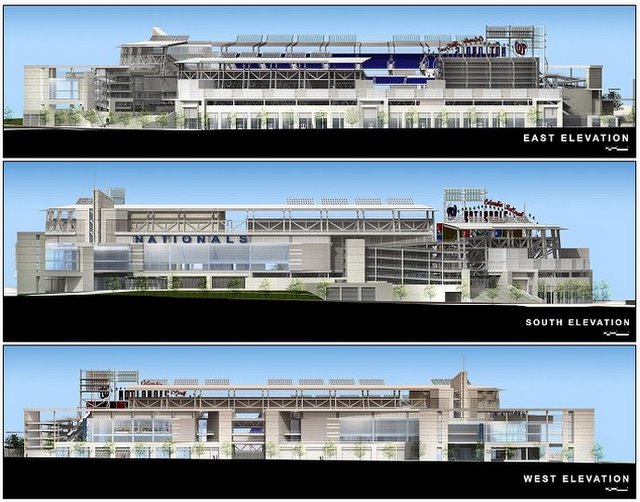 [October 27th] -- Thus far, all of the renderings and computer animation of the Nationals' new home show one common theme: the stadium is going to be nice. Not great, not outstanding, not "monumental." Just nice. And that's what I thought too. That is, until I saw these elevation renderings.
We were told that our stadium was going to be our's alone; no brick, no black metal beams, no copper sheathed roofs. No sir; our stadium was all about glass and concrete, with rich, traditional exteriors that reflect D.C.'s history.
Really?
Take a look at the above rendering (click on it to see a larger image). Do you see anything that resembles what we were promised? The middle image shows the front of the stad ium, yet the great majority of the exterior is a compilation of a little bit of this, and a little bit of that. One might say that the right side looks like something you'd expect to find in the rear of the old Bloomington stadium in Minnesota, or even Jarry Parc, Montreal's first attempt at a major league facility. If the intent of the architects was to create that "haphazard" steel and chain link fence aura of the past, then I guess I could accept it. Remember, though, this was to be a stadium of the future, a building as much a museum as a ball park.
I guess a little bit of glass here, a little bit of concrete there, and a whole lot of "stuff" strewn about is what we're going to get. I have to say that I'm disappointed. I can only hope that these renderings don't do the completed facility justice. I'm afraid, however, that the new stadium is a brick and mortar version of the laws that are passed in this town. By the time both sides do their "give and take," the end result, while palatable, isn't particularly attractive to either side.
I am surprised, considering the constant change of politicians and policy in this city, that RFK was a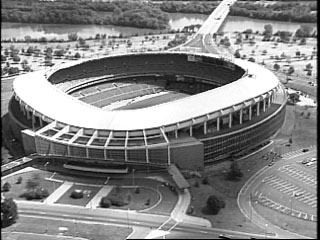 ble to be created and built with a minimum of harping from the politicos. I do remember that a group with a name something like the "D.C. Arts Commission" meddled now and then, changing little things without confusing the over-all vision the architects had for the place. I remember one particularly old lady with a fox around her neck complained on one of the local television stations that the stadium couldn't have those "awful light towers," and demanded that the lights be connected to the roof in some way. But when you took a step back and looked at the big picture, you could see what the architects were trying to achieve. The stadium was "balanced," with one side a carbon copy of the other. Sight lines were clean and unobstructed, and the entire stadium had a feel of openness throughout its confines (Remember, this is 1961 openness, far better than what was then availalable but certainly nothing like today's stadiums have).
I look at our new stadium and don't see this sense of unity, where every part of the stadium acts in unison with the rest. There is a break in the right field stand; why? Parts of the stadium are covered with glass, other are open and expose he stadium's skeleton; why? There are too many concepts built into the facility that are just "there," that don't seem to have any reason for being part of the plan.
And now, it seems all but certain that those unsightly parking garages are going to rise from the ground beyond the left field wall. Mayor Anthony Williams says he has "given up" trying to create a more alluring vista from within the park itself. Without Williams, and with the Lerner's demanding the "above-ground" garages, another nail in the ugly coffin has been hammered into place.
Don't get me wrong, the stadium is likely not going to get a disparaging moniker like Alaska did (remember Seward's folly?) but neither is it going to be a building that makes people go "oooh" and "aaah." And that's a shame; I'm pretty sure that's what $600 million dollars is supposed to buy.
World Series: Now, all you Tigers' fans shouldn't be getting all in a tizzy this morning, what with the Cardinals being up three games to one heading into game five tonight. Those of us near the age of fifty remember clearly that the Tigers were in the same position against the Cardinals in the 1968 World Series, yet they came back and took the crown by winning three games in a row. Mr. Motta and Mr. Berra were right, I haven't heard any large ladies crooning and it aint over because it aint over.
Curtis Granderson's faux pas in centerfield was reminiscent of Curt Flood's mis-step in the '68 series. In both cases, the mistake changed the flow of the game and allowed the other team to win. Those errors and mis-plays happen a dozen times a night during the regular season, but in the spot light that is the World Series, Granderson's fall will be played and replayed for decades to come. Willy Mays' "the catch" in the 1954 World Series is replayed hundreds of times each season, yet I think Ryan Zimmerman's over-the-shoulder catch 'n dive from earlier this season was a much more difficult catch.
One day, perhaps Zimmerman will make one of his patended "can you do that?" catches in the World Series. Then, the circle of life will be complete.
TELL YOUR STATISTICS TO SHUT UP!
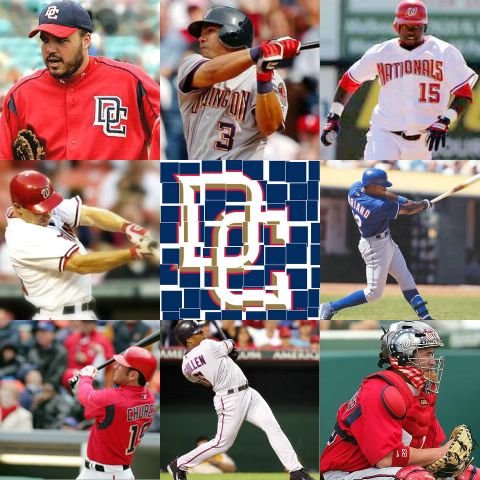 [October 26th] -- I thought it would be fun to take a look back into the Beltway Boys' archives and see how I did at predicting the outcome of the Nationals' 2006 season. Please feel free to give my a pat on the back, or snicker at my stupidity, as the case may be.
"Now that the smoke has cleared [at least for the moment], it might be fun to take a step back and see what Bowden hath wrought.
If the Nationals had been at full strength last season, if the team had suffered an "average" amount of injuries, they would certainly have won 85-90 games and finished in the middle of the pack in the NL East. None of us really knows what Nick Johnson, Jose Vidro, Jose Guillen and Ryan Church can do when healthy.
BSC. "Best Case Scenario." During this time of the year, with it's short days and long nights, when snow is deeper than even our darkest secrets, we look at our team's lineup and see what they should do and not what they can do.
How good will the Nationals offense be if Bowden is done dealing and this is the final result? Pretty good really, assuming all the Nationals stay healthy, and they play up to their talent level. Here is my "best case scenario" for the 2006 Washington Nationals.
1B] Nick Johnson -----.292 - 20 - 90
2B] Jose Vidro ---------.283 - 12 - 68
SS] Cristian Guzman --.252 - 4 - 44
3B] Ryan Zimmerman-.281 - 18 - 75
LF] Ryan Church-------.289 - 21 - 80
CF] Alfonso Soriano---.285 - 28 - 116
RF] Jose Guillen-------.291 - 30 - 104
C] Brian Schneider----.265 - 13 - 55
That's a pretty good lineup assuming that nobody dies or refuses to take the field because they are playing out of position. If Cristian Guzman rebounds from his dismal 2005 campaign [and he will, I just feel it], there won't be a single "easy out" in the entire lineup. Things could be a lot better if Ryan Zimmerman is really, truly the "wunderkind" that Bowden believes he is. There is an equal chance that he'll spend some time in New Orleans too. You just never know with kids. Jose Guillen had 18 homers well before the all-star break, before he hurt himself, and it's possible that both he and Alfonso Soriano could hit 35+ homers next season. Steve Phillips, former Mets' general manager and current ESPN pundit, said that most of Soriano's home runs are of the "Oh my gosh" variety and will travel out of RFK just as easily as anywhere else.
Assuming the pitching staff is not as good as last year but not "worse," the Nats' best case scenario for 2006 is 77-87 wins, about the same as last season. Hopefully, the improved offense will negate the watered-down pitching staff and give Washington another "fun" year.
I could have done better, but hey -- it could have been worse. The 77-87 wins were way off, but at least I threw a "caveat" in there, as assumption that the pitching staff wouldn't be any worse than the previous. We all know what happened there. Really, when you consider how much worse the staff was, ten less wins wasn't all that bad.
NEW CBA (GOOD), PENDLETON SAYS NO (BAD)
 [October 25th] -- I'm going to make this short tonight -- my wife (who I love dearly) had a, um, bad evening and when she does, so do I.
Terry Pendleton: The list of managers who don't want to come to D.C. is starting to grow longer than the list willing to take the job. Just like Girardi, Pendleton said all the right things right before telling the Nationals to go take a hike. Maybe the Nationals should hold a press conference and say, "You know, we got it wrong. Frank Robinson was the best man for the job all along." Then, they can fire him again next year and try this all again.
New Collective Bargaining Agreement: Good-good-good! The Nationals will still get a first round pick and a sandwich pick in exchange for the soon-to-be ex-National Alfonso Soriano. No longer will type "B" & "C" free agents bring the losing team compensation. Also (and this is a biggie), teams who don't sign their picks in the first three rounds will receive a similar pick the following year. No longer will 18 year old's hold a franchise ransom for millions of dollars. You don't want to sign? No sweat. Good luck next year (if you're willing to wait) and we lose absolutely nothing. What J.D. Drew did to the Phillies a few years back will be a thing of the past.
Have a good day, everyone. I'm going to be hiding from my wife until things settle down. Wish me luck.
Update: As usual, I got some facts wrong. Brian was kind enough to give me the straight poop:
Farid - Type B Players will still return a draft pick"Teams that lose a Type B free agent will now earn a sandwich pick instead of taking selection from club that signed player"It's just that a team will not lose a pick for signing a Type B
GIRARDI SAYS THANKS BUT NO THANKS
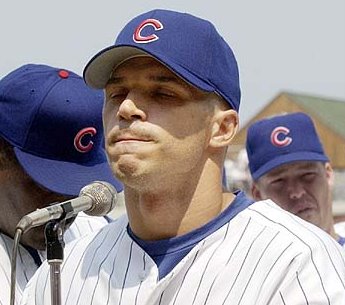 [October 24th] -- Joe Girardi sees his future clearly, and it's not in Washington, D.C.
The former Marlins' manager said all the right things about the city, the owner, the general manager, the president, and the players in an interview on Monday. He then said that he didn't want the job.
So, now what?
The Nationals have many names in the hopper -- Terry Pendleton, Manny Acta, Ron Washington, Tony Pena -- but whoever is swept into the clubhouse come April won't have a mandate. Somehow, the Nationals are going to have to call their news conference, slap on some happy-faces, and say that "Joe Jones" was our first choice all along. The Nationals have held their search for a new manager behind closed doors for just this reason -- they didn't want to publicly hire their second or third choice.
Something else troubles me regarding the remaining pool of managerial candidates. They are all minority. Now, before you call me a such-and-such, hear me out. I want the Nationals to be as diverse as the applicant's talent allows. I cheered that day that Frank Robinson became the first black manager in baseball history. But here's the rub: When the entire group of applicants are minorities, whoever is hired, no matter how solid the hire might be, someone -- well, many people actually -- will say that the "only reason" that so-and-so got the job was because of their skin color. I think Terry Pendleton would make a superb manager, but baseball has set him up as a "diversity hire" and not "the best man available" (which he just may be).
Sometimes, trying too hard to be fair leads to an unfair situation. Unfair for the Nationals, unfair for Major League Baseball, and unfair to the person ultimately hired for the job. I understand that demons are being excised here, but let me ask you this: what do you think would be happening right now if that applicant pool was all white?
Truth always lies somewhere in the middle, and that's where the team's hiring process should be. In the middle, and fair to everyone.
LET'S PLAY HARDBALL!
 [October 23rd] -- I'm Chris Matthews ... let's play Hardball ... boy talk about not playing hardball ... The Nationals suck ... I mean, God, we had to wait 34 years for this for goodness sake ... Holy Cow, I grew up in Philly, big Phillies fan, I was a Phillies fan, and, though you won't believe I'm old enough to remember them, I liked the A's too, we called the the Athletics, that's because I'm from Philadelphia; so anyway, I was at RFK Stadium, wow, what great memories that place must bring back for native Washingtonians, *hah* like there is such a thing, I watched the the Nats play the Diamondbacks, I think they were from Phoenix or somewhere outside of Pennsylvania, so it really doesn't matter, and the Nationals actually swept them, they swept them, they won all the games, wow, but then they got swept By the Reds, they play in Cincinnati, and man, they suck!; I mean they reminded me of old Tom Dewey in 1948, but I wasn't there, the Nuns, the Nuns, *hah* the Nuns, oh God they were great, the Nuns, they taught me my history in Catholic school; I remember Shibe Park so very well, with that tall right field fence and the seats on the houses across the street, but then old man Shibe built that "spite" fence so you couldn't see the game from those houses *hah* only in Philly only in Philly, God I could use a Philly steak sandwich right now; Let's go to Frank Robinson, manager of the Expos, uh, Nationals, *hah* like I'm the only one whose ever done that, so Frank, former Red, Oriole, Dodger, Indian, wow, I hope you got frequent flier miles *hah* so Frank, the Nationals suck and I hear you'll be canned soon, whadya think? Frank Robinson: Well, Chris ... I've already been replaced ...*hah* that's priceless Frank, Franki, Franko, first manager of color, wow, but not the first colorful manager *hah* that Casey Stengel, oh God, he was great, colorful, funny, man that guy could talk Franki will join us after we return; we're playing Hardball, and the Nationals are not! *hah* I'm priceless .....
WE'RE GEORGE BAILEY AND BUD SELIG IS MR. POTTER ....
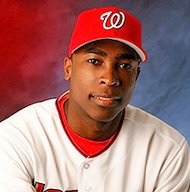 [October 22nd] -- It just may turn out that Jim Bowden ended up trading Brad Wilkerson, Terrmel Sledge and Armando Galarraga .... for no one at all.
 Tracy Ringolsby wrote on Saturday that the players and owners are very near a collective bargaining agreement that will, for the first time since 1970, cause no work stoppage. Though he says that "little" will change, one small detail will have a significant impact on the Nationals:
"The new deal won't have any major changes from the past, but there were be several subtle alterations that will have a long-term benefit. The two sides have agreed to eliminate draft choice compensation for teams losing free agents, and they will have a slotting system for bonus money paid to June draft choices."
A long term benefit? Now, let's think about that for just a moment. I don't think that anyone feels that free-agency is bad for baseball, as long as the team losing a player is  protected by some mechanism that will insure it's continued long-term survival. I lived in Seattle when the Chicago White Sox signed pitcher Floyd Bannister. The M's were bad with Bannister, and they were going to be horrid without him. In that machination of free agency, the team that lost the free agent was granted a compensation player from a pool of unprotected players left unprotected by all of the other major league teams. The Mariners selected Danny Tartabull, who went on to have an extremely successfull career (though not with Seattle). More recently, the team losing a player received the first round draft-pick of the team that signed their player (plus a sandwich pick). Now, the teams losing the free-agent, often the team with one of the smallest payrolls and doing business in some of the smallest cities, will get nothing. Nada. Zip.
Enter Soriano. Last July 31st, Jim Bowden could have traded Soriano for minor leaguers (something he refused to do because of the lack of talent being offered) or kept him for the remainder o f the season, either re-signing Soriano or taking the two draft picks in return. Either way, it was "fair." Now, the Nationals will have nothing to show for those three players traded to the Rangers last year. Oh sure, they can plunk down $15 million dollars --or more --for Soriano, but (from the Nationals' perspective), he's just not worth it. No longer can a team allow another franchise's greed to help them restock their farm system (it was just last off-season that Hector Carrasco inked a big contract with the Angels on the basis of just one good year. The Nats got the Angels first round draft pick and signed pitcher Colton Willems).
Without a doubt, this change was demanded by the likes of the Yankees, Red Sox and Angels. They want to have their cake and eat it too. They want to be able to ravage other team's rosters without having to give up anything in return. This latest version of free-agency helps only the rich, and can have a devastating effect on the "poor." How can this be considered a move that is in the "best interests" of baseball? It can't under any scenario that I can postulate. It seems that nothing that Bud and the boys does in the game's best interest. Every one of Selig's decisions makes the big-market teams richer and far more dominant over the Royals, Brewers, and yes -- even the Nationals.
So, what are the Nationals to do? They don't sign Soriano, that's for sure. I have this deep-seeded fear that he is going to return to his old ways, and is going to hit .265-33-88 while earning $15 million dollars next year. I'd much rather he screw up some other team's payroll .
There is a way, however. The Nationals can still let Soriano walk and still end up with warm bodies in his place. The Nationals should use those $15 million dollars and sign two free-agents, maybe three. Using last year's free-agent market as a guide, the Nationals could have signed Kevin Millwood (16-12 4,52), Eric Byrnes (.267-26-79 w/25 steals) and Ryan Freel (.271, 37 stolen bases) for what Soriano is going to eventually sign for. There are just as many players in this year's market who could help stabilize the Nationals until the kids in Hagerstown, and Potomac, and Harriburg mature and strengthen their games.
The Nationals have a solid every-day lineup for 2007, that is, assuming that Cristian Guzman returns to short and Felipe Lopez moves to second base. It's the starting pitching that scares me. John Patterson will man the top spot in the rotation, and Mike O'Connor or Beltran Perez will fill the five slot nicely. That leaves three spots open, and $15 million dollars available to entice free-agents to fill them. The Nationals can get certainly three ".500" type pitchers for $15 million, perhaps less. No, that's not going to get Washington into the playoffs, but, yes, they will be able to get get back to 81 wins, a position where the Nationals need to be heading over to the new stadium in 2008.
One of the reasons the Detroit Tigers are in the World Series this year is not because of who they signed, but rather, who they didn't. Following the 2000 season, the Tigers tried to re-sign outfielder Juan Gonzalez (obtained from the Rangers the previous year) to the kind of contract that Soriano is seeking today. Gonzalez turned them down flat, and after one good year with Cleveland the following year, "Juan Gone" has made no impact at the major league level. In 2005 -- what would have been the last year of his "mega-deal" -- Gonzalez had exactly one at-bat. One.
That $15 million dollars will go a long way to rebuild the Nationals starting staff. If Ryan Church is given the chance to play left field next season, his career stats suggest that he would give the Nats a .282-25-92 type season at a cost 1/300th that of Soriano. Is the additional  $14.5 million worth 10-15 more home runs? I don't think so.
I think the Nationals have an excellent opportunity to once again become a .500 team if, if (if) that $15 million is spent on pitching while the vacancy in left field is filled "in house." Hey, if you don't like Church, Jose Guillen could produce as much offense, maybe more, for $12 million or so less.
The one thing the Nats cannot do, however, is re-sign Soriano. I'm not going to say he's another "Tee Set" (one year wonder), but I doubt he'll ever put together another season like 2006.
Remember your mantra, Jimbo: "Pitching - Pitching - Pitching."
UPDATE: Reports are now surfacing that the free-agent compensation plan won't be eliminated, but merely modified. The stories are not indicating exactly how this modification would take place. I'm guessing we won't have the whole story until a formal announcement is made.
This may surprise you, but MLB officials might actually be ready to make a change that's actually good for baseball (I know; it's hard to believe). One of the problems for small-market teams has been their unwillingness to draft high-profile players, players they would likely have difficulty signing. Because the team would lose that pick if the player wasn't signed, many teams draft the "most signable" player and not the best player available. Some are suggesting that a new progam might be in place soon that would allow a team to recoup that lost pick. If Chris Marrero (#16, 2006 amateur draft), for instance, had refused to sign in 2006, this plan would have given the Nationals the 16th pick in next year's draft. This would cut the legs out from under hot-shot players with big-time agents who would threaten to sit out the season, forcing that team to lose their pick. I think you'd find that many more players would sign under this plan.
Now, if they'd only allow teams to trade their picks before the draft ....
UNIFORMITY
 [October 21st] -- Because readership here at the Beltway Boys (and all Nationals' blogs for that matter) drops significantly during the weekend, I'm not going to write about anything too terribly deep today.
Let's talk about uniforms.
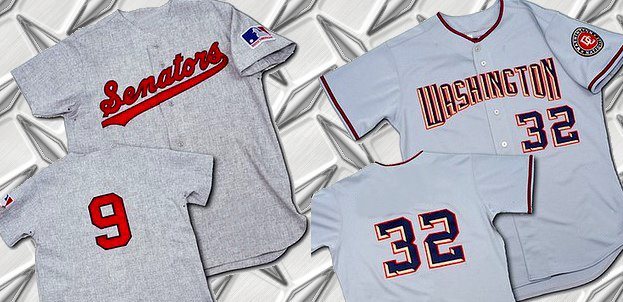
Growing up as a kid, I was always saddened that the Senators wore a very traditional, almost "blah" uniform. Unlike many of the other teams who wore the team name at home and city name on the road, the Nats' uniform carried that same script "Senators" logo on both home and away jerseys. Other than that (and the number of course), there was nothing else on the uniform. No secondary number on the front of the jersey, no piping on the sleeves or around the neck, and no striping down the side of the pants. Even the stirrups were bland -- all red with no stripes. The only patch the Senators wore was the mandatory "1969 - 100 year anniversary" patch that all teams wore.
The Nationals' uniforms made up for a lot of that dullness. Where the Senators had only two jerseys, the N ationals have four different variants, not to mention four different hats (including the spring training edition). About the only thing I don't like are the letters across the jersey's front, the way they go from larger to smaller and back to larger again. The problem stems from the sheer number of letters that have to appear on the jersey. "Nationals" has nine letters, "Washington" ten. The only way you are going to get all those to arch across the jersey's front would be to make them so small that they would be hard to see (remember the '61-'63 road jersey with the tiny black letters?). A way to correct that problem would be to use the interlocking 'DC' full time -- that is, to use the basic design of the Nationals' "alternate" jersey for both home and road uniforms. Of course, that would force the team to stop using the "curly W," as differing logos on the hat and jersey wouldn't look terribly good. I don't think Washington fans are ready for that, unless the traditional hat would be kept for Sunday's and holidays.
There is one thing about the Senators uniform that I do miss, however. If you look at this picture of the '69 Senators jersey, you'll notice that the away uniform isn't just a dark gray material. It was typical of the design of the day,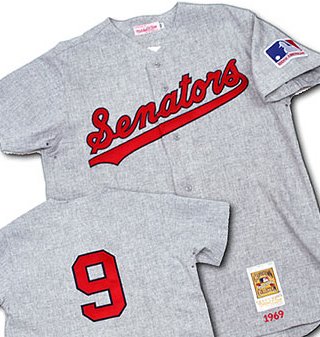 a texture with both dark and light grey material interwoven into the shirt, giving it more of a three dimensional quality. I'm guessing that we don't see that type of design any more because it was simply the way flannel was loomed, and it can't be reproduced using today's synthetic materials.
How boring was the Senators' uniform? I remember how excited I got when the Washington Post ran a headline in early 1971 that stated, "Senators Shoes To Be Red White And Blues," meaning that the team would be only the second team to eschew the traditional black spikes for white (the A's were the first).
Nothing important to write about, but hey, since almost no one visits on Saturdays .....
Speaking Of Uniforms: Do you think the Nationals will sport any new or revised uniforms next year? You would think that the Lerner's might have requested some changes to the togs during their first full season of ownership. Hard to say at this point. Under normal conditions, any request for uniform changes must be approved by Major League Baseball by mid season the year before, and no such request was made (of course, the Lerner's didn't own the team at that point, either). You would think, however, that the Nationals might have been given special permission considering the ownership change. We didn't hear about the alternative uniform for '06 until late winter, so we won't know anything for sure until next year.
Acta To Interview: Former Expos' coach Manny Acta will be interviewing with the Nationals sometime next week, after his interview with the Rangers. I'm a fan of Acta, and would be happy to see him in the dugout next year (though Girardi is still my top choice). Acta is one of those "above and beyond" guys -- doing whatever it takes, whenever it's needed. After making an error a few years back, Vlad Guerrero refused to talk to reporters after the game. Acta went and sought out Guerrero and "strongly urged" him to discuss his miscue. He eventually did. Acta believes in accountability -- the superstar has the same rules as the 25th player. I like that.
IT'S 1968 DEJA VU ALL OVER AGAIN
 [October 20th] -- And so now we know -- it's the St. Louis Cardinals and the Detroit Tigers in this year's World Series. Though I've lived in both cities, I don't particularly have a dog in this hunt this year (for those of you who don't speak "Dr. Phil," that means I don't care who wins). But I like this year's pairing because both teams bring interesting story lines into the series.
The Tigers are what the Nationals hope to soon become. Having lost 119 games just three years ago, Detroit built a winner the proper way, with just the right blend of veterans, rookies and free-agents. When they lost the pennant to the Twins on the last day of the season (talk about a near record-setting collapse!), everyone gave them up for dead. After losing the first game of the LDS to the Yankees, they won the next seven games they played to reach the Fall Classic.
The St. Louis Cardinals came into this season missing two very important pieces of last season's puzzle: Reggie Sanders and Larry Walker. Without them, they weren't as good on the field, and they were even worse off the field. The Cardinals' clubhouse had many problems during the last month of the season. It got so bad that some players were suggesting that Albert Pujols was turning into the next Barry Bonds. What? But the amazing thing is that the Cardinals reached the World Series with just 83 wins. Eighty-three wins! The Washington Nationals won just two less games in 2005, and there was no way that team had any hope of succeeding in the playoffs.
I guess I'm going to root for the Tigers, only because their appearance in the Series is so improbable. Don't get me wrong, though. I'm not a Detroit fan. That city was by far and away the worst I've ever lived in. St. Louis was a very clean and enjoyable city -- lots to do and I felt safe wherever I went.
The Cardinals - Tigers matchup is very interesting, particularly for me. I was 12 years old the last time the two teams met in the World Series, and it was the first year I followed baseball. Though it was 38 years ago, the memories from that series are still fresh: (note -- these are from memory; I didn't look anything up. I may get a couple of facts wrong, but memories don't mean much if they are fact-checked).
- The Senators played their last series of the season in Detroit, and for the first time that year, their game was broadcast on "NBC's Game Of The Week." Well, sort of. Giving the nation a preview of the Series, NBC did a split screen for most of the broadcast, with the Cardinals - Astros(?) and Senators - Tigers games showed simultaneously. All I remember about the game itself was Mike Epstein hitting a triple that hit the base of the wall in Tiger Stadium (it was concrete) and bounced around for quite some time.
- Tigers' manager Mayo Smith made a gutsy decision prior to game one by playing an outfielder at shortstop. Al Kaline was injured for part of the season, and Smith played Willie Horton, Jim Northrup and Mickey Stanley in the outfield during his absence. When Kaline returned, Smith moved Stanley, a shortstop in high school, to the infield to replace light hitting Ray Oyler (.135 in 235 at-bats). Okay. His stats I DID look up!
- Bob Gibson absolutely dominated the first game played at Busch Stadium, striking out 17 batters and setting a new World Series record.
- Pitcher Mickey Lolich hit a home run in game two(?) to help the Tigers tie the series at one game a piece.
- Down 2 games to 1, a thunderstorm hit Detroit with the Tigers down big to St. Louis in the fourth inning (It was something like 5-1 or 6-1). The Tigers' players did all they could to slow the game down in hopes of the umpires canceling the game. I remember Willy Horton had a butter knife in his back pocket, and after each pitch, he'd call time and step out of the box, then s-l-o-w-l-y remove the caked-on mud from his cleats. Finally, the home plate umpire got wise to what was happening and told the pitcher to pitch even if the batter wasn't ready. I didn't work.
- After tying the series at 3-3, Mickey Lolich pitched against Bob Gibson in the 7th game in St. Louis. In the 7th inning, Curt Flood, about the best fielding center fielder in the game, mis-played a routine fly ball and allowed three runs to score, securing a 4-1 victory for Detroit.
Denny McLain struggled throughout the series, going 1-2. Mickey Lolich, however, was superb, winning 3 games and almost single-handedly brought the championship to Detroit. That the Tigers won it all wasn't a surprise -- Detroit was clearly the best team in the major leagues that year.
The "year of the pitcher" came to a close with Mickey Lolich jumping into catcher Bill Freehan's waiting arms. Bowie Kuhn and the team owners were so concerned that the lack of offense was keeping fans away from the parks that they lowered the mound five inches. And it worked. Once again, baseball was a balance of offense and pitching.
Okay, I waited until the last paragraph to mention Endy Chavez' great catch that robbed Scott Rolen of a two-run home run. Without a doubt, it was the finest post-season catch I've personally seen, and that covers more than 40 years of baseball. I just hope you got tired of reading this story and moved on before you had to read this, painful as I know it is.
WAS WATERGATE RETRIBUTION FOR NIXON'S INACTIVITY IN 1971?
 [October 19th] -- With all due respect to President George W. Bush, Richard Nixon was the Oval Office's most rabid baseball fan. During his years in congress [1948 - 1952], the legislator from California would often duck out of meetings and head over to Griffith Stadium to watch the Senators play. He once told Senators' manager Ted Williams that he had watched more than 200 games at the old park during the 1950's.
The then vice president spoke out against Calvin Griffith's move of the Senators to Minnesota, and was ecstatic about the city receiving a replacement expansion franchise the following year.
When he lost the 1960 presidential election, he returned to his home state of California, and began to follow the new Los Angeles Angels, owned by his friend Gene Autry, and spent many nights in the owner's box with Autry and his family. By 1968, though, the was again ready to run for national office. He returned to Washington in 1969 as the president of the United States.
Nixon was a familiar face at RFK Stadium during the 1969 season, the lone highlight of the expansion Senator's decade in Washington. Ted Williams was the new manager, Bob Short the new owner. the team's 86 win season renewed hopes in a city decimated by the assassinations of Martin Luther King and Bobby Kennedy the previous year. Resurrection City was gone from the mall and blacks and whites seemed comfortable with each other for the first time in years. Most Washingtonians believed that Nixon would keep his campaign promise and get the country out of Vietnam.
It was a hopeful time for all. Things change quickly, however. Especially in D.C.
By 1971, Bob Short, underfunded to begin with, was having real financial problems, and he began floating the idea of moving the team if the D.C. Armory board, which had oversight authority for RFK Stadium, wouldn't negotiate a new lease that would have ended up being little more than legalized theft. The acrimony reached the sports page of the Washington Post as both sides hammered the other throughout the summer.
On July 1st, Roger Ailes, then a Republican strategist, contacted an aide to Bob Haldeman and suggested that it would help the president's image if he got involved in the Short - Armory fight. Ailes thought that some "federal assistance" might end the standoff and save the team. By mid August, fans were beginning to worry that Short might actually move the team. Virginia Senator William Spong wrote Nixon, asking him to meet with Washington Post columnist Shirley Povich to come up with a plan to block any potential move. The Post's sports editor, Marty Zad, asked the president to use "the power of the presidency" to help stop the move. Ultimately, all hopes of a "presidential pardon" came to an end on September 7th. Herb Klein, White House director of communications, told Zad that it would be "inappropriate" for the president to get involved in a private financial matter. The following week, Nixon made his first and only public remarks regarding the matter, saying that he would be "heartbroken" if the team were to move to Dallas.
Now assured that there would be no last minute Oval Office intervention, Major League Baseball voted 10-2 to allow the team to relocate to the Dallas - Fort Worth area. The two dissenting votes were Brewers owner Bud Selig and the Baltimore Orioles. The vote was announced on September 21st.
Nixon was right; he had no "legal" authority to stop the move. But in the rest of the world, away from the beltway, "moral" authority is something used when "legal" authority isn't available. Nixon might have been able to apply enough pressure to force Short to sell the team to someone better able to run the team. It wasn't the fault of the Senators' fans that Major League Baseball chose an underfunded owner with a history of moving professional sports franchises to run the team. Nixon's position as the leader of the free world was strong enough to scare the Russians and subdue the Egyptians, so why wasn't it strong enough to put a little "scare" into Bowie Kuhn and the baseball boys?
Is it a coincidence that just a year after refusing to help the Senators, Richard Nixon's world came tumbling down around him? Maybe. Maybe not.
He spent the next two years fighting the media, the Democrats, and ultimately, his own base until he was finally forced to resign in August of 1974. Watergate was payback from the baseball Gods. In 1948, Harry Truman threatened to draft striking railroad workers into the Army if they didn't go back to work. He knew he couldn't, but he didn't care. Both sides caved and the workers returned to their trains.
Nixon could have done the same thing. Draft Bob Short. Draft Bowie Kuhn. It would have worked. Scare them all. Isn't that what Washington D.C. is all about?
GIRARDI TO YANKEES AS COACH? MAN, I HOPE NOT
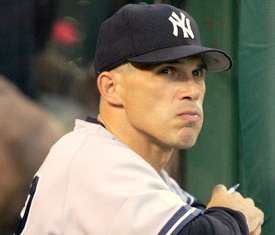 [October 17th] -- This from Tracy Ringolsby and the Rocky Mountain News:
Girardi a Yankees coach again?
Now that Lou Piniella has signed a three-year contract as manager of the Cubs, Joe Girardi is expected to return to Joe TorreÂs Yankees coaching staff.
And with Piniella committed to the Cubs, there is the expectation that Girardi could move into the managerÂs job if Torre retires at the end of next season.
Washington still is a possibility for Girardi, but indications are general manager Jim Bowden is pushing for former Kansas City manager Tony Pena. Pena is currently a coach with the Yankees, so if he left for the Nationals, that would open a spot for Girardi.
I could see this happening only if Joe Torre has let it be known that he will be voluntarily stepping down at the end of the 2007 season. Only then would Girardi be willing to put his managerial career on hold and return to the life of a baseball coach. That said, wouldn't it have made more sense for Lou Pinella to have been the "wait a year" guy and then move to New York? Pinella, after all, is a favorite of George Steinbrenner, and "The Boss" likes to have full control over his managers -- something he'll never have with the feisty Girardi. But because Pinella has taken over as manager of the Chicago Cubs for the next three years, I have to assume that there is no "wink-wink nod-nod" agreement in place, and that Ringolsby is just guessing.
I hope that the Nationals don't stay "inside the box" like so many other major league teams and hires a re-tread, a manager who has managed and failed in another city. Sure, I realize that several managers have succeeded after failing elsewhere (Jim Leyland in Detroit), but if we're going to grow this organization from the ground up, then we should start with someone who has talent but perhaps hasn't had the opportunity to show it just yet. If Girardi won't be available, then Ron Washington seems to be a bright star in the making. I think Tony Beasley could make a solid manager one day as well. But p-l-e-a-s-e, don't hire Tony Pena, he of the .415 winning percent duringuing his stay in Kansas City.
Give us fans someone to cheer for, okay?
Lopes to Phillies: Not willing to take his chances with the new D.C. skipper, first base coach Davey Lopes has signed on to be one of three new coaches in Philadelphia. Lopes, a former manager of the Milwaukee Breweers, joins Art Howe (Athletics) and Jimy Williams (Astros) as the newest members of the Phillies' staff. I'm surprised that Lopes wasn't given a chance at the Nationals' head job; after all, he was just as bad in Milwaukee as Tony Pena was in Kansas City.
St. Claire Stays: Good news from the off-season ticker: Randy St. Claire will be staying as the Nationals' pitching coach. This is an unusual move as most new managers have a free hand in naming his own staff -- especially the pitching coach. But St. Claire has done a fine job, making sirloin out of cube steak for four years. One when can only imagine what he can do when he's given some real horses to train.
THE COST OF WINNING
 [October 16th] -- Baseball is without a doubt a sport that revolves around statistics. There is a statistic for everyone and everything. Some, like on-base percentage, is very important. Others, like game winning RBI's, were so meaningless that statisticians stopped using them.
From my perspective, the best way to gage a team's front office success or failure is the "wins to payroll dollars" ratio. Divide the total payroll by number of wins, and you have a pretty good idea of how well (or how poorly) a team' front office is doing.
Here's how the National League ranked in cost per win for the 2006 season (playoff teams are in red):
- Chicago Cubs [$1,430,666.00]
- San Francisco Giants [$1,184,952.00]
- Atlanta Braves [$1,141,226.00]
- Houston Astros [$1,128,670.00]
- L.A. Dodgers [$1,118,715.00]
- St. Louis Cardinals [$1,070,000.00]
- N.Y. Mets [$1,042,103.00]
- Philadelphia Phillies [$1,038,000.00]
- Washington Nationals [$889,338.02]
- San Diego Padres [$794,274.32]
- Arizona Diamondbacks [$785,318.90]
- Milwaukee Brewers [$767,577.88]
- Cincinnati Reds [$761,368.30]
- Pittsburgh Pirates [$697,279.33]
- Colorado Rockies [$542,539.27]
- Florida Marlins [$192,307.66]
The top four teams on the list, as well as the bottom six, didn't make it into the playoffs The amount of money spent on payroll, then, doesn't necessarily increase a team's chances of making the post-season, but spending too little almost guarantees a winter bereft of baseball. The great majority of the teams that made it to the post season fell into the middle (the American League teams spent far less than their N.L. counterparts), spending just the right amount of money.
In 2005, the Nationals' 81 wins came at a cost of $592,592.33 per game, much better than this year's $889,338.02. The league average was $862,000, and the average of the playoff teams was surprisingly less, coming in at $686,500 per team.
Many Nationals' fans have been concerned that the Lerner's payroll limit in the low $60 million dollar range would keep the team from competing for a spot in the playoffs. That doesn't seem to be the case. Half of this year's post-season teams have a payroll less than the Washington Nationals, so it's becoming pretty evident that spending millions and millions of dollars on super-stars doesn't make a team that much more likely to make the playoffs. To that end, only five of the fifteen highest payrolled teams made it to the post season in 2006.
What's the right payroll amount for the Nationals? Take a look at the following breakdown:
- $15 million - $50 million payroll: No teams made the playoffs
- $50 million - $60 million payroll: No teams made the playoffs
- $60 million - $70 million payroll: Three teams made the playoffs
- $70 million - $80 million payroll: No teams made the playoffs
- $80 million - $90 million payroll: Two teams made the playoffs
- $90 million - $100 million payroll: One team made the playoffs
- $100 million - $200 million payroll: Two teams made the playoffs
Surprisingly, teams with a payroll in the $60-70 million range had the most entries in the post season, and that's where I think the Nationals' payroll should be for the foreseeable future. That level of payroll would demand that the team's roster would be constantly pruned of older players with bloated contracts, forcing the team to keep the minor league system well stocked.
Most importantly, a $60+ million dollar payroll doesn't allow for players like Alfonso Soriano to make $15 million dollars per year. No matter what players' agents might say, there is no way that any baseball player is worth that kind of money. For that same $15 million, Bowden could sign two or three players, players whose combined stats would likely dwarf anything Soriano could produce. For instance, the Nats could have three members of the Tigers (Magglio Ordonez [.298-24-104], Carlos Guillen [.320-19-85] and Brandon Inge [.253-27-83]) for less money than Soriano would cost the Nationals next season. They combined for 70 homers and 272 RBI's -- do you think Soriano would be that productive in 2007??
The only teams that could afford Soriano would be the Yankees, Red Sox, Angels, White Sox, Mets, Dodgers and Cubs; they are the teams with the seven highest payrolls in baseball. Only two of them went to the post season this year. And that's what I'm trying to say. Scouting is far more important to the Nationals' future than Mark Lerner's checkbook.
Alfonso Soriano or two to three quality players for the same price: which would you prefer to see next year at RFK? I think it's a no brainer.
WHY THE NATIONALS SHOULD NOT RE-SIGN ALFONSO SORIANO
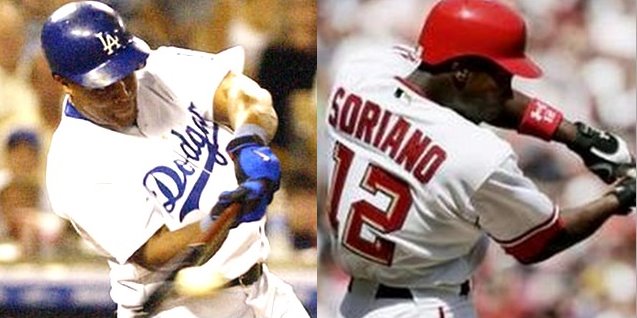 [October 14th] -- I am very impressed with the general understanding that Nationals' fans have regarding the business of Major League baseball. You would think that Alfonso Soriano, coming off a .272-46-95 season, would be considered a "sign at all costs" player by the Nats Nation. Not so. The vast majority of posters on the various team message boards have a "tread carefully" attitude regarding Soriano. Yes, they want him back, but only at a price that won't hamstring the team in the future. If Soriano doesn't take the Nationals initial offer of five years, $70 million dollars, then most think it best if the Nationals look elsewhere for a left fielder.
I couldn't agree more with the Nationals' fans. More than that, however, I really don't even want to spend the $70 million dollars. Too many things can go wrong. Remember, it wasn't too many months ago that Jim Bowden offered Jose Guillen a multi-year deal at $10 million per year. Had the Nationals been hampered by that excessive contract, I don't think they would have even tried to re-sign Soriano this off season.
Signing Soriano is a bad idea; it's hurts the team's long-term viability.
From 1999 through 2003, The Los Angeles Dodgers waited for 3rd baseman Adrian Beltre to play up to his talent. Oh, he wasn't playing poorly, but neither was he playing like the team had hoped. In 2004, Beltre finally had that breakout season that Dodger fans had been waiting for. He batted .334 with 48 home runs and drove in 121 runs. The stud had finally arrived. Too bad he arrived during Beltre's free-agent year. The Seattle Mariners, desperately trying to regain their dominance in the American League Western division, signed Beltre to a five year, $64 million dollar deal (almost $13 million per year).
In the five years before his break-out year, Beltre averaged .265-20-73. In the two years since signing that mega-deal, Beltre is hitting .261-22-88. In other words, he has reverted to being that slightly-above-average 3rd baseman, but he is now getting super-star money, and there is nothing that the Mariners can do about it. They certainly aren't able to trade him for any prospects -- unless they "eat" a majority of Beltre's contract that is. So, they have to wait until the contract expires in 2009 before they can out from under their mistake.
All across the major leagues, big-contracts haunt the majority of teams. The St. Louis Cardinals paid Scott Rolen and Jim Edmonds a combined $24 million dollars in 2006 in return for 41 homers and 165 RBI's. Nick Johnson and Ryan Zimmerman combined for 43 homers and 187 RBI's while earning $3.6 million, $21 million less than the Cardinals' duo. The Rockies are paying Todd Helton $16 million to be there first baseman -- he hit .302-15-81 in 2006. Is his production worth $13 million dollars more than Nick Johnson's .290-23-77? I don't think so. Even teams like the Oakland Athletics, who have worked miracles with a small payroll, can get caught with an inflated salary on their roster. Jason Kendall batted .295-1-50 for the Athletics in 2006 and was one of the keys in helping them win the AL West. But he received almost $12 million dollars for his efforts, an amount worthy of a slugging outfielder, but not a singles-hitting catcher.
I hope the Nationals adopt a policy of not paying long-term, hyper-inflated contracts to its players. Once the minor league system is restocked with prospects, the Nationals should adopt a system of 1) developing a young player, 2) playing him for five or six years, then 3) trading him for prospects before he qualifies for free-agency. Some think this is a policy of low-payroll / high-profits for the owners (read: Tampa Bay Devil Rays), but I couldn't disagree more. Just look at our own team. Jose Vidro is making $8 million dollars a year, but today has only $3 million dollars worth of talent left in his aging body. We can't play him and we can't trade him. Because he has a guaranteed roster spot, the Nationals are stymied from signing other, more needed players because of Vidro's salary.
Certainly, there are exceptions. Ryan Zimmerman has shown himself to be a "team player" of the highest caliber. He was the first draft pick to come to terms with his new club, and is driven by desire, not income. He is the second coming of Frank Howard -- a player who reflects all that is good in baseball both on and off the field. He deserves whatever he wants. But if Nick Johnson, for example, continues to play at the level he did in 2006, he is going to be able to demand a hefty price tag when his current contract expires in 2010. He won't be worth the money he'll make. No one will at that age and with that experience. The answer, then, is to refrain from signing players in their late 20's and early 30's.
The only option, then, is to enjoy the fruits of the players' labor during that time before he is eligible for free-agency. Once that player is close to free-agency, trade him away for two top-tier prospects. By replacing one player with two, the team will always have a surplus of prospects and would then be able to trade them should the team need a veteran player to shore up a weak point in the lineup during a pennant drive.
This will work, but only if it becomes policy. A hap-hazard, "I'll do it today but not tomorrow" way of running the franchise will only continue its poor performance. Kasten has got it right. Build for the future. But he and Bowden have to be consistent to that end, and means fielding some sub-par teams over the next two or three years.
I'm willing to accept that. Are you?
WHAT HAPPENED TO ALL THE PLATOON PLAYERS?
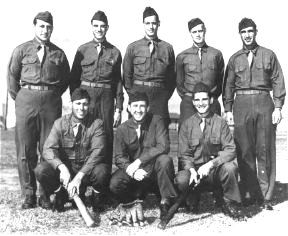 [October 15th] -- I loved going to Senators' games in the late 1960's. I enjoyed watching guys like Mike Epstein, Lee Maye and Bernie Allen "do their thing" at RFK. The problem was that I never knew if they'd be playing on any given night. Ted Williams, a firm believer in playing the eight best players that night, platooned five of the eight positions. Here are the platoons for 1969:
Catcher: Paul Casanova and Jim French
First Base: Mike Epstein and Frank Howard
Second Base: Bernie Allen and Tim Cullen
Left Field: Frank Howard and Brant Alyea
Right Field: Lee Maye and Hank Allen
Only shortstop Eddie Brinkman, third baseman Kenny McMullen, and centerfielder Del Unser played every day. Let's take Mike Epstein as an example. In 1969, Epstein batted .278-30-85 against right handed pitching. In 1970, Epstein played a great deal more against lefties and did far worse, batting only .256-20-56. With the Oakland A's a few years later, he was again part of a platoon and played superbly, hitting .270-26-70.
Many managers don't want players like Epstein and Lee Maye on their teams these days; they consider them "incomplete" players. Today, many players take the field with little hope of success. Austin Kearns is a prime example. Since the trade that brought him to D.C., Kearns batted .368 with 3 home runs and 13 RBI's in just 57 at-bats against lefties. He had a Bonds-like 1.149 OPS. Against righties, however, he batted only .206 with just two more home runs in 100 more at-bats. He had a woeful .681 OPS. Who would you platoon with Kearns in right field? How about Kory Casto, a rookie looking to find a place to play next season. Casto, the Nationals' Minor League "Player Of The Year" the last two seasons, batted .303 with 17 home runs and 62 RBI's against right handers. From the left side, he was terrible, hitting .189 with a .584 OPS. A Casto/Kearns platoon (I understand that I'm using Casto's minor league numbers) would produce a .313-25-95 stat line, much better than Kearn's .264-24-86. Who cares if it takes one player or two players or five players to produce at a single position? More importantly, who wants to watch a player (like Casto) bat .189 against lefties?
I hope that the new Nationals' manager takes a page from Ted Williams' managerial book and platoons as needed next season. Set the players up to succeed, and not to fail. That's what platooning is all about. Casey Stengel won like a zillion World Series with the Yankees platooning at several positions.
It works!
THE SORIANO-GO-ROUND
 [October 13th] -- Jose Rijo says that the Nationals offered Alfonso Soriano a five year, $70 million dollar contract. Jose Rijo says that the star outfielder flat turned down the Nationals offer. Jose Rijo says that he doesn't how the Nationals will ever be able to re-sign Soriano. Enter Stan Kasten, who "questions" that Soriano turned anything down. Now Jose Rijo says that he was misquoted, and that he said nothing about either Soriano turning down the Nats' offer, or the team having little chance of retaining him.
What gives?
I have no idea. Kasten is showing himself to be very secretive in all of his dealings, so who really knows if Soriano has even been tendered an offer yet. All we can do is watch and wait.
Some say that the $14 million/year contract was carefully calculated as the highest dollar amount that the team knew Soriano wouldn't take. Then, the Nationals can say, "Hey, we tried," and spend that money on pitching. Others say that it was a good faith offer, and that the team will up the ante a few more times before going in another direction.
Either way, I hope that the Nationals don't re-sign Soriano. If he signs elsewhere, we'd likely see Ryan Church or Kory Casto, perhaps even Jose Guillen, in left. Let's assume it's Church. Based on his first two seasons in the major leagues, Church, if given 550 at bats, will hit 30 homers, drive in 100 RBI's, and steal close to 30 bases. He'll make about $400,000 next year. Soriano, then, would hit 5-10 more homers than Church, drive in the same number of runs, and steal a dozen or so more bases. Does it make sense, then, to pay an additional $14.5 million dollars to get a half-dozen or so more homers? I don't think so. Put Church in left, and use that $14 million to sign two very good pitchers.
That would be the makings of a pretty good "transitional" team. Wouldn't it?
TURNS OUT THAT I KNEW CORY LIDLE BUT DIDN'T EVEN KNOW IT
 [October 12th] -- Thirteen years ago, I was living through a remarkable time in my life. I didn't have any gray hair yet, and my 30 foot jump shot still traveled 30 feet. Heck, back then, I could actually stoop to pick something up and then stand back up. * Sigh ...*
I had a camera store / photo studio that I thoroughly enjoyed running, and had a string of some of the best part-time jobs you could find. In the late 1980's, I was the stadium announcer for the Idaho Falls Braves, a class 'A' rookie team for Atlanta. I got paid $25 dollars a game to sit in the best seat in the house and say, "Leading off and playing shortstop, number 10, Jose Offerman..." Then, beginning in 1991, I was the "official" photographer for the Idaho State University football and basketball teams. It was a great time for me. Now, don't get me wrong, this was more about being in the right place at the right time then having any marketable talents. I got the job with the Braves because I was in the stadium trying to sell the players boom-boxes when the old announcer quit in a huff. Rai Henniger, the team's GM, who didn't know a soul in Idaho Falls, walked up to me and asked me if I'd like to be the team's PA announcer. As for working for the university, the new football coach came in to my store one day to buy a video camera, and asked me to be his photographer. I spent my summers at McDermott Field in Idaho Falls and my winters in Holt Arena in Pocatello. It was great.
In 1992, The Salt Lake Trappers, an independent team in the Pioneer League, were forced out of the Utah capital because Derks Field, their home park, had been condemned. The city tore it down and built a new Triple-A stadium in its place. They moved north to my home town of Pocatello Idaho, changed their name to the Posse, and began the process of settling into town. Needing a photographer, the team's general manager contacted me, and I spent the summer snapping pictures at Halliwell Park. Again, right place, right time.
I got a chance to get to know several of the players. Some asked me to take pictures and send them to their families in Oklahoma, and Florida, and Wisconsin. Others just wanted to know where the pubs were in town. A few of the players were jerks, but the vast majority were good, decent kids, most of them away from home for the first time.
Towards the end of the season, it became known that the team would be moving to Ogden Utah in 1994. The players were told to make sure they returned the jerseys at the end of the year. Because the Posse would be in existence for only one year, they would probably become valuable, and the owner wanted them.
The players groused, because (I think) they were told earlier that they could keep them.
I was in the clubhouse during the last homestand, snapping pictures and saying goodbye to the players. One young pitcher came up to me and thanked me for taking some pictures of him during the season. He had a vibrant personality -- he joked -- he cajoled -- he laughed all the time. He was confident, on the cusp of being arrogant, but not quite. He had told me earlier in the season that he had been released by the Twins the previous year, and that "The gig in Pocatello was the only one I could find." He said that he was confident he was going to find work in '94. He had pitched well, going 8-4, 4.13 in 16 starts. I genuinely like the guy and told him I thought he had a bright future (I was just guessing). I walked through the clubhouse door and headed towards my car when I heard a voice call out, "Hey, Snappy!" (Some of the players called me that because of the loud "snap" sound that my camera made). The pitcher caught up with me in the parking lot.
He reached under his shirt and pulled out a black and teal Posse home jersey. "They said we couldn't keep them, but they didn't say we couldn't give 'em away," he said with a smile. He tossed me the jersey, waved, and ran back into the clubhouse. It was a real "Mean Joe Greene" moment.
I knew that player as Cory. I Never knew his last name -- never new any of their last names. So when the tragic news of the death of Cory Lidle hit the news yesterday afternoon, I never gave it a second thought. Oh sure, I was saddened by the death of this baseball player, but it wasn't like I had any relationship with the guy.
After driving my son to band practice this morning, I stopped at the corner convenience store to grab a newspaper. "Dead Baseball Player Had Pocatello Ties" read the headline. Oh, my. I ran home and searched through my copies of all those pictures I took, trying to find one of Lidle. Turns out that most of them are in storage, including the ones I took for the player's baseball cards (I got a whole $50 for that job). I did find the picture at the top of this story, however. It was taken in July, 1993. I scribbled the names of the players on the back of the picture. Second from the left reads, simply: "Lidle."
I never realized that "Cory," that fun loving kid who gave me the jersey (I don't know if it was his or not) made it to the major leagues until this morning. I didn't follow these players' careers after they left Pocatello because, well, this was an independent team for goodness sake -- these were players who couldn't sign with a big league club. I didn't think they had the talent to make much farther.
I was wrong.
I wish I could remember more about Cory Lidle than just the shadowy impressions that remain with me these many years later. He was fairly short. He laughed a lot. He was really confident. But he was so much more than that.
Adieu, mon ami. May God bless your family until you see them again.