BEHIND EVERY NATIONAL IS A SENATOR WITH A STORY
 [October 1st] -- I am part of that generation that remembers baseball in Washington before the Nationals. I spent many summer days in the upper deck of RFK Stadium, watching players wearing red hats with "curly W's" on them glide along the stadium's lush green grass. Although I remembered the names and the statistics of those players, I had forgotten the texture of their talent, their idiosyncrasies, their passion.
That is, until last night.
I was watching the Nationals - Mets game from my easy-chair in the den. Living In Idaho, the twenty inch, two-dimensional version of a Nationals game is the best I can get, so I make the best of it. But this day was different. I was given a surround system for my birthday, and though it was hooked up, I hadn't thought to turn it on. My son came in around the 4th inning, and said, "Hey Dad, why don't you turn on the sound?" He walked to the unit and flipped the switch.
I had never listened to a game this way before. Suddenly, I could hear the ball zipping to the plate. That "pop" sound that the ball makes when it hits the glove echoed behind me. In the distance I could make out a vendor selling his wares, "Get your peanuts, get your peanuts here ... they're nutritious AND delicious!" I turned down the center-channel and the announcers were silenced. It was just me and RFK, together for the first time in three decades. Beltran Perez was warming up on the mound. I could hear the public address announcer drawing the attention of the fans to a message on the scoreboard. Then it happened.
I felt like Sam Beckett, the character in the TV show "Quantum Leap." I was no longer in my den. I was back in 1969, at RFK Stadium, in the upper deck. "Oh boy."
Where Perez was just a moment before stood the imposing figure of Dick Bosman. Bosman came out of nowhere that season to win 14 games and lead the American League in ERA. Like Patterson, he had missed part of the season due to an injury. At first, barrel-chested Mike Epstein was laughing with the umpire as he warmed up the infield. His physical appearance was very similar to Nick Johnson. A lefty, Epstein clubbed 30 home runs in '69 even while platooning. Eddie Brinkman ran deep into the hole at short to retrieve one of Epstein's throws. He back-handed the ball, twirled in the air and fired a strike to first. Epstein caught the ball chest high and pointed to the slender shortstop as if to say, "nice catch." Frank Howard was warming up with Del Unser in centerfield. Even then, while just trying to get loose, it was apparent that Hondo had no speed, no range, and little hope of tracking down a ball in left unless it was hit on a line directly at him. The fans in the leftfield corner [all six of them] were chanting Hon-do, Hon-do, Hon-do. He waved in appreciation. Lee Maye was leaning against the chain-link fence, chatting with ace reliever Darold Knowles. Maye, acquired from the Indians in a mid-season trade, plugged the only real hole in the lineup that year. Bernie Allen, the soft spoken second baseman, was preparing to play, stretching his hamstrings behind the mound. Paul Casanova took the last warm-up pitch from Bosman and fired it to second base. Allen whipped the ball to third, where the imposing figure of Ken McMullen stood. McMullen was the second best fielding 3rd baseman in the American League. But because Brooks Robinson played only 45 miles away, Mac's talents were underappreciated around the league. From my perch in the upper deck, I could barely see Ted Williams in the dugout. Williams, wearing his ever-present red Senators warm-up jacket, was leaning forward, his left foot resting on the top step. The team was ready. The manager was ready. I was ready.
As New York's Horace Clarke came to the plate, the public address system came to life: "Leading off for the ..... Mets, second baseman Jose Reyes." Like the penny in the pocket of Christopher Reeve in the movie "Somewhere in Time," hearing the name of this present day Met returned me to my 2006 reality.
What a trip. I had forgotten the "feel" of the Senators. Kenny McMullen could really hit. Paul Casanova really couldn't. Bernie Allen was slow yet got to all the balls hit in his direction. I had forgotten just how far a ball would fly when powered by Frank Howard's god-given muscles. Although the Senators are made fun of even today, most forget that the 1969 version won fifteen more games than the Nationals did in 2006.
I hope that 30 years from now, kids who have watched the Nationals play will remember the feel, the smell, the texture of a game played at RFK Stadium. The statistics, the wins or losses, the highlights are all secondary to the experience of watching your team playing in your town at your park.
I had forgotten.
The Class Of 2005
 [September 30th] -- With Ryan Zimmerman making a run at the National League rookie of the year award, I thought it might be fun to look back at the 2005 MLB draft and see how the three players taken before Zimmerman are doing.
#1 - Justin Upton (SS) Arizona Upton was considered hands-down the best player in the draft. A Virginia high schooler, he was one of the best high school shortstops to come along, but Jerry Ford of Perfect Game USA, a scouting service, says Justin would grade higher than any player in high school history if he were a center fielder. With Steven Drew already in the majors, that's where he'll probably end up. Upton read his press clippings, and demanded a financial package so large that the Diamondbacks weren't willing to pull the trigger. He finally signed last winter. The lost season seems to have hurt his development. He spent 2006 at Class 'A' South Bend, hitting .263-12-66 -- not exactly top pick numbers. I don't think his stats are indicative of the player he'll be, just the player he was. I suspect that in a few years, he'll be a Hanley Ramirez clone, perhaps with a bit more power. The problem, though, is that he's likely three years away from playing in Phoenix.
#2 - Alex Gordon (3B) Royals Alex Gordon thought he should have been the #1 pick, and so held out all of last season for #1 money. Like Upton, he signed last fall. Unlike Upton -- probably because he was a college player -- Gordon thrived in his first professional season. Playing for 'AA' Witchita, he batted .325-29-101 with an outstanding 1.015 OPS. Gordon, the Baseball America college player of the year, wasn't as demanding in terms of his signing bonus (he signed for $4 million) as he was wanting a major league contract and a spot of the 40 man roster. Gordon, who bats left and throws right, was a two-time All-American. In 193 games at Nebraska, he hit .353-44-189 with 43 stolen bases in 57 attempts, 53 doubles, 11 triples and 44 home runs. Gordon looks like the real deal, and will likely get his "cup of coffee" next September. He'll probably have more power than Zimmerman, but he doesn't have Ryan's gold-glove defense.
#3 - Jeff Clement (C) Mariners Clement, a graduate of Southern California, was the highest draftpick to sign last year. He began the season at Everett of the Northwest League, batting .273 in just 11 at bats. He finished the year at class 'A' Wisconsin of the Midwest league, where he batted .319-6-20. This year, splitting time between 'AA' San Antonio and 'AAA' Tacoma of the PCL, he batted .257-4-32. The Mariners seem to be promoting him a level above his ability, forcing him to play up to that league's talent. He's a left-handed hitter with power, a perfect fit for Safeco Field, where balls hit to right field and right-center travel better than balls hit to left field and left-center. Though he's just one level below the major leagues, his offense, barely average for the league, has a long way to go before he can survive in the American League. Don't look for him to make an impact in Seattle for at least another two or three years.
Upton is too young to be able to tell if he's going to be a better player than Ryan Zimmerman. Certainly, he won't get a chance to show his talents for a few more years. Jeff Clement may still become an all-star catcher, but he hasn't shown anything yet to warrant those pre-draft comparisons to Johnny Bench. Alex Gordon, however, seems like he's going to be an impact player very soon, maybe even next summer. There is no question that he's more powerful than Zimmerman, but there is also no question that he doesn't have his defensive skills either.
Ryan Zimmerman might not become the best major league player of the group, but he certainly will be one of the best. But more than that, he has shown that he is as good a person as he is a player. While Alex Gordon and Justin Upton were holding out for "big bucks," Ryan Zimmerman was making his major league debut. He is the kind of person you don't mind giving a $50 or $60 million dollar contract to in a few years. He deserves it.
The others? Well, we'll just have to wait and see ....
IT'S TIME TO SAY "SEE YA" TO SORIANO
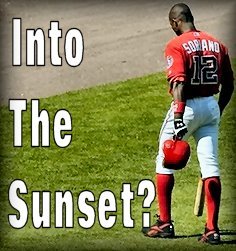 [September 28th] -- He was magnificent for five months. He was better than magnificent. He was one of the top two players in the National League. Heading into September, Alfonso Soriano had 43 home runs and was a lock to reach 50 -- he had at least seven homers in four of the previous five months. A good September would have guaranteed him a "blank check" from a dozen teams, including the Nationals.
Many teams will still come-a-calling, but I don't think the Nationals will be one of them. At least, they shouldn't be.
Soriano is mired in his worst month of the season. He is just 22-105 with just six doubles, three home runs and eleven RBI's. He's batting only .210 with a miserable .652 OPS. Now, I know what you're thinking; anyone can have a bad month -- it doesn't mean a thing. He's going to end the season with super-star numbers. Yes, that's true. But something else has become clear: The Alfonso Soriano we've watched this month looks very much like the one we expected to see all season. Remember all those stories written by the pundits in the Nats' blog-o-sphere (including me)? He strikes out too often. He doesn't hit in the clutch. His power will be limited in the outfield expanse that is RFK. On and on it went. I predicted that Soriano would bat .265-23-88 in 2006. I was stunned at how he played throughout the summer; he seemed to be someone else entirely.
Maybe he was.
Soriano's career statistics are more similar to his September than the first five months of the year. It seems that he has reverted to those same sloppy swings that caused him to be branded "tradeable" by both the New York Yankees and the Texas Rangers. He isn't "just missing," he is embarrassing himself on many of his swings. He looks lost and he is guessing at what pitch is coming his way. Some will say that he's having an "off" month, and that he's entitled. And sure, that's true. But I don't think that's what's happening. I think we're seeing the rebirth of the old Soriano.
This isn't a player who is worth $15 million dollars a year. Oh, he'll get it, though. Some team -- the Angels, the Orioles, the Cardinals -- will have both the money and the means to sign him to a five year, $75 million dollar deal with a no-trade contract, just like he wants. But if the Nationals were considering it, they shouldn't be any more.
Reason #1: Ryan Church & Jose Guillen. The Nationals outfield looks very muddled for 2007, with quality outfielders having no place to play. Ryan Church is one of them. Even with the head games heaped upon Church this year, he's still produced. Based on a 550 at-bat season, Church would have hit 25 home runs and driven in 100 RBI's while stealing 20 bases. He's a fine corner infielder but can't play there if Soriano returns. If Bowden chooses to trade Church for pitching, they team can re-sign Jose Guillen and move him to left. Either way, the Nats can fill his vacant position from within, and fill it quite nicely. No, they won't hit as well as Soriano, but either will hit "enough."
Reason #2: Pitching - Pitching - Pitching. The Nationals certainly have enough payroll dollars to sign Sorinao, but at expense of the pitching staff. The team needs at least two more solid pitchers to have any hope of being respectable next year. If Bowden can plug left field with either Church or Guillen, he could conceivably use the $15 million dollars to sign two quality starters. That would have brought guys like Paul Byrd and Jarrod Washburn to the Nats last year. No, they aren't "the answer" long term, but they don't need to be. The once barren farm system now has a half-dozen prospects who will be ready to join the starting rotation in two or three years. These guys need only be stop-gap hurlers (but good ones).
If the Nationals are going to be rebuilding, I'd much rather have two rather high draft picks than one player who may eat up 25% of the team's payroll. Even if the Nationals only use half of the savings, the team can still buy a starter and bank the rest of it for later.
I've enjoyed Alfonso Soriano's time in Washington. Brad Wilkerson wasn't the answer in the Nationals' outfield, so it's not like we lost a great talent for Soriano's one-year rental. But would you trade Wilkerson for two draft picks? I would.
And I hope the Nationals feel the same way.
Oh Well ....
 [September 27th] -- That the Nationals lost to the Phillies in 14 innings doesn't bother me. Philadelphia is trying to make it to the playoffs for the first time in thirteen years, and the Nationals are going to finish last in the NL East for the second consecutive year. The win is meaningless. But a few things about the game did cause me some angst:
1. The Phillies fans were in control of RFK most of the night. For the last eight innings, ESPN's cameras focused not on the many empty seats but rather the group of Phillies fans cheering and booing with every pitch. It made it seem like the Phillies have more fans and better fans. Not once did the announcers bother to mention that all of the Nats' fans have to go home and go to bed, while the Phillies fans took a few days off and came to D.C. to watch their team. They could sleep in.
2. The Nationals had the opportunity to make all those Phillies' fans cry on National television. After Jimmy Rollins two-run triple in the top of the 14th, they knew, I mean, they knew that they had the game wrapped up. The Nationals then loaded the bases in the bottom of the inning with no one out, yet were able to only score a single run. I love to see people from Philadelphia cry.
3. Frank Robinson mis-managed the game. I'm not one to take a swing at Frank; I really like the guy. But because of a lot of player moves in the middle innings, he was out of position players for much of the extra innings. In the 14th, he used Beltran Perez as a pinch-hitter. That Perez got a hit is immaterial -- he shouldn't have been there. Phillies' manager Charley Manuel did a much better job of managing his resources.
That said, there were some positives to come out of the loss. Ryan Zimmerman hit his 20th homerun, drove in two more runs, and got on base five of the six times he came to the plate. With a stat-line of .287-20-109, he has to be the frontrunner for the rookie-of-the-year award. I really thought he had to get that 20th bomb to win it, and he did. Charley Slowes interviewed Tim Kirkjen (It's late and I'm too tired to look up the correct spelling of his name), who said he believes that Zimmerman is the best rookie in the NL this year (though stopped short of predicting that he'd win the award).
I'm beginning to like the speed aspect of this team. In some inning (geez, there were sooo many), Nick Logan was on first base with one out when Ryan Church hit a ball right at first baseman Ryan Howard. Easy double play? Nope. Logan was running on the pitch, making it impossible for Howard to turn the twin killing. Brian Schneider than lined a ball to right field, scoring Nook. Without his speed, the Nats don't score the run. I hope Jim Bowden can keep the speed-burners on the team next year.
I'm staring at the test-pattern on my local tv channel, so I'm guessing it must be very very late or very very early. I think that's enough for tonight.
IT'S THE RYAN ZIMMERMAN SHOW
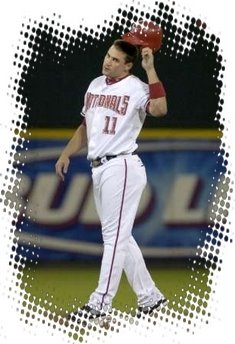 [September 27th] --I think I'm ready to pull the trigger and formally predict that Ryan Zimmerman is going to win the Rookie Of The Year award this season. A couple of weeks ago, I said that, unless he got really hot the last fifteen games of the season, he was probably going to lose out to Marlins' second baseman Dan Uggla. He's not hot; he's on fire.
Zimmerman went 3-4 against Brett Myers, raising his batting average to .286. He drove in a run with a ground-out in the first and plated two more with a line-drive double to left, his 47th of the season and most by a rookie since some guy who played for the Brooklyn "Robins" in the early 1920's. He now has 107 RBI's. Dan Uggla went 2-3 for the Marlins and is now batting .283.
Zimmerman has been a model of consistency throughout his rookie year. Last June 15th, I wrote an article that showed that Zim's statistics, extrapolated out over 162 games, would be: Runs:85 -- Hits:172 -- 2B:45 -- 3B:3 -- HR:23 RBI:103 -- AVE:.277. Heading into the last week of the season, Zimmerman's projected end-of-season numbers are remarkably similar: Runs:86 -- Hits:176 -- 2B:48 -- 3B:3 -- HR:20 -- RBI:109 -- AVE:.286. He has a few more RBI's, a few less home runs, but all-in-all, Zimmerman has remained surprisingly constant. He was on path to walk 60 times in June, and he's on path to walk 60 times today. He has done much better the second half with regard to strikeouts, however. He was on pace to strikeout 155 times in June, but will end the season with about 124. Zimmerman learned to lay off those off-speed low-and-away pitches that caused him so much aggravation earlier in the year.
Often, rookies come into the all-star break with glitzy numbers but pitchers will find weak-spots over the second half of the year, significantly lowering the stats. Not Zimmerman. He had difficulty in late April and early May, but since May 23rd, his average has remained above .270. I hope -- no, I pray -- that Jim Bowden takes a lesson from the Cleveland Indians of the mid 1990's and signs Zimmerman to a long-term deal now, before salary becomes a problem in two or three years.
The Nationals have the opportunity to end the season on a strong note, winning enough games to make the season "quasi-successful." If the Nationals can go 3-2 the rest of the way, the Nats will the season 73-88, much better than the mid 60's total that they looked headed towards a month or so ago. No, 73 wins is not a successful year (but it's what I predicted in March, so I'm "way" rooting for the Nats to hit that number), but that total is only eight wins less than their amazing 2005 total. Eight wins -- about one less per month. From that perspective, it doesn't sound like a radically different total, does it? Eight less wins with no starting pitching, having lost Luis Ayala and Brian Lawrence for the year, Jose Guillen for most off the year and slew of other players for parts of the season; I'd say that the team over-achieved.
C'mon guys; sweep the Phillies and keep them out of the playoffs. It's the right thing to do.
BIG APPLE TRIFECTA FOR NATIONALS
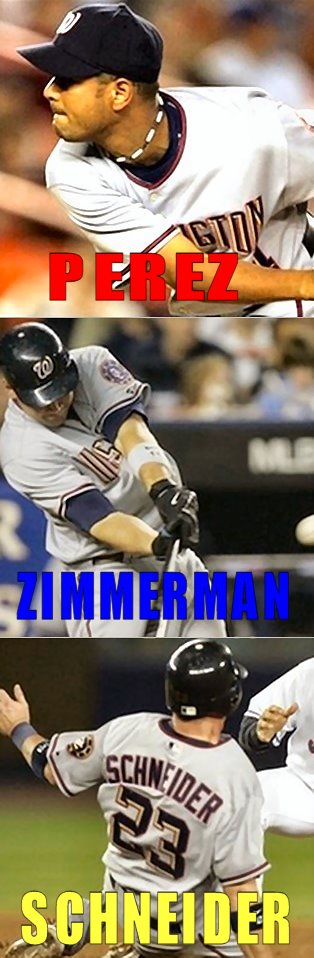 [September 26th] -- I'm guessing that most of us hoped that Beltran Perez would duplicate his first major league start (six innings, no runs, one hit) Monday against New York, but expected the vastly superior Mets' offense to humble him pretty early in the game.
Well, surprise.
Perez pitched another solid game, allowing just two runs on four hits over six innings. His ERA since being recalled from 'AA' Harrisburg is a sparkly 1.50. Now, to be fair, he did give up six walks. The flip side of that stat is he allowed only two of the Mets' ten base-runners to score. I'd say that's pretty impressive. Again, to be fair, Perez almost, and I'm talking a combined eight feet, gave up three more home runs. Shawn Green, Jose Reyes and David Wright hit long .... deep .... high .... balls that were caught by Alfonso Soriano and Ryan Church with their tuschy's up against the outfield fence. Flip side time: they didn't leave the yard and were just very long, very loud outs. Granted, seventeen innings isn't a realistic gage of a pitcher's ability. Remember, Mike O'Connor's first month in the big leagues made a whole lot of people think of Tom Glavine. Lately, however, those same people are thinking they were really wrong. Perez, I think, has a better chance of avoiding the kind of drop-off that O'Connor experienced this summer. O'Connor is a control pitcher -- he has to paint the black to be effective, and his fast ball comes in on an arc. Perez, on the other hand, has some gas on his fast ball and some bite on his slider. I'm not suggesting that he's a lock for the rotation next spring, but I think he's shown enough to get a long look.
Ryan Zimmerman isn't going to lose the rookie-of-the-year award because of any late-season slump. Although he only went 1-5 against the Mets, he hit his 46th double of the year and drove in runs numbers 102, 103 and 104. He has a week left to hit his 20th home run. If he does, then he's a lock for the award. If he doesn't, I still think Dan Uggla may ultimately win because of the 26 home runs. Writers are homer-fixated. That said, Mets' broadcasters Ron Darling and Keith Hernandez both cast their votes for Zimmerman, while their play-by-play guy (I didn't catch his name) thinks Russell Martin of the Dodgers is the best rookie in the league.
Brian Schneider went 4-5 and upped his once pathetic batting average to .254. Did any of you really think that he had a chance to redeem himself after coasting into late July with a batting average in the low .220s? I sure didn't. Schneider showed last year that he was a streak hitter; he went from .244 to .293 in the span of a month before finishing the season at .268.
Within each game, the Nationals continue to show glimmers of hope for not only next year, but the years to come. As Keith Hernandez said during the broadcast, "I like their offense -- it's a winning lineup. I like their bullpen. If they find some starting pitching next year, I think they will have a pretty good ballclub."
I'll settle for "pretty good" next year.
Bob Short Finished What Other's Had Started
 [September 25th] -- Bob Short. Just the mention of the name darkens the skies and depresses the soul. In 1970, Short traded three of his best players to the Tigers for the enigmatic and over-the-hill Denny McLain, drastically reducing both wins in the standings and fans at the stands. Crying "poverty," Short and the team were in Arlington, Texas a year later.
D.C. baseball fans remember what Calvin Griffith did to the city of Washington in 1960. D.C. baseball fans remember what Bob Short did a decade later. Few remember, however, that there was another owner who tried to move the team in that period between pariah #1 and pariah #2.
The Braves were not the first baseball team courted by the city of Atlanta. A new, modern stadium, "like that one in Washington," according to the mayor, was on the drawing board since the early 1960's. The city was ready to begin construction the moment a team was found.
Days after Kansas City officials turned down owner Charlie Finley's request for a new park for the Athletics, he was invited to Atlanta to look at potential sites for the new stadium there. By July of 1962, however, it was obvious that Finley didn't have the support of his fellow owners for a move to Atlanta. The deal was dead. 1963, however, was more fruitful. The Braves, no longer the wonderchild in Milwaukee, were suffering from a combination of low attendance and political indifference. Agreements were eventually signed, a stadium built, and although slowed by a judge's ruling, the move to Atlanta was completed in time for the 1966 season. Atlanta had their baseball team. The Athletics were Atlanta's second choice, the Braves their third. The Senators had been their first.
Calvin Griffith's attempt to move the Senators to Bloomington, Minnesota was met with all the bluster that Washington politicians could muster. It was only when Major League Baseball promised an expansion franchise to the city did the lawyers finally back off. Griffith's moving vans weren't past Fairfax Circle before Elvin Quesada, the FAA administrator, was named the owner of the Senators II.
The honeymoon lasted less than a year.
Quesada was not a wealthy man, and his operating capital was depleted before the end of the first season.
Attendance dropped by 55,000 from 1960. Although playing in the new RFK Stadium would greatly increase revenue, Quesada wasn't sure he could keep the team afloat until then.
Enter Colonel Beauregard Peyton of Atlanta. Beauregard was a life long resident of Atlanta. He was a businessman who envisioned an Atlanta based baseball team as a conduit to a regional television and radio network. A team in Atlanta, he correctly assumed, would likely be embraced by fans in all the southern states. Unlike Short, Peyton didn't hide his plans. Many believed that it was just a matter of time before the team moved south. Washington legend Shirley Povich wrote, "It is not believed that the American League would allow him to move for the 1962 season, so he will have a full year to work on American League president Joe Cronin, a former Senator player."
Peyton promoted manager Mickey Vernon to general manager, and hired another former Senator, Cecil Travis, to manage the club. Povich was wary of this move, "wondering" in his column if Peyton made Vernon the GM so that he could succeed, or more likely, so he could fail.
Of course, Peyton never got his wish. American League owners didn't want to hear about losing their "anti-trust exemption" from piqued congressman still angry about the Calvin Griffith move, and refused to entertain Peyton's request to move the team. The Senators were sold again before landing in the lap of Robert Short, who completed Peyton's "dirty deed" in 1971.
In the end, all is forgiven. Washington now has a National League team, plans for a new stadium, and a fan base large enough to support a top-notch organization. Although the thirty-four year wait was painful, it helped all of us remember what its like not to have a team. This time, D.C. baseball will be forever embraced and never taken for granted.
Oh, and by the way ... rot in hell Bob Short.
NICK GOOD TO GO FOR SPRING TRAINING
[September 24th] -- I don't feel like writing an in-depth story today after watching what happened to Nick Johnson yesterday at Shea Stadium. We've all seen it -- we've all been sickened by it.
The good news is that both the Nationals' team trainer and team physician Dr. Ben Shaffer have said in separate Sunday morning interviews that Nick's surgery went extremely well. A rod was inserted into the broken femur and he will begin bearing weight on his right leg as early as this evening. Surprisingly, he won't be in a cast, and he is expected to be 100% ready come spring training.
Had this happened to anyone else, I would have been saddened. But because this happened to Nick, the posterboy for weird injuries, I was devastated. Although he didn't make it through the 2006 season without going on the disabled list, he nonetheless produced a solid, full-season effort.
Godspeed, Nick. We're all 1] (for those of us who are religious) praying for you or 2] (for the secularists) wishing you well.
I have said for the last couple of weeks that Dan Uggla will probably win the National League rookie-of-the-year award, but that Ryan Zimmerman is without question the best rookie in the National League. So much of what makes Zimmerman "top-rook" are the intangibles -- especially his fielding prowess.
This is a (admittedly very bad) screen capture of the kid's leap into the third base stands on Saturday -- he caught the ball between three fans while almost perpindicular to the ground. It was another ESPN "webgem," but I'm afraid defensive ability and baseball acumen just don't get you votes in today's "home-run derby" world of baseball.
I don't care how the vote comes in -- Ryan Zimmerman is the best rookie in the bigs this year.
ZIM-ZAM-ZOOM! RYAN HITS CENTURY MARK
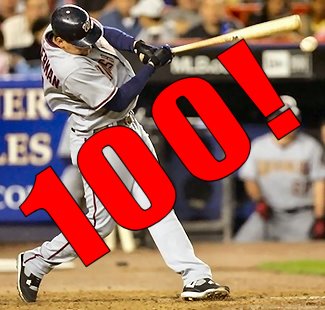 [September 23rd] -- Simply amazing.
When Ryan Zimmerman spun a outside slider from "El Duque" past Carlos Delgado and Jose Valentin into right field, the affable 21 year old did something that only two other National Leaguers have done since the Truman administration: drive in more than 100 RBI's. He joined Mike Piazza and Albert Pujols as the only recent rookies to hit the century mark in runs-batted-in.
Hits, and runs-batted-in, have been hard to come by in the last month. Heading into August, Zimmerman was at a season high .293 and was on pace to hit 23 home runs and 113 RBI's. Pitchers have adjusted, however, and the summer's heat have taken a toll 0n his performance. And while Zimmerman has cooled, Florida's Dan Uggla has heated up and will be the likely winner of the 2006 rookie-of-the-year award.
It doesn't matter. Zimmerman, five years younger than Uggla and with less than a 10th of his minor league experience, should be judged not by what others have done, but rather by what he has accomplished. Jim Bowden and Frank Robinson shied away from predicting how their new third baseman might fare this season, but when pressed, Robinson and Bowden both suggested that a .260-12-60 season would be a good start to Zimmerman's career. It was his defense, not his offense, that garnered him the starting job last fall. They were not the only ones who got Zimmerman's rookie year wrong. In a November 2005 story, I predicted that Zimmerman would bat .263-16-69.
What does the future look like for the Nationals' young star? Well, the doubles column is usually a good indicator of things to come. Young sluggers usually have a disproportionate number of doubles -- basically, home runs that haven't "grown up" yet. Dan Uggla, for example, currently has 26 doubles and 26 home runs; his age and experience has already moved all those "uber-doubles" into the home run column. Zimmerman has 42 doubles and 19 home runs thus far. If he were to hit the same number of doubles as Uggla, for example, the remaining 16 doubles would become home runs, giving him 35 for the year. Convoluted? Sure, but it works. Willie Mays hit 33 doubles and 41 homers in 1954. The next season, he hit 15 fewer doubles but 10 more home runs.
What does the future hold in store for Ryan Zimmerman? I think it's very safe to say that he'll have Chipper Jones type numbers ( .300 - 33 - 110) for many years to come. Because of his age and maturity, he might end his career with some very special numbers. If he were to average 31 homers a year from now until he is 37 (a fair "end of career" age), he'll end up with 515 home runs (including 19 from this year).
Congratulations, Ryan Zimmerman. Frank Howard is considered the modern day icon of baseball in Washington, and he played here for only seven years. If Zimmerman plays here for the majority of his career, he will become "Mr. Baseball" in D.C.
WARNING: OFF DAY FLUFF PIECE
 [September 22nd] -- The Nationals are almost done reshuffling their minor league deck, and so far, so good. Harrisburg and Potomac will continue to be the team's Double-A and Single-A clubs, respectively. That's great. Both teams have been successful at the gate despite having a poor product on the field. Harrisburg has a new stadium plan ready to go when/if they get if financed. Potomac's Pfitzer Stadium isn't anything special, but it's clean and it draws decent crowds. In the past couple of days, Hagerstown has replaced low-A Savannah, and the new crown jewel of the Nationals farm system is Columbus, Ohio. Although no official announcement has been made, it's clear that Vermont will no longer be the Nationals' short-season rookie team.
The Columbus development was certainly a surprise, but the backstory helps the move make sense. John Galbreath, one of the Nationals' limited partners, has a history with the Columbus Clippers. Turns out that Galbreath called Clippers GM Ken Schnacke and set up a conference call involving both teams on Saturday, and then a tour of the facilities for Jim Bowden and his "posse" a couple of days later. A deal was hammered out the next day.
Here's where it gets a little hinky. Mike Shapiro of the Nationals says that Columbus was the team's first choice all along. I think he's just playing patty-cake with the press. If Columbus was the Nats' first choice, I'm sure they would have insisted on a PDC (player development contract) of more than just two years. Word out of Columbus is that both clubs demanded a "look-see," short-term deal. Both the Reds and Indians will be looking for a new 'AAA' team in 2008, the same year the Washington-Columbus agreement expires. Well, you get the picture. Cooper Stadium is one of the oldest stadiums in the International League. It was renovated in 1977 in preparation for the Yankees coming to the Ohio capital a year later.
A new stadium is in the works, but it won't be ready until 2008 at the earliest. Either way, if I'm reading the war drums correctly, the Nationals players won't ever play there. Bowden, however, says the Nats will make every effort to "re-up" when the current contract expires. That said, I'd be surprised if the team doesn't make another run at Norfolk in two years.
No changes are planned for the Clippers next year. The team uniform, similar to the Yankees' pin-stripe attire, will keep it's existing logo and colors. One change will happen, however. No longer will the stadium PA system blare Frank Sinatra's rendition of "New York, New York."
There will be one major change on the field. The Clippers, because of their American League affiliation, have played with the designated-hitter at Cooper Stadium since the Yankees moved in nearly 30 years ago. For the next two years at least, pitchers will again embarrass themselves at home plate.
I'm fine with the move to Columbus. However, I am saddened at the way New Orleans has been "dissed" by some members of the Nationals' front office staff. Jim Bowden, during the official announcement, made it seem like the Nationals had to get out of New Orleans as soon as possible. That must have left a bad taste in the mouths of Zephyr fans. Considering what the city has gone through in the last year, the Nats could have found a more tactful way to leave the Crescent City.
ZIMMERMAN, UGGLA, TO BATTLE IT OUT FOR ROOKIE-OF-THE-YEAR AWARD
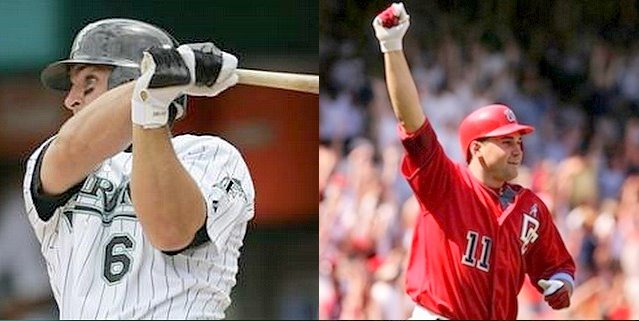 [September 21st] -- I didn't need a sheet of paper to write down all of the Nationals' highlights from last night's game; the back-side of a used 3x5 card would have done just as nicely. In fact, Ryan Zimmerman was the only highlight.
Zimmerman hit his 19th home run of the year and drove in his 99th run, numbers that continue to keep him in the hunt for the National League rookie-of-the-year award. He's had a superb freshman season. He'll be only the 4th N.L. rookie to drive in 100 runs in the last two decades, and if he doesn't win the award, he'll be only the second 100 RBI rookie not to win it in many years.
Will he win the award?
As I watched Zim circle the bases after hitting his line-drive homer, I got to thinking about who his competition is and how they are doing compared to Ryan. Although there are many players with stats good enough to warrant consideration for the award, I think it's going to be either Zimmerman or Marlins' second baseman Dan Uggla who will walk away with the hardware. So which player is better? It's hard to say -- it's the old "apples and oranges" comparison.
Ryan Zimmerman is a 21 year old rookie. Uggla, 26, has four years of minor league experience. Although Uggla produced solid offensive numbers in the minors, he never showed the Diamondbacks enough to get above the 'AA' level. Even though he hit .297-21-87 in 2005, Arizona left him unprotected and was claimed by the Marlins in the Rule V draft.
Look at the comparison between the two players.
There are a few differences, but none of any real consequence. But check out the double and home run categories. Uggla has hit 26 doubles and 26 homers, Zimmerman 42 and 19. Uggla, five years older than Zimmerman, has a more mature body and has learned how to hit with home run power. Zimmerman has seven fewer homers but has hit sixteen more doubles. In time, ten or twelve of those doubles will turn into home runs as his body matures. Offensively then, the only real difference is the age of Dan Uggla.
Defensively, Ryan Zimmerman is already one of the best 3rd baseman in the league. His 14 errors are the second lowest in the National League, and is a mainstay on ESPN's "webgems." Uggla, however, is considered an "average" second baseman. Marlins coach Perry Hill said that Uggla had poor footwork and a mediocre arm when he reported to spring training (though he now says that Uggla has improved throughout the year). Uggla has committed 18 errors, second highest in the National League for second baseman.
So, who is the National League rookie-of-the-year for 2006? I think it's Zimmerman, but Uggla has a good chance to win the award. Uggla is on a team that has received a lot of ink this year between the Marlins' amazing record and Joe Giardi's problems with management. Zimmerman is on a moribund team that hasn't gotten any national ink since June. Also, Uggla is a power hitter playing a position not known for power. Zimmerman's home run total is below average for a 3rd baseman, and his defensive abilities won't sway many voters.
While Uggla may win the award, his future is not nearly as bright as Zimmerman's. The Marlins' infielder has a career capped at 10-12 more years because of his age. Ryan could easily play beyond 2020. And Zimmerman, only 21, will only get better with time. In five years (when he's Uggla's age), Zim will probably produce 300-35-110 type numbers while Uggla is today about as good as he's going to get.
It took Uggla 2500 at-bats and the Rule V draft to make it to the major leagues (if you could call the Marlins a major league team last spring). It took Zimmerman 250 at-bats. Ryan was expected to be a star; no one expected anything of Uggla. Though Uggla may become rookie-of-the-year, Zimmerman will have the longer, and better career.
Going into the 2005 season, only three National League rookies have hit more than 20 homers and driven in more than 75 RBI's in the last 40 years -- Frank Robinson, Orlando Cepeda and Albert Pujols. Make that five with the addition of Uggla and Zimmerman. Now that's pretty good company.
BELTRAN BEDAZZLES BRAVES
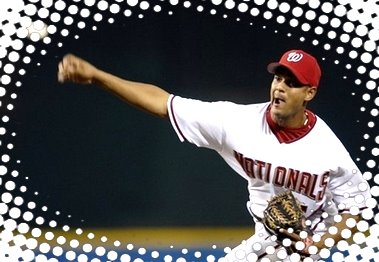 [September 20th] -- Beltran Perez? Who the heck is Beltran Perez? His just completed minor league season was so inconsequential that I didn't even notice that he was part of the September 1st cattle call. When I sat down to watch last night's game, I couldn't even identify who he was.
That isn't going to happen again.
Starting his first game in the major leagues, Perez went six strong innings, allowing just one hit while striking out three. His September ERA is now an incredibly low 0.77 (he had previously pitched 5 games in relief). I am trying very hard not to get excited about Beltran's performance -- I can't begin to count the number of September studs I've seen over the years only to find that they end up being spring training duds. That said, Beltran has shown that he has the talent to start in the major leagues; whether he'll be successful is an entirely different matter.
Beltran was signed by the Arizona Diamondbacks as a non-drafted free agent out of San Francisco de Macoris in the Dominican Republic in 1999. He was the typical Dominican signee -- tall (6'2") and rail thin (157 lbs) -- typical for an under-fed 17 year old. He spent his first two years playing for the Diamondbacks Arizona Fall League team, going 11-1 against some of the major league's top young talent. Perez spent 2001 and 2002 at Single-A South Bend and Lancaster, going 15-6, 2.64 during that span. He was seemingly on a fast-track to the majors, but got derailed at 'AA' El Paso the next season. Over parts of the next three years, Perez went 7-25 with an ERA near 5.00. Not exactly a promotional bell-ringing performance. The Diamondbacks, believing that Beltran's ceiling had been reached, traded him along with Dioner Navarro, Danny Muegge and William Juarez to the Los Angeles Dodgers for slugging outfielder Shawn Green.
The Dodgers tried to rebuild Beltran's confidence by starting him in Vero Beach, part of a low-A league. He pitched pretty well, and finished the season at 'AA' Jacksonville, combining to go 5-5, 3.22 between the two teams last year. In conversations with the Dodgers, however, Beltran was told he wasn't in the team's long-term plans, and he opted for minor league free agency. He signed with the Nationals last fall.
He pitched well enough for Harrisburg this year, but wasn't spectacular, going 8-6, 3.11 in 121 innings. I never read a story about him this year, never saw a highlight on the Harrisburg webpage. He was just, for lack of a better word, "there."
There was no indication in Perez' minor league career that would have suggested that he had the ability to pitch that well at the major league level. The guy just completed his fourth year at the Double-A level, for goodness sake. I mean, the guy's never seen the inside of a Triple-A stadium, let alone a major league facility. Can he be a major league starter? I have no idea. But he's still young (24) and can throw in the low 90's. He's got a quality breaking ball and has good location on his pitches. As thin as the pitching staff will be next spring, I guess he's got as good a chance to make the rotation as anyone else.
Regardless, that was one heckuva first impression.
NATS 9, BRAVES 2: Ryan Zimmerman broke out of his 2-25 slump, going 2-4 with a double and an RBI. Edgar Renteria robbed him of a single up the middle his first time up and he just missed extra bases on a long ball to left. Perhaps all he needed was a day off to rest and regroup. Zimmerman has, at best, been holding his own the last three weeks while fellow rookie Dan Uggla has been surging in the home run and RBI categories. Though I was certain that he was going to win the rookie-of-the-year award just a month ago, I'm beginning to think that's going to go to one of the stable of Marlins' rookies ..... Sure, Alfonso Soriano hit a double and drove in two runs, but man, has he looked awful the past week. He struck out his first three times up last night, looking as bad as a major league player could look at the plate, kinda of like the "old" Alfonso Soriano of the past few years ..... Nick Johnson hit a home run, tying him with Austin Kearns with 23 ..... Jose Vidro hit a home run too and is beginning to look like a major league hitter. Sadly, I don't think he'll ever be a major league second baseman or a major league runner ever again. The Nationals have to trade him this off-season, regardless of how much of that bloated contract the team will have to eat .... Brandon Harper continues to impress as the team's number two catcher. Though I'm sure that Bowden will bring in another slew of veteran catchers (like he did this year) next spring training, I'm perfectly comfortable with Harper on the roster come opening day.
RASNER POSTER BOY FOR BOWDEN'S STUPIDITY
 [September 19th] -- What was Jim Bowden thinking?
Now, I've tried to give Jim Bowden the benefit of the doubt when it comes to his questionable [read: crappy] player personnel moves. He knows a lot more about baseball and running a franchise than I do. Making a trade is all about taking a chance and Jimbo does takes chances. I'd much rather have a GM who takes risks versus guys who are afraid to shuffle the roster when the situation calls for it (like Bill Stoneman in Los Angeles and former Devil Rays' GM Chuck LaMar). The Jose Guillen trade is a perfect example. When Bowden traded 4th outfielder Juan Rivera and backup short stop Maicir Izturis to the Angels for the slugging Guillen, every report I read touted the deal as a steal for the Nationals. It was a steal, all right, but to the benefit of the Angels. Rivera is batting .298-22-77 and is now playing ahead of former all-star Garrett Anderson. Izturis, platooning at short, is hitting near .300 and is showing some power. Jose Guillen, however, is likely done in D.C. I don't have a problem with the trade, because it made sense at the time, and all indicators pointed to Guillen being the team's clean-up hitter for the next decade while Rivera and Izturis were journeyman at best.
That it didn't work doesn't matter -- it was based on sound baseball judgment.
No, making righteous trades aren't Bowden's downfall. It's his ongoing inability to judge young talent that makes my head hurt. I was watching the Nationals' 6-1 loss on TBS last night, and Chip Carey and Pete Van Wieren had some very nice things to say about the Nationals. Van Wieren believes that the Nats' starting lineup and bullpen are both set and solid (he especially likes the bullpen), but without any decent starting pitchers, he believes that the team has no hope of playing anywhere near .500 ball next year. Since the day he took over as the team's GM, Bowden has used "Pitching, pitching pitching" and "You can never have enough pitching" as his personal catch phrases. Those are great soundbites, but they are just words in a sentence unless he walks-the-walk and talks-the-talk. The Nationals likely have the worst starting rotation in the major leagues today, yet, had Bowden been judicious with his roster moves, the team might be at least within shouting distance of .500.
Bowden released Claudio Vargas last summer after just three ineffective starts. He was promptly picked up by the Diamondbacks and went 9-6 for Arizona. This year, Vargas is the D-backs' #3 starter and has an 11-9 record going into the season's final two weeks. Tomo Ohka, traded because he "groused" at Frank Robinson last year, went 11-9 for Milwaukee after the trade. He has been hurt much of this year, but Ohka's career stats show that he's a lock to win 10-12 games every season. The GM that puts pitching before all else traded Ohka for Junior Spivey, who spent the 2006 in the Cardinals' minor league system. Two pitchers -- both succesful with their new teams -- and the Nationals have nothing to show for them.
The biggest slap in the face, however, has to be Bowden's decision to waive pitcher Darrell Rasner just before the start of spring training. Rasner had a solid 6-7, 3.59 record for Harrisburg in 2005, but to Bowden, that just wasn't good enough. "It's not like he's a major league prospect" was Bowden's answer to his seemingly senseless move. Bowden jettisoned Rasner because he had to make room on the 40 man roster for (as my memory serves) one of the many veteran infielders he signed over the winter. Bad move. Rasner went 4-0, 2.76 at 'AAA' Columbus, earning him a call-up to New York after a stint on the disabled list. The pitcher who Bowden said wasn't a "prospect" won another start for New York last night, beating Toronto 6-3. He's now 3-0, 2.04 for the Yankees and will probably keep his turn in the rotation when the post season begins.
This is why Bowden drives me crazy. He's great at making trades, but seems to have no clue as to how to manage his 40 man roster. How much better would the Nationals be if they had Vargas, Ohka and Rasner in the starting rotation? I'm not suggesting that Vargas and Ohka would have helped propel the Nats into the playoffs, but they certainly would have helped the team more than Pedro Astascio and Ramon Ortiz did. The Rasner move was classic Bowden. He looks like he's going to become a solid major league starter, capable of winning 12-15 games a year. Only 25, Rasner will still be pitching when the Nationals celebrate their 10th anniverary in Washington. He wasn't traded, and he wasn't released because he couldn't pitch. He was released because Bowden signed one too many over-aged middle infielders and he had to get rid of someone. But why Rasner? There were other players on the roster who had no hope of becoming a major leaguer -- guys like Bernie Castro -- but they remained on the roster while Rasner was sent packing. It seems as though he just picked a name at Random, and then said, "Ah, he's not a major league prospect."
This October, there is a very good chance that a guy that Jim Bowden said wasn't a major league prospect will be pitching in the World Series. Isn't it bad enough that the New York Yankees have an unlimited bankroll -- that they can sign anyone they want to -- without teams like the Washington Nationals giving them starting pitchers for nothing?
WHAT A FARM SYSTEM SHOULD LOOK LIKE
 [September 18th] -- Well, well. The Nationals were actually able to win two out of three against the Milwaukee Brewers this weekend. And that's a really good thing, because the Brewers are the better team. Hey, don't get me wrong; I know that the Nationals have lost only two more games than the Brewers this season. That's not what I'm talking about. The Brewers are a better team because they have done a good job in the past few years of drafting and developing young players. Prince Fielder and Rickie Weeks are just two examples of what they've been able to accomplish. Note: more coverage on Sunday's game can be found at the end of this story.
And then there's the Washington Nationals.
I got to wondering how different the Nationals' top farm team in New Orleans might look when compared to the Tucson Sidewinders, the Arizona Diamondbacks top club. The Diamondbacks are considered to have one of the top farm systems in the major leagues, top heavy with players at the 'AAA' and 'AA' level who are almost ready to make an impact with the big club. So I did some side-by-side comparing of the two teams' 'AAA' franchise to see if there was anything drastically different in the makeup of the two teams.
Oh, yeah. There's a difference all right.
The Sidewinders finished the just completed PCL season with a record of 91-53, a whopping 38 games over .500. The Zephyrs came in at 72-71, a marked improvement over 2005. New Orleans roster is full of players who have been released by other organizations as well as former major leaguers who just weren't good enough to remain there. The average Zephyr pitcher is 28 years old and has more than eight years of minor league experience, having pitched an average of over 900 innings during their minor league careers. The Sidewinders' pitchers are younger, less experienced and far more talented. Tucson's pitching staff averages just 25 years of age, less than four years of professional experience and have thrown less than 400 innings in their minor league careers.
That's what a 'AAA' pitching staff should look like.
There isn't a single pitcher on the Zephyrs' roster who could be considered in any way a "prospect." Andrew Good, Steve Watkins, Nelson Figeuroa and Kevin Gryboski have all failed elsewhere. A few of the pitchers have been with the Nationals/Expos their entire careers, but some have spent as many as six years without ever seeing a major league stadium, and probably never will. The Sidewinders, on the other hand, boast seven pitchers 25 or younger (the Zephyrs don't have a single pitcher under 26). Four Sidewinders have less than four years of minor league experience -- again, the Zephyrs don't have anyone who has moved up through the system that quickly. The entire Zepyrs' staff, then, is made up of of players who have no real chance of playing in the major leagues.
Don't feel too bad, though. Harrisburg ended the season with several pitchers who will have a great chance of playing with the Nationals one day. There are a few more at Potomac. The best news of all is that Mike Rizzo, the guy who created that marvelous Diamondback farm system, is the guy in charge of doing the same for the Nationals. It's going to take time. It'll probably be the second half of 2008 before some of those young arms make it to Washington.
When you have a chance, take a look at the Diamondbacks' farm system. That's what we have to look forward to. Things are lean now, but in a couple of years, a new stadium and a solid farm system will make watching baseball in D.C. a whole lot of fun.
Nationals 6 - Brewers 1: I need to keep a closer eye on what happens to teams outside of the Nationals' division. The last time I looked, the Brewers were just a game or two under .500 and were certainly a "feel good" story for 2006 -- even if you're not a Brewer fan. Now, Milwaukee is just two games better than the Nats, and that, my friend, isn't very good.
Ryan Zimmerman went 0-4 and is once again swing late on the ball, making his outs on the right side of the infield. He also struck out twice, looking bad both times. Zimmerman is hitting that wall that many players do during their first full year as a professional. He's tired -- at times, he looks almost asleep at the plate -- and the 162 game season is wearing him down. Unless he can starting hitting again, I'm afraid his chances of winning the rookie-of-the-year award are going to diminish -- there are just too many good first year players this year to allow for a 10 point drop in batting average.
Chris Schroeder was amazing on Sunday. Two innings pitched. Six batters faced. Six strikeouts earned. The Nationals are certainly going to have an abundance of quality relief pitchers next year. A day after the bullpen pitched shutout ball for five innings, they turned the trick one more time on Sunday. Schroeder, Saul Rivera, Jon Rauch and Ryan Wagner combined to allow no hits and two strikeouts. Wagner seemed like a throw-in in the Austin Kearns / Felipe Lopez trade, and he probably was. He was the Reds' number one draft pick in 2003, and was playing in the major leagues that same year, and man, was he good, going 2-0, 1.69. In 2004 and 2005, however, his numbers got worse, and he spent 2006 in the minors before being traded to Washington. The Reds began to tinker with his delivery in 2004, raising his side-arm delivery to a more three-quarter approach. Nationals' pitching coach Randy St. Claire told Wagner to revert to his side-arm delivery and *presto* he's beginning to dominate batters again. My guess is that Wagner will easily replace Billy Bray in the team's bullpen. I wonder of the Reds' management is mad about that too.
Mike O'Connor pitched well for the second start in a row, alloing just three hits and one run in four innings -- he was pulled due to a high pitch count -- and now has to have leap-frogged over Billy Traver and Jason Bergman in the rotation (at leat for the rest of the season). He'll be pitching in Washington next season -- that's for sure -- though I'm not sure if it'll be as a starter or reliver.
Though wins don't mean much this time of year, they're still fun to watch.
ALFONSO SORIANO: NO LASTING LEGACY IN D.C.
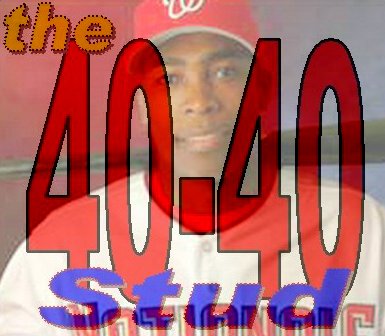 [September 17th] -- So it happened. Big deal. I mean, Frank Howard was only 39 steals away from 40-40 three times with the Senators.
Nah, just kidding. It is a big deal. A single to left, a bobbled fastball, and -- just like that -- Alfonso Soriano was holding second base high over his head, joining Jose Conseco, Alex Rodriguez and Barry Bonds as select members of the "40-40" club.
Soriano is the first "normal" member of the group. Jose Conseco took steroids and bounced home runs off his head in his spare time. Barry Bonds took steroids and has a slew of home run records, none of which carry any weight these days. And Alex Rodriguez, well, he's a liar. Remember, he said that if he left Seattle after his free-agent season, it would have nothing to do with money. $252 million dollars later ....
A week ago, I would have been excited for Soriano. He had showed himself to be a decent guy, a decent outfielder, and -- thus far -- a man of his word. So when Jim Bowden and the Nationals weren't able to pull the trigger on a deal that would have sent Soriano packing this summer, I was quietly confident that it was best for the team. I believed what the man said, that he loved playing in Washington, that he'd give the team the right of first refusal on any contract he might sign, and that he saw a bright future for both he and the Nationals. When he said "I no want to leave Washington," I believed him.
In the last week, however, things have changed. Soriano's words, once crystal clear, are now becoming hopelessly vague. No longer does he want to sign with the Nationals. Now, he hopes that something can be worked out, if the team proves to Soriano that they are getting better, if the team continues to build the minor league system, if the new stadium is up to his standards, if ... if ... if ...
If Soriano does what he seems to be doing; that is, to renege on all those "feel good" promises made before the trading deadline, he may find that trying to secure a few extra bags of gold can cause very bad things to happen. Very bad. Alex Rodriguez was the most-liked player in the American League when he played for the Mariners, getting regular ovations from fans when he played on the road. During that final season in Seattle, he told anyone who would listen that money would play no real determining factor regarding where he'd sign in 2001. And the people of Seattle believed him. He was, after all, Alex Rodriguez. Then came the bombshell: Rodriguez signed a 10 year, $252 million dollar contract with the Texas Rangers. Wearing the Rangers' jersey over his Armani suit, he said that he signed with Texas because they offered him the best opportunity to win a world championship.
Talk about insulting your fan's intelligence.
From that moment on, Rodriguez, one of the nicest guys to ever play baseball, became public enemy #1. In his first year in Texas, he had one of his best seasons, batting .318-52-135, yet he was booed both at home and on the road. Half the fans booed because of the shear size of his contract, and the other half booed because of the way he turned his back on the city of Seattle. Today, six years into that contract, he is still in the cross-hairs of most fans, especially in New York.
Do you think Alfonso Soriano would learn from the mistakes of Alex Rodriguez? Oh no; not a chance. He is making it clear now -- kind of setting the stage -- that his loyalty to Washington is predicated on his getting exactly what he wants, with the knowledge that the team can't possibly provide what he'll demand. The bidding will start at $15 million per year, and will go up from there. Gone is the "home town discount." Gone is the "right of first refusal." All that's left are the two extra picks in the amateur draft, and even those are questionable until a new collective bargaining agreement is reached.
Although I've never believed that Soriano is worth that type of contract, I was willing to, as a fan, incur the extra costs of signing him to a long-term deal. If he was to show loyalty to us, then we'd need to reciprocate. I don't want Jim Bowden to re-sign him any more. I'd much rather have the draft choices. Why? Glad you asked:
1) Adrian Beltre Syndrome. After five decidedly slightly-above-average seasons with the Los Angeles Dodgers, Beltre had a monster "money" year in 2004, batting .334-48-121. That got him a huge deal with the Mariners, where he promptly reverted to his slightly-above-average status, maybe even a little less-than-average. Now, the Mariners are stuck with both him and his contract for many years to come. Soriano had five good years in the majors before this season. Yes, he hit a good many home runs, and yes, he drove in a good number of runs, that's all true. But he also had a career on-base percent of .320 and a strikeout ratio much to high for a leadoff batter. And unlike both Rodriguez and Beltre, Soriano is a poor fielder. Why pay $15 + million per year to someone who is probably going to revert back to old habits once the check clears?
2) Other Team Needs Take Priority: Re-signing Soriano isn't the only team priority this off-season. The Nats could use three new starting pitchers. By letting Soriano walk, the Nationals would get the aforementioned two extra draft-picks and the opportunity to sign other players who could help the team. Need a slugger? Carlos Lee is available. In fact, That $15 million could buy Lee and a solid starting pitcher. The club has made it clear that Ryan Church isn't the answer in center, but he could very well be the answer in left -- he's proven that if left alone, he could easily put together a .285-25-90 type season for the Nationals.
By not signing Soriano, the Nationals would have a myriad of ways to improve the team for 2007. The team will probably have the #5 or #6 pick in the draft, plus the two for losing Soriano, plus picks (granted, in the lower rounds) for the loss of Pedro Astacio, Ramon Ortiz and Tony Armas Jr., players the team has no desire to re-sign anyway.
The time has come to accept the fact that "Mr. 40-40" will be plying his trade elsewhere in 2007. Don't cry -- rejoice! I have no doubt that Soriano will return to his old ways and will once again perform at a level far below his asking price. There are too many "above-average" pitchers available this winter to be spending all that money on a star -- but not a superstar -- outfielder.
Congratulations, Alfonso. We're happy for you. But we'd be happier if you hadn't gone back on your promises to the fans of the Washington Nationals.
NATS DON'T LOSE ON FRIDAY, BUT SENATORS DO?
 [September 16th] -- NOTE: GENERAL APATHY HAS FORCED THIS REPORT TO BE SHORTER THAN NORMAL.
You know it must have been a nauseating game if I lead my story off with a headline from a local Milwaukee television station.
Hey, you go with what you've got.
I came across this Associated Press story posted on wfrv.com. It's the same story that's been posted on just about every website that has an interest in either the Brewers or Nationals, but the headline was written by someone at the station. "Brewers Out Do Senators?" Some guy in the newsroom must have been watching "Law And Order" as he posted the story, someone like me who is old enough to associate baseball in D.C. with the Senators (as I still do). I'll bet you that if you check out the story some time Saturday, they'll have corrected their faux pas.
Other than the funky headline, there was no real news coming out of RFK on Friday night. Alfonso Soriano still isn't a member of the 40/40 club (How many of you over 40 remember the running gag on Saturday Night Live's "Weekend Update" in the late 1970's -- "This just in, Francisco Franco is still dead!." Ramon Ortiz continues to prove that his near no-hitter was pitched by another pitcher who looked like him, and Nook Logan continues to not look like the team's long term answer in center, regardless of what Jim Bowden may think.
Oh, there was some good news. Ryan Zimmerman got a hit and drove in his 97th run of the year. As long as Zimmerman continues to play like a rookie-of-the-year candidate, then I can handle dealing with all the losses. The other good news came from the bullpen. Messers Schroder, Booker and Campbell combined for a four innings of shutout ball, striking out six while walking none. It looks like the bullpen will again be a strength next year, especially if Luis Ayala's health returns and Mike O'Connor doesn't make the rotation.
I guess Tomo Ohka's (apparent) season ending injury is good news for any of us who get tired of watching Jim Bowden's mistakes come back to haunt the Nationals.
Hey, tomorrow's another day. That is, unless you're Bill Murray in "Groundhog Day."
MEET: JOSH LABANDEIRA
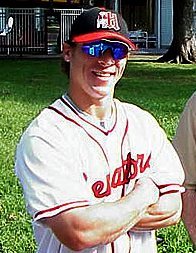 [September 15th] -- If, as it is suggested, that there are only a handful of players in the Nationals' minor league system with enough talent to make it to the major leagues, then just what's going to happen to those players who are filling out the 140+ uniforms in New Orleans, Harrisburg, Potomac, Savannah and Vermont?
This is the first in a series that takes a look at Nats' minor leaguers who have been branded as "organizational" players, athletes with little-to-no chance of having any kind of career in the major leagues.
What does a marginal player do when trying to keep up with players both younger and better than him? Why, he uses drugs, of course. This year, many minor leaguers have been suspended for 50 games as baseball finally began to crack down on illegal drug use. Josh Labandeira, however, was suspended last year, before mandatory testing became common place. His suspension was for only 15 games -- barely a slap on the wrist -- and was back playing in a couple of weeks. At the time, getting caught taking amphetamines was only a mild embarrassment, something that didn't effect a player's chances of making it to the major leagues. However, with MLB's "crackdown," times have changed.
Labandeira is a 27 year old middle infielder from Tulare, California. He attended Fresno State, batting .345 with 17 homers during his two years with the Bull Dogs. In 2001, he was drafted in the 6th round by the Expos / Nationals. He hit .286 while playing for Clinton in his first year and .324 with Brevard County of the Florida State League in 2003. He faltered during his mid-season call-up to 'AA' Harrisburg though, hitting only .239 with a sickly .636 OPS. He returned to Harrisburg in 2004, and regained his stroke, batting .270 and showing some power, hitting 9 home runs while crafting a .357 OBP. He was September call-up that year, going 0-14 (ouch!) in seven games with Montreal. An MRI at season's end showed a 50% tear in his shoulder, so I guess we shouldn't snicker too much about the 0-14 skein. Like we could have done better, right? He returned to Harrisburg in 2005 and batted .269 with a .380 OBP. He continued his good hitting in 2006, batting .276-3-44 with 11 stolen bases and a .351 OBP with the Zephyrs of the Pacific Coast League.
That injury came at a particularly bad time for Labandeira. Shortly after taking over as the Nationals' general manager, Jim Bowden said he was looking for a backup infielder to work with Jamey Carroll in backing up Jose Vidro and Cristian Guzman, and the thought that Labandeira -- if healthy -- could be that man. It was acknowledged at that time that the kid had the strongest infield arm in the system, though he was committing too many errors, but Frank Robinson said that with experience, he could be a "nifty little shortstop." That said, shortly after recuperating form his surgery, he had to go pee in a cup.
Man, bad timing dude. The good news was that his suspension was related to amphetamines, and not steroids (he was trying to stay awake, not bulk up illegally).
Frank Robinson said that Labandeira's work ethic is "as good as it gets," and that his defense has the potential to be very special. The fans in the Eastern League seemed to agree, voting him it's best defensive player in 2004. He was assigned to the Arizona Fall League that year, a sure sign that the Nationals believed he was one of the team's top prospects. Following his stint in the AFL, Labandeira was transferred to the team's 40 man roster.
Somewhere between the damaged shoulder and the drug suspension, Josh Labandeira's star has lost most of it's luster. He still hustles just like Pete Rose and he's cut down his errors and raised his on-base percentage. He's even learned to play several new positions. But it's not enough. His age, his injury, his past trouble with amphetamines have all combined to make a "prospect" an organizational player. When asked to compare Labandeira with someone on his roster a couple of years ago, Frank Robinson thought for a moment and said, "Jamey Carroll." Sadly, players like Carroll (and Labandeira) don't seem to be welcome here these days. You gotta be toolsy.
Josh Labandeira isn't toolsy. He's just a player getting older every year -- a guy who deserves a chance to show what he can do.
I think the term "fish or cut bait" would work rather well here.
AT LEAST CASTRO KNOWS BETTER
 [September 14th] -- This is not a political commentary -- I have worked hard to keep politics away from the Beltway Boys. That said, sometimes anyway, politics transcends all else.
Even baseball.
Unless you've been living in a cave the past three years (and if you have, did you happen to see Osama?), Hugo Chavez has become the leader of the anti-American lip-flappers. It seems that no matter what we do, no matter how we act, or react, we just can't please ol' Hugo. And that's fine. Little despots in little countries don't concern me very much. But what he can do to baseball (our pastime, not his), is a cause for concern.
Venezuela is one of the top producers of South American players in the major leagues. Since 1939, 193 Venezuelans have donned a major league uniform. Since coming to Washington, the Nationals have played five Venezuelans, four in 2006 alone (Mel Dorta, Tony Armas Jr., Wiki Gonzalez and Alex Escobar). Endy Chavez was the fifth member of the group. My concern is how Chavez' motor-mouth might effect the relationship between the players and the fans of their adopted cities.
Let's say that Mel Dorta is a patriotic and nationalistic Venezuelan, and supports Chavez and his anti-American rhetoric. Perhaps he likes the feel of his small nation verbally attacking America. How difficult must it be to be in the very country that your president attacks, almost on a daily basis. Who are these players loyal to? Regardless of how they may feel about their homeland, there is no country that offers more freedoms, more opportunities, than the United States. Can they be loyal to both their birthplace as well as their adopted home? And if they do feel some sense of loyalty to America, if they turn their backs on Chavez' rhetoric, will there be repercussions against the players back home?
And what of the fans in the stands, patriotic Americans who are growing weary of Hugo Chavez and his anti-American diatribe. Won't some take their frustrations out not on Chavez, but on the Venezuelan players, even on their team? Might Tony Armas Jr. get booed if he sides with his president?
I don't have all the answers; heck, I don't have any of the answers. I do know, however, that Hugo Chavez isn't about to let up anytime soon, and sooner or later, the bad blood between the two countries is going to take its toll on American baseball.
For all his faults, Fidel Castro understands that politics don't belong in baseball. As much as he dislikes the United States, he takes every opportunity for his Cuban National team to come here and play, usually dominating the competition. I hope that Chavez realizes one day that baseball can be a conduit between the two countries, a way of communicating without all of the rough and reckless language.
Hey Hugo, it's okay this one time to take your cue from Fidel. Baseball is hallowed ground. Leave politics out of it.
DIAMONDBACKS 4, NATIONALS 2: Nothing worth mentioning here. Blah all the way around.
NOTE: comments will be available again on my next post. I pushed a wrong button last night. Oops.

NATS PREFER DESERT TO MOUNTAINS, BEAT D-BACKS AGAIN
 [September 13th] -- It would appear that the Arizona Diamondbacks didn't didn't bother to scout the Washington National this past weekend. More likely, they've never scouted them. The Rockies, who swept the Nationals this season has Washington's number plain and simple. No matter how well the Nats played, the Rockies played better. Yet, a couple of days later, and a couple of states over, it's the Nationals who own Arizona. They are just a couple of games away from sweeping the Diamondbacks, who are clearly the better team. I'm not complaining, mind you. It's just a pretty weird deal.
Ryan Zimmerman had another one of his off nights at the plate, doing what he always does when he's not seeing the ball well. He struck out once, left three runners on base, and popped out to second, grounded out to the right of short, and flied out to right. This is a clear signal that he is, once again, lunging over the plate and trying to pull the off-speed stuff. Not a big deal, though; he'll get it straightened out tomorrow and go 2-5 with an RBI or two. But while his offense was suffering, his defense was sparkling. With two out in the 9th, and speedy Eric Byrnes at the plate, Zim edged near the grass in case Byrnes tried to bunt for a base hit, something he often does. On Cordero's first pitch, however, Byrnes lined a one-hopper at Zimmerman who snagged it, did a 360 before righting himself, then threw a perfect strike to end the game. S-m-o-o-t-h, baby. Smooth.
Nick Johnson continues to push hard to end the season on a high note. The burly first baseman went 2-3 and hit his 22nd homer off of Tony Bautista, giving him 75 RBI's for the year. He could finish the season with 25 homers and 85 RBI's, a solid first "full" year for Johnson. As I mentioned in my last post, I think he'll be the National most coveted during the off-season. He's still relatively young, signed to a long-term cheap contract, and normally plays a solid, just-a-notch-below gold glove first base. With Larry Broadway in the wings, and Robert Fick available should Broadway falter next year, the Nationals can afford to trade Johnson for a #2 / #3 starting pitcher and a prospect. I'm talking a guy who has a history of winning 13 games a season with a ERA under 4.00. Frank Robinson mentioned last night that he felt Nick Johnson isn't a natural clean-up hitter, and I completely agree. Nick is a born number-three hitter. If he returns (and I'm guessing he will), look for he and Ryan Zimmerman to flip-flop spots in the batting order.
I think the time has come to say that Jason Bergman is not a major league starting pitcher. I know, I know, they said the same thing about a young lefty named Sandy Koufax, and he turned out okay. But unlike Koufax, Bergman has no knockout pitch; he is what he is. He lasted only three innings against Arizona, giving up 6 hits while allowing 3 runs. It's time to turn his spot in the rotation over to Mike O'Connor, who, unlike Bergman, had considerable success before a spate of poor outings and eventual demotion to New Orleans. O'Connor has no more "stuff" then Bergman, but he is a lefty, and that helps. I still think Shawn Hill can plug a hole in the rotation next season as well.
Kudos to Felix Rodriguez, who pitched a 1-2-3 7th inning, and ended up winning the game for the Nats. I thought Rodriguez was a great pickup last winter, and felt he had the potential to regain his form that he had with the Giants. He pitched poorly early in the year, however his injury may have had something to do with it.
Darn that Nook Logan. He had another couple of hits and an RBI and is now batting .308. Please, let's not give Jim Bowden any ammunition in his zeal to destroy Ryan Church. I have nightmares where the world "toolsy" chases me down the street, beating me over the head while screaming the names of Endy Chavez, Kenny Kelly, Brandon Watson and Nook Logan.
Way to go, guys, but I got to tell you, this whole "roller coaster" win-loss thing is starting to make me queezy.
[NOTE: I have no idea why the "leave a comment" link is missing -- it's on all the other posts. I'll do some snooping and see if I can fix it.]
LOOKING INTO THE FUTURE .... AND BACK AT A WIN
 [September 12th] -- In a few short weeks, the pain caused by the Nationals' 2006 season will finally, gratefully, subside. Soon thereafter, we'll all begin to predict who will and won't return to the Nationals come next spring.
Here's my early predictions (with the chance of them returning) for the position players:
1b - Nick Johnson: 75%
Finally, Johnson played a full, injury free season in the major leagues, and he's making the most of it. Nick is on pace for a .295-24-80 season with a .431 on-base-percentage. Combine all of that with a long term contract that pays Johnson less than he's worth, and you have to believe that there will be several teams looking to make a deal with Jim Bowden this off-season. If Bowden really wants to get young, he could trade Johnson for a starting pitcher and a minor league prospect (though he might have to add a low level prospect to sweeten the deal). If he does this, then Larry Broadway, who has nothing left to prove in the minors, would have the opportunity to step in and show what he can do. What could he do? I'd say somewhere around .270-15-80 or so. If Broadway fails, the Nationals could move Jose Vidro to first, or perhaps play Robert Fick there (Fick had a good season playing first for the Braves a few years ago). My vote: trade Johnson for pitching and a prospect; his value will never be higher.
2B - Jose Vidro: 35%
For the Washington Nationals to have any hope of improving next year, the defense has to get better, and for the defense to get better, Vidro has to move on. Now, for another team to take him, the Nationals will have to cover a sizeable portion of his remaining contract (two more years) and will have to move him to an American League team (can you say DH?) or to a National League team in need of a first baseman. Nomar Garciaparra and Jeff Kent and Ernie Banks have proved that middle infielders can transition over to first with ease. To my chagrin, Bernie Castro has proven that he isn't good enough to turn double plays in the major leagues, so he's out (I thought he could). My vote: move Felipe Lopez to second base. His erratic arm is less of a concern there, and his offense can easily produce a .280-17-60 (40 steals) type season, superior to anything Vidro could have done. That said, Lopez would be a marked improvement defensively too.
SS-Felipe Lopez: 50%
He's a terrible shortstop -- Cincinnati knew it and now Washington knows it. But he's a talented athlete and a solid offensive player. Move him to second and let him thrive as a major leaguer. I know you're going to laugh, but I'd put Cristian Guzman back at short. Remember, he only made 15 errors in 2005 compared to Lopez, who is on pace to commit 30+ miscues this year. The Nationals could bat Guzman 8th, and, considering the team is far more powerful than in 2005, all Guzman would be asked to do is play defense. He would probably bat .250, great for a number 8 hitter. My vote: move Lopez and bring back Cristian Guzman.
3B - Ryan Zimmerman: 100%
That's all I have to say about that!
LF - Alfonso Soriano: 25%
It's going to take a minimum of $15 million dollars to re-sign Soriano, and it's only going to go up from there. As much as I want Soriano to return, those dollars would be better spent rebuilding the pitching staff. Also -- and this is important -- the only hope of seeing Ryan Church as a starter in the Nationals' outfield would be for him to take over left field. Church is a good defender, but he isn't a center fielder. Put him in left, leave him alone, and he'll produce a solid season -- something like .285-23-80 with 15 stolen bases. Those certainly aren't Soriano like numbers, but it's good enough for a team trying to get better. My vote: let Soriano go and make Church the team's left fielder.
CF - Nook Logan: 0%
I refuse to believe that things are so bad that the Washington Nationals would start Nook Logan next year. There is no natural center fielder in the minor league system, so unless the Nationals make a trade, the team is going to go open the season with a substandard center fielder unless (unless) -- unless -- Alex Escobar is healthy and can remain healthy. He's shown that a .290-20-80 type of season is easily obtainable if he remains healthy. My vote: beggars can't be choosers. Move Church to left and give Escobar one more chance.
RF - Austin Kearns: 75%
Kearns is never going to be the player that Jim Bowden thought he was. He's going to be a low average, high strikeout, above average defender who will hit enough home runs and drive in enough runs to make a very good team great, but he doesn't have enough bullets in the revolver to make a bad team average. One option would be to trade Kearns and/or Johnson for pitching, giving his spot to rookie Cory Kasto, who was recently named the Eastern League rookie of the year. My vote: Either Kearns or Johnson, perhaps both, should be traded for pitching. I think the team can afford to give Casto a chance in 2007.
C - Brian Schneider: 100%
Brian Ladson wrote in his "mailbag" column on Monday that he used to believe that Schneider was as good defensively as Thurmon Munson, but that he didn't anymore. We can only hope that Schneider is having an off year defensively and will rebound in 2007. We really don't have any choice. My vote: give Schneider another year (like we have a choice with that four year deal he signed this spring)
There you have it. If I had my way, the team would return only a couple of the team's starters at their current positions. Without improving their defense, and without getting more athletic, it's going to be another long year at RFK.
NATIONALS 7, DIAMONDBACKS 6: It's sad when the game becomes a sidebar report in a nightly blog, but then the Nationals have done that to themselves, haven't they? I was watching the Redskins lose to the Vikings on the TV while I was keeping an eye on the Nationals via MLB.com. It looked a lot like all those games in Denver over the weekend. Get behind early, then tie the game in the later innings. Sure enough, after tying, then going ahead 6-4, Jon Rauch gave up a two-run homer to Damian Easley, tying the game at six. Yep, just like the Rockies Series.
Not this time. A run in the 9th and a Chad Cordero save stopped the slide at four games.
It was interesting to listen to the Diamondbacks' TV announcers sound a lot like the Nats' broadcasters during the Rockies' four game "whupping." It seems that the Nationals have done to the Diamondbacks this year what the Rockies have done to the Nationals. when Arizona plays Washington, they seem to get really stupid, really fast. Their announcers moaned about that all game.
It was kind of nice to have that shoe on the other foot, at least for one game.
THIS WEEKEND SEEMED V-E-R-Y FAMILIAR ...
 [September 11th] -- Now, don't get your dander up. Bad teams win five games in a row all the time. Then, they lose four in a row, sometimes more. Sure, the Nationals looked really good for most of last week, but there really isn't any doubt that they played above their heads, is there? We have to consider, then, that the Rockies' series was just part of the evening-out process that had to occur. I mean, it just had to.
At this stage of the season, I don't even look at wins or losses -- the subtext of the game holds more clues for next season then the team's record does. One thing I noticed: The Washington Nationals aren't quitters. They're just bad. In each of the four games, the Nats got down early (and by a lot), only to come back and tie the game, then lost in the later innings. Sunday was a perfect example. Down 7-2, they game all the way back to tie the game. They tied it again at 8 before losing 13-8. It's not that they aren't trying, it's that they suck. But, we already knew that. Right?
Every time I think Ryan Zimmerman is about to fade into oblivion, he shows me that he's not going anywhere. After a few hitless games, a couple of one-hit games, and three errors in two games, he came back to go 4-5 with two RBI's (his third 4 hit game of the season, each coming after slumps). He now has 96 ribbies for the year, and will probably finish the year with 110 or so RBI's, one of the highest totals for a rookie in fifty years. Jeff Huson, one of the Rockies' broadcasters, said on Saturday after Zim made his 3rd error of the series, "Folks if this is your first time you've watched Ryan Zimmerman play, I need to tell you that this is uncharacteristic -- he's probably right now the best fielding 3rd baseman in the National League, and he's only 21." I have no doubt that he'll finish in the top three for the Gold Glove award, and, even with those three errors, still has the second highest fielding percent in the league. I think we expected that. But what about his offense? He's probably going to end the season somewhere around .285-21-110 with 45 doubles and 13 stolen bases. Most bloggers (and the Nationals' front office) predicted numbers in the neighborhood of .260-12-60 for 2006. Why has he done so well? I don't think I've ever seen a player as young as Zimmerman who made adjustments so quickly. Early in the season, he was striking out at-bat after at-bat on curve balls down and away. He kept trying to pull the ball with no success. After a few games, Zimmerman began to drive that ball to right field. A few games later, pitchers found another hole, pitches high and inside. He went hitless for a few games before learning how to pull that ball down the line for a double. The pitchers make a chance, he corrects. They make another change, Zimmerman makes another correction. Amazing.
Nook Logan. Eeech. Nook Logan. Just when I thought he'd slowly disappear into the cornfield, he slugs a home run and a triple, driving in his first three runs of the season. His average is now up to .290. The last thing I want is for this Endy Chavez wanna-be to show any talent this month. The thought of him being named the de facto centerfielder before the season even ends makes my brain hurt. The front office doesn't need a reason to jettison Ryan Church right now -- give them a reason and they'll be downright giddy as they trade him for yet another "toolsy" outfielder. Why, perhaps they'll even move him to the Mets for .... dare I say it .... Endy Chavez.
Sorry, that wasn't funny.
My 9/11 memories: It's been five years now since that day that changed our lives forever, and I can remember it as if it were yesterday. It was my day off, and I had jumped in my car to drive my daughter to her bus stop down the street. I turned on the radio and heard an announcer say, in a still calm voice, "Reports are coming in that a small, piper cub plane has accidently crashed into one of the World Trade Towers. On to other news...." It was almost like, no big deal. I ran to the corner to buy a pop, and got home and flipped on Fox News. Although the gash on the tower was huge, they were still reporting that eye-witnesses said it was a small "commuter" plane that crashed into the building. Moments later, while the announcer was calling it a "tragic accident," the second plane hit the other tower. Strangely, I watched it happen, but the announcer wasn't aware of the second plane, and kept droning on about a small plane and its tragic end. It took him several minutes to realize what happened and report on it. I never moved from the TV that day, and I hope that this, the 5th anniversary of the tragedy, will be the first that I will shed no tears.
OH, BROTHER
 [September 9th] -- I thought long and hard about whether to write a story about Friday's game. I hate to be negative, but that's the only way the story can possibly be written.
I don't believe that the Nationals aren't "trying." Too many players on the team will be fighting for a position next year for them not to give 100%. But six errors in one game, and nine over two?
Pretty much every story I've read regarding the Nationals' effort against the Rockies included the word "embarassing," and so it should have. I got a reprieve from watching the games on my computer screen as I can view the Nationals on my local Fox Sportsnet channel -- the Rockies home network. Jeff Huson, who said on Thursday that the Nationals "played as poor a game defensively as I've seen in the major leagues" was dumbfounded by their play on Friday. "Last night," he began, "I watched a game that I would have expected to see at a rookie league level. But tonight, well, tonight was a performance that I wouldn't have expected to see at the Little League level."
And he was right.
Out of curiosity, I went back and reviewed the score book for my son's last year in little league. He played 22 games that season, and the Braves (his team) committed six errors in a game exactly ZERO times. It never happened. So, it would seem that the Nationals did something that a bunch of 12 and 13 year olds couldn't do -- make six errors in a game. Now, to be fair, one of Ryan Zimmerman's two errors really wasn't an error. After he chased down a bad throw into foul ground behind third, he fired what looked to be a strike towards home plate, but it hit the runner in the back of the leg, allowing him to score. That said, five of the Rockies eleven runs were earned.
Five.
Huson said something else that I found interesting. In the Bottom of the 8th inning, with the Nationals still ahead, 8-7, he noted, "You would think that a team that has committed six errors and walked nine batters would be blown out of the game -- yet the Rockies are trailing." Spot on, Jeff. More importantly, how could a team make six errors and walk nine batters, period? That's the mark of a team who is too tight, given up entirely or simply playing out the string. Perhaps it's none of those, but more likely, it's a combination of all three.
More on the centerfield situation: Nook Logan, the defacto starter for the rest of the year, went 0-3, struck out twice and left three runners on base. He also made an error. His average is now down to .250. And this is the guy that Frank Robinson and Jim Bowden will give the bulk of the playing time down the stretch, to "see what he can do." Uh huh. Ryan Church, verbally abused all season, sent down twice, all the way to Double-A the second time, who has been treated with contempt and disrespect, came off the bench Friday and hit a pinch-hit double, driving in two more runs, raising his average to .269. Had the Nationals just put him out in center on opening day, and forgotten about Endy Chavez II & III, Church, based on what he's done so far this year and extrapolated out to 560 at-bats, would have had a season something like this: Ave:.269 ~ Hits:150 ~ 2B:52 ~ 3B:3 ~ HR:28 ~ RBI:105 ~ SB:21 ~ OPS:900. Oh, no, says Bowden. That's not good enough. We want a "toolsy" player in centerfield, not someone like Ryan Church. We want solid defense in center. Okay. Nook Logan has made 9 errors in his 174 game career in the major leagues. Ryan Church, he of the "inferior" glove, has made just 2 errors in his 156 career games. Offensively, Logan has a career .671 OPS mark this season, while Church's sits at .900. Bowden also is demanding stolen bases from the position. As noted, Church would have stolen 21 bases this year if given the opportunity. Yet with all this information common knowledge, I have little doubt that the Nationals' GM will trade Church away this off season, and will probably trade for yet another "toolsy" outfielder to start in center next year. Church, of course, will blossom away from the constant sniping and silliness, and will probably have a career similar to another former Nationals' outfielder, Grady Sizemore.
Amazing.